

 Educational institutions face unique sidewalk maintenance challenges that extend beyond simple infrastructure management. Campus walkways serve thousands of students, faculty, staff, and visitors daily—including young children, individuals with mobility devices, and elderly community members attending events. The combination of high foot traffic, diverse user populations, and stringent ADA compliance requirements makes proactive campus sidewalk maintenance both a safety imperative and a legal obligation.
At Precision Concrete Cutting, we partner with Southern California schools and universities to implement comprehensive sidewalk care programs that prioritize accessibility, prevent injuries, and protect institutions from liability exposure that threatens educational budgets. Strategic maintenance planning transforms campus walkways from potential hazards into safe, welcoming pathways that support your institution’s educational mission.
Understanding Campus-Specific Sidewalk Challenges
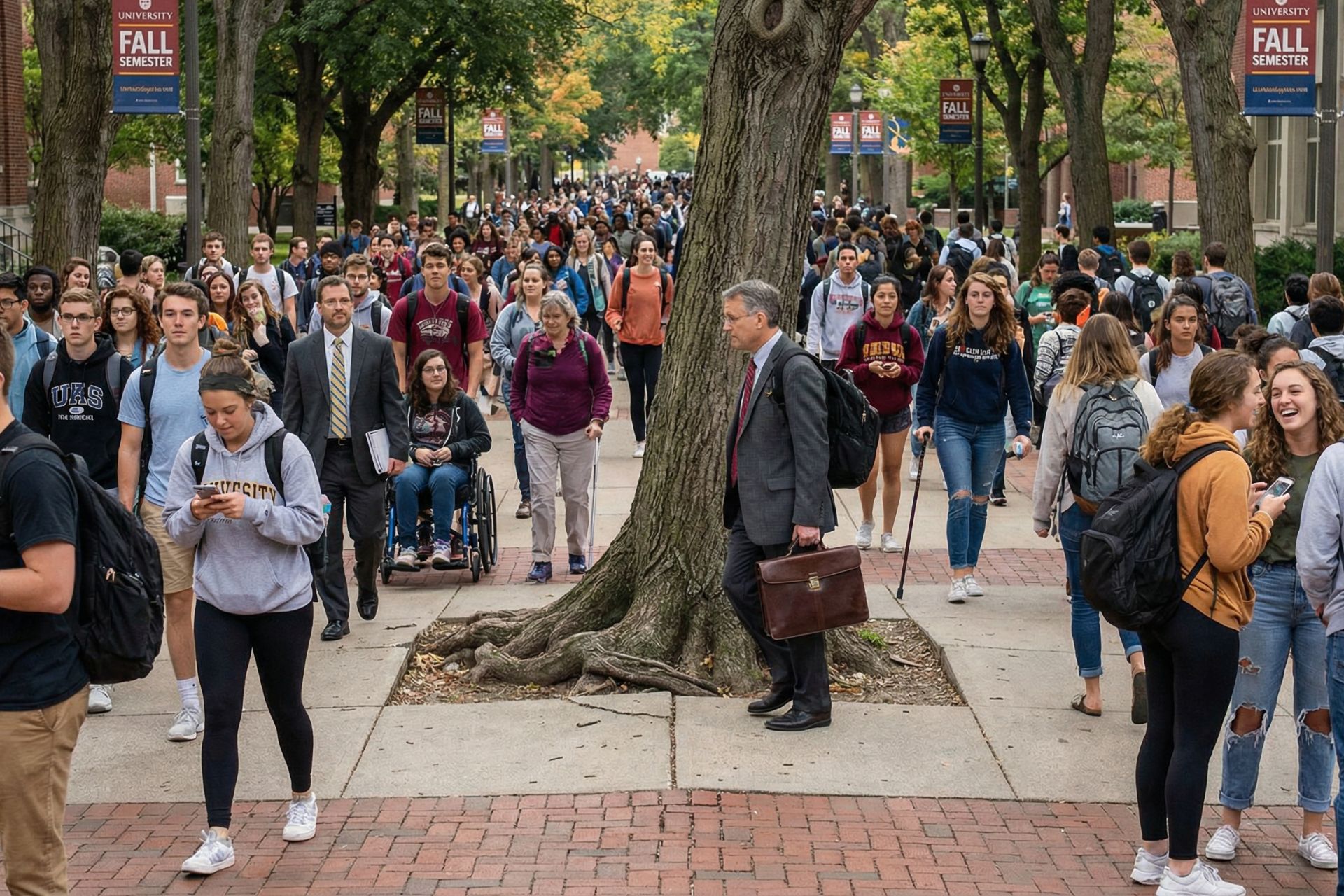
Volume and diversity of pedestrian traffic
Universities may see 20,000+ daily pedestrian trips across campus sidewalks during peak academic periods. Elementary schools concentrate hundreds of children—many still developing balance and coordination—into narrow entry pathways twice daily. This usage intensity accelerates wear while multiplying exposure to any existing trip hazards compared to residential sidewalks serving dozens of people weekly.
Campus populations span all ages and mobility levels: wheelchair users navigating between classes, vision-impaired students using canes, elderly faculty members, visiting parents with strollers, and maintenance staff transporting equipment. Every uneven concrete section that an agile undergraduate might navigate without incident poses serious fall risk to vulnerable users who deserve equal campus access.
Mature landscaping creates ongoing root pressure
Many established campuses feature beautiful mature trees that contribute significantly to campus character and environmental comfort. However, these same trees—often planted decades ago adjacent to sidewalks—develop extensive root systems that lift concrete sections as they expand. Southern California’s drought-resistant trees like eucalyptus, pine, and various palms create particularly aggressive root growth patterns that continuously pressure sidewalk infrastructure.
Deferred maintenance compounds problems
Educational institutions operating under constrained budgets often defer sidewalk maintenance during difficult fiscal years. What begins as a single raised section caused by root growth becomes multiple interconnected problems as water infiltrates cracks, subbase materials erode, and adjacent sections settle. A $400 trip hazard removal through horizontal slicing—deferred for 2–3 years—transforms into $2,000+ repair requiring extensive work as damage spreads.
 Federal and State ADA Compliance Requirements
Educational institution obligations
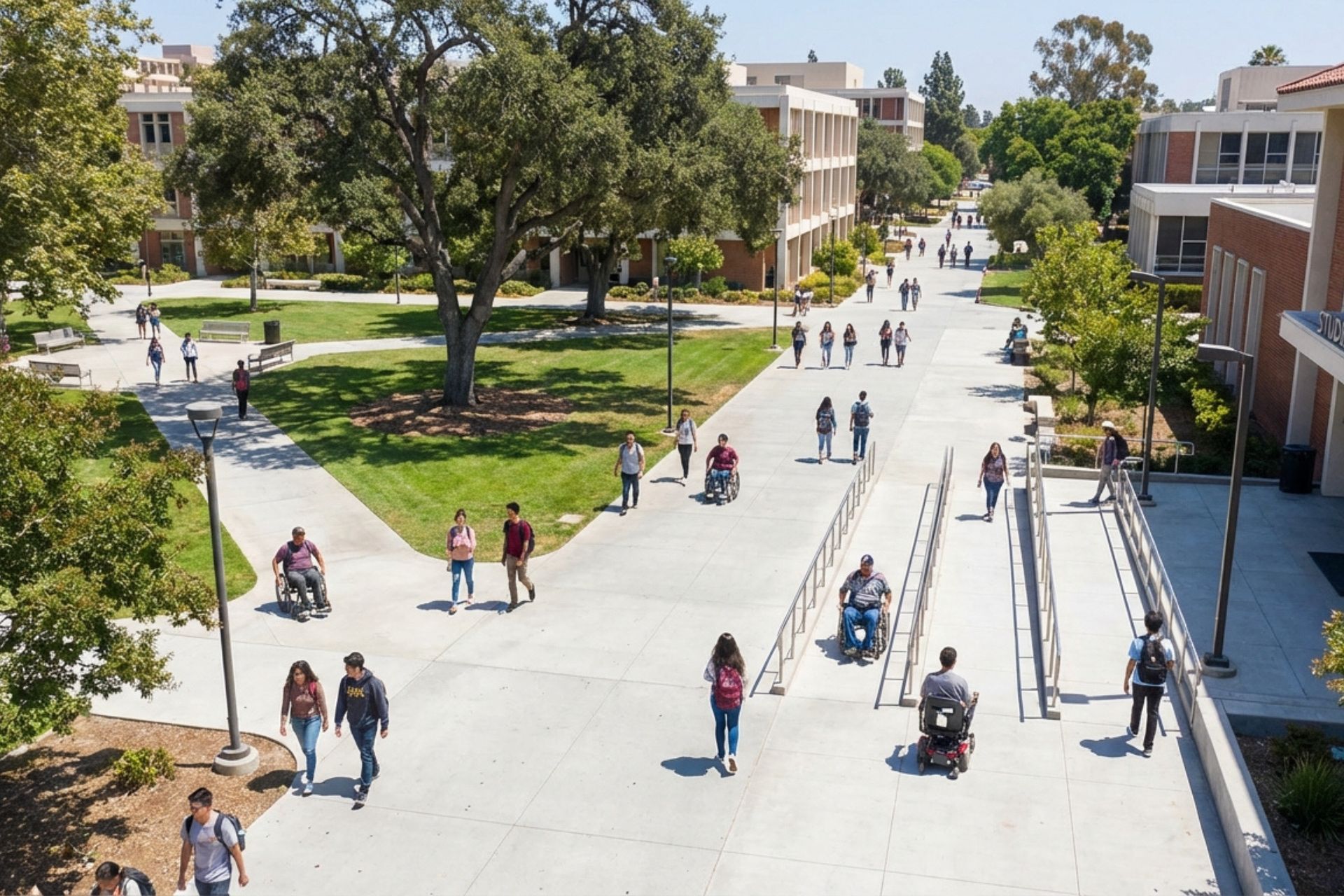
Schools and universities qualify as “public accommodations” under the Americans with Disabilities Act, creating strict accessibility requirements that apply to all campus pathways. Title II (public entities) and Title III (private institutions receiving federal funding) mandate that walkways meet specific standards ensuring equal access for individuals with disabilities.
California’s accessibility laws often exceed federal minimums, with the California Building Code establishing detailed requirements for slope, cross-slope, surface conditions, and transitions that educational institutions must satisfy. These aren’t aspirational guidelines—they’re enforceable legal standards with significant penalties for non-compliance.
Key ADA sidewalk standards
ADA compliance for campus sidewalks demands specific measurable conditions:
-
Maximum vertical displacement: ¼ inch between adjacent concrete sections
-
Running slope: Maximum 5% (1:20) for accessible routes
-
Cross slope: Maximum 2% (1:50) perpendicular to travel direction
-
Clear width: Minimum 36 inches maintained continuously
-
Surface stability: Firm, stable, slip-resistant walking surfaces
-
Proper transitions: Beveled edges with 1:12 maximum slope on unavoidable height differences
Meeting these standards requires precision that conventional concrete repair methods often cannot achieve. Grinding typically lowers raised sections but cannot guarantee elimination of height differentials or ensure proper 1:12 slope transitions that ADA compliance demands. Our patented horizontal slicing method, by contrast, meets compliance standards through controlled cutting that creates flush transitions with appropriate slopes.
Enforcement and consequences
The U.S. Department of Justice actively investigates ADA complaints against educational institutions, with enforcement actions resulting in consent decrees requiring comprehensive accessibility improvements and ongoing monitoring. Recent settlements have mandated multi-million dollar campus-wide sidewalk remediation programs, demonstrating the financial consequences of neglecting accessibility obligations.
Beyond federal enforcement, private lawsuits under ADA allow individuals to sue for injunctive relief and attorney’s fees. California’s Unruh Civil Rights Act adds state-level enforcement with statutory damages that can multiply financial exposure when multiple accessibility barriers exist.
Liability Risks from Campus Trip Hazards
Premises liability for educational institutions
California premises liability law holds educational institutions to high duty-of-care standards given their role serving vulnerable populations including minor children. Schools must maintain reasonably safe conditions and warn of known hazards—standards that sidewalk trip hazards clearly violate.
Trip-and-fall incidents on campus create substantial liability exposure. Average settlements range $15,000–50,000, with severe injuries to elderly faculty, staff, or visiting grandparents potentially exceeding $100,000. Beyond direct settlement costs, institutions face increased insurance premiums, legal defense expenses regardless of outcome, and reputational damage affecting enrollment and community relations.
Special duty to student populations
Elementary and secondary schools owe heightened duty of care to minor students, with courts holding institutions responsible for maintaining safe premises given children’s limited ability to recognize and avoid hazards. A trip hazard that might constitute simple negligence when injuring an adult becomes enhanced liability when it injures a child the school was legally obligated to protect.
Documentation and preventive defense
Systematic campus sidewalk maintenance programs with documented regular inspections, prompt hazard correction, and multi-year improvement plans provide crucial legal protection. When incidents occur despite good-faith maintenance efforts, these records demonstrate reasonable care—often the difference between dismissed claims and six-figure settlements.
Strategic Campus Maintenance Planning
Comprehensive initial assessment
Effective programs begin with detailed campus-wide sidewalk assessment documenting all existing conditions. Professional evaluation identifies immediate trip hazards requiring urgent attention, moderate concerns suitable for near-term repair, and minor issues for monitoring and future scheduling. This comprehensive baseline establishes priorities and supports multi-year capital planning.
Digital documentation—GPS-tagged photos, severity ratings, measurements—creates searchable databases showing where problems exist and tracking how conditions evolve over time. Annual reassessments update this data, revealing new hazards from root growth or settling while confirming that previous repairs maintain their effectiveness.
Prioritizing high-traffic and vulnerable-user routes
Strategic campus sidewalk maintenance focuses resources on pathways serving the most people and the most vulnerable users. Main entry walks, accessible routes between parking and buildings, pathways to disability services offices, and routes serving elementary school children receive priority attention. This risk-based approach maximizes safety improvements and liability reduction per maintenance dollar spent.
Integrating with capital improvement cycles
Sidewalk maintenance should coordinate with broader campus infrastructure planning. When major utility work, landscaping renovations, or building projects affect walkway areas, coordinate comprehensive sidewalk renewal rather than performing isolated trip hazard repairs followed months later by disruption from unrelated projects. This integration reduces total costs while minimizing repeated disruption to campus activities.
Horizontal Slicing: The Optimal Solution for Campus Applications
Why slicing excels in educational settings
Precision Concrete Cutting’s patented horizontal slicing technique addresses campus trip hazards with minimal disruption to ongoing educational activities. Individual repairs typically complete in 15–20 minutes, allowing work during class periods without creating extended pathway closures that force route changes. The method generates minimal dust and low environmental impact—important for maintaining air quality near classrooms and reducing cleanup requirements.
Cost efficiency for institutional budgets
Campus budgets must stretch across competing priorities—educational programs, faculty salaries, facility maintenance, technology upgrades. Horizontal slicing typically costs 60–75% less than removing and replacing concrete sections, allowing institutions to address more hazards within constrained budgets. A maintenance allocation sufficient for correcting 10 trip hazards through replacement can address 30–40 locations through strategic slicing.
What slicing addresses effectively
Our horizontal slicing method excels at removing raised concrete portions caused by tree root displacement, soil heaving, or differential settling. The precision cutting creates flush, smooth transitions that meet compliance standards requiring ¼-inch maximum height differentials and proper 1:12 slope ratios. This targeted approach preserves functional concrete while eliminating specific safety hazards—ideal for campuses with extensive sidewalk networks where wholesale replacement proves financially impractical.
However, institutions should understand that slicing addresses raised sections and trip hazards specifically. It does not repair sunken areas, potholes, or locations where concrete has deteriorated significantly. For these conditions, our team also offers professional patching services, or severe cases may require general contractors for more extensive concrete work.
Long-term durability and maintenance planning
While environmental factors like continued root growth or soil movement can eventually create new hazards in previously repaired locations, horizontal slicing provides durable, long-term trip hazard elimination. Properly executed slicing typically maintains safe, compliant conditions for 5–10 years or more depending on site-specific factors. This extended performance allows institutions to plan systematic multi-year maintenance cycles rather than facing constant emergency repairs.
Expansion Joint Maintenance: Preventing Future Problems
Understanding joint function and failure
Expansion joints accommodate concrete’s natural expansion and contraction with temperature changes, preventing stress cracks that would otherwise develop. When joint material deteriorates—common after 10–15 years of weather exposure—concrete sections contact directly during expansion cycles, creating cracks adjacent to failed joints. Water infiltrates these cracks, eroding subbase material and causing sections to settle into the voids created.
Preventive joint replacement
Systematic expansion joint maintenance prevents this failure cascade. Biennial inspections identify deteriorating joint material; prompt replacement using appropriate flexible fillers costs $50–100 per joint for material and labor. This modest investment prevents the $800–2,000+ slab repairs required when deferred joint maintenance leads to cracking and settling.
Integration with overall maintenance programs
Precision Concrete Cutting offers expansion joint maintenance alongside our patented horizontal slicing services. During scheduled campus maintenance visits addressing existing trip hazards, our team also inspects and replaces compromised joint material—maximizing efficiency while providing comprehensive sidewalk system care that extends infrastructure life.
Addressing Root-Related Sidewalk Damage
Tree preservation versus sidewalk safety
Campus trees provide environmental benefits, aesthetic value, and educational opportunities that institutions rightfully wish to preserve. However, mature trees lifting sidewalk sections create ongoing maintenance challenges requiring balanced solutions. Horizontal slicing removes immediate trip hazards created by root pressure while preserving both trees and concrete infrastructure.
Root barrier considerations
For locations with recurring root-related heaving, root barriers installed between trees and sidewalks can prevent future displacement. While this work typically requires landscape contractors or arborists rather than concrete specialists, coordinating barrier installation with trip hazard removal through slicing provides comprehensive long-term solutions.
Strategic tree management
Campus planning should consider future sidewalk impacts when planting new trees near walkways. Species selection, proper spacing, and root-directing infrastructure prevent problems decades before they develop. For established landscapes, ongoing monitoring and timely intervention when roots begin affecting concrete prevents emergency situations requiring rushed repairs.
Developing Multi-Year Maintenance Schedules
Annual inspection and assessment cycles
Systematic programs establish annual campus-wide sidewalk inspections during consistent timeframes—typically late spring or early fall when weather facilitates thorough evaluation. Inspections update condition databases, identify new hazards, and track whether previously repaired areas maintain safe conditions.
Phased repair implementation
Inspection data supports strategic multi-year repair scheduling. Year one addresses severe immediate hazards and high-priority accessible routes; year two tackles moderate concerns in secondary pathways; year three handles minor issues before they progress. This phased approach prevents budget shocks from emergency special allocations while maintaining defensible safety standards should incidents occur.
Reserve funding and capital planning
Educational institutions should establish dedicated sidewalk maintenance reserves within facility capital budgets. Proper funding prevents competition between trip hazard correction and educational program needs—inappropriate choices institutions shouldn’t face. Reserve studies projecting 10–20 year sidewalk renewal needs support appropriate annual allocations.
What Precision Concrete Cutting Offers Educational Institutions
Specialized campus expertise
We understand educational environments’ unique requirements: minimal disruption to academic schedules, safety protocols near children, budget constraints, and rigorous ADA compliance standards. Our patented horizontal slicing method addresses these needs through rapid repairs with minimal dust and low environmental impact, meeting compliance standards through precision cutting, and cost efficiency allowing broader hazard correction within institutional budgets.
Note: While some repairs (like complex drainage issues or large-scale concrete pouring) may require general contractors, Precision Concrete Cutting specializes in patented horizontal slicing and also offers patching and expansion joint maintenance. We do not perform grinding or full concrete replacement.
Volume pricing for campus-wide projects
Educational institutions bundling multiple repair locations receive competitive pricing reflecting efficiency gains from consolidated scheduling. Campus-wide contracts establish consistent service relationships, predictable pricing, and priority response when urgent hazards develop.
Documentation supporting compliance
We provide detailed before-and-after documentation, compliance certifications, and maintenance records supporting institutions’ ADA compliance efforts and legal defense needs. This documentation integrates with campus facility management systems, creating comprehensive maintenance histories.
Create Your Campus Safety Program
Proactive campus sidewalk maintenance protects students, faculty, staff, and visitors while demonstrating institutional commitment to accessibility and safety. Strategic programs combining systematic inspections, risk-based prioritization, appropriate use of horizontal slicing, preventive expansion joint care, and multi-year capital planning outperform reactive emergency approaches in both safety outcomes and cost efficiency.
Call Precision Concrete Cutting at 760-334-8921 to discuss your campus sidewalk maintenance needs. We’ll assess your educational facility, identify current hazards, and develop comprehensive ADA compliance recommendations aligned with your institution’s budget and safety obligations. Our specialized expertise in horizontal slicing and targeted repairs helps Southern California schools and universities maintain safe, accessible campuses without the budget strain of unnecessary full replacements.

