
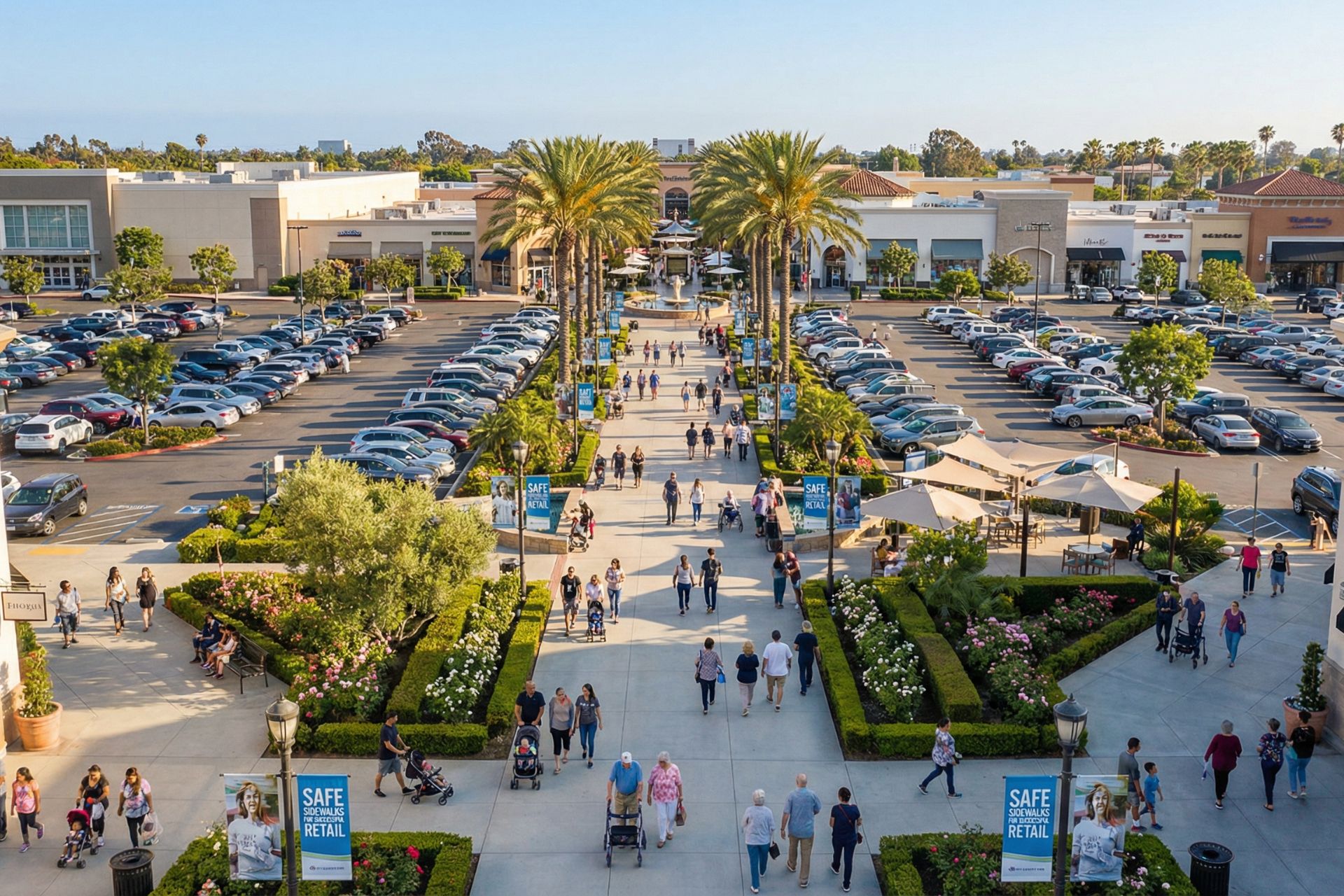
Shopping centers and retail plazas face unparalleled sidewalk maintenance challenges driven by continuous high-volume foot traffic, diverse customer demographics, and the severe financial consequences of trip-and-fall incidents in commercial environments. Property managers overseeing these facilities must balance immediate operational demands with long-term infrastructure preservation while maintaining retail sidewalk safety standards that protect both customers and the business enterprise.
At Precision Concrete Cutting, we partner with Southern California retail property managers to implement strategic shopping center maintenance programs that eliminate trip hazards, ensure ADA compliance, and prevent the costly liability claims that threaten both tenant relationships and property profitability. Proactive sidewalk management transforms walkways from potential liability sources into safe customer pathways that support successful retail operations.
 The Unique Sidewalk Challenges of Retail Environments
Extraordinary pedestrian volume and diversity
Major shopping centers see 10,000–50,000+ pedestrian trips weekly across parking lot walkways, building entrances, and common areas. This traffic concentration far exceeds residential sidewalk usage, accelerating wear while multiplying exposure to any existing trip hazards. Weekend peaks, holiday shopping periods, and special events create surge conditions where thousands of customers navigate pathways simultaneously.
Retail customer populations span all ages and physical capabilities—elderly shoppers with limited mobility, parents managing young children and strollers, teenagers moving quickly between stores, delivery personnel transporting merchandise, and individuals using wheelchairs or other mobility devices. Every uneven concrete section that an agile shopper might navigate without incident poses serious fall risk to vulnerable customers who deserve safe access.
Distracted pedestrians increase incident risk
Unlike residential sidewalks where users travel familiar routes with attention focused on navigation, retail customers often walk while texting, managing children, carrying packages, or searching for specific stores. This divided attention means hazards that careful pedestrians might avoid catch distracted shoppers by surprise, increasing both incident frequency and injury severity.
Weather and environmental factors
Southern California’s intense sun exposure degrades concrete surfaces and expansion joint materials faster than in moderate climates. Seasonal rains—while infrequent—create concentrated water flow that erodes subbase materials beneath parking lot and walkway edges. Mature landscape trees providing valuable shade also generate aggressive root growth that lifts sidewalk sections, creating the very trip hazards shopping center maintenance programs must address.
Night operations and lighting concerns
Evening shopping hours mean significant foot traffic occurs after dark when reduced visibility obscures trip hazards that might be obvious in daylight. Even well-lit shopping centers create shadows near planters, building overhangs, and parked vehicles where uneven concrete becomes difficult to see. These lighting challenges demand higher sidewalk maintenance standards than daytime-only facilities.
Liability Exposure in Commercial Retail Settings
Premises liability for commercial property owners
California premises liability law imposes stringent duty-of-care obligations on commercial property owners and operators. Shopping centers qualify as “business invitees” locations where owners explicitly encourage public entry for mutual benefit—retailers profit from customer traffic, customers access desired merchandise. This relationship creates the highest duty-of-care standard California law recognizes.
Commercial property owners must maintain reasonably safe conditions, conduct regular inspections sufficient to identify hazards, correct known dangerous conditions promptly, and provide adequate warnings about hazards that cannot be immediately remedied. Failure to meet these obligations creates liability when customers suffer trip-and-fall injuries.
Financial consequences of retail trip-and-fall incidents
Commercial trip-and-fall claims typically involve higher damages than residential incidents. Average settlements range $25,000–75,000, with serious injuries to elderly customers potentially exceeding $150,000–250,000. Catastrophic injuries—severe head trauma, hip fractures requiring surgery, permanent disability—can generate verdicts exceeding $500,000 when juries find negligent maintenance of obvious hazards.
Beyond direct settlement or judgment costs, commercial properties face substantial collateral consequences. Commercial liability insurance premiums increase dramatically following claims, often by 25–50% for 3–5 years. Multiple claims can result in coverage denial, forcing properties into surplus lines markets with premiums 2–3 times standard rates.
Legal defense costs—even for successfully defended claims—typically range $25,000–75,000 for cases proceeding through discovery and settlement negotiations. Cases reaching trial generate defense costs of $100,000–200,000+ regardless of outcome.
Tenant relationship impacts
Trip hazards affecting customer access to specific stores create tenant relations problems beyond direct liability exposure. Retail tenants paying premium rents expect safe, well-maintained common areas that encourage customer visits. Visible sidewalk hazards deter customers, reduce foot traffic to affected stores, and provide grounds for tenant complaints or lease disputes.
When incidents occur near specific tenant spaces, affected businesses may pursue contribution claims against the property owner if injured customers also sue the store. These inter-party disputes complicate litigation while straining the landlord-tenant relationships essential to successful retail operations.
ADA Compliance Requirements for Commercial Properties
Strict accessibility obligations
Shopping centers and retail plazas qualify as “public accommodations” under the Americans with Disabilities Act, creating rigorous accessibility requirements that apply to all customer walkways. Title III mandates that commercial facilities provide equal access to individuals with disabilities, with specific standards addressing sidewalk conditions, slopes, transitions, and surface quality.
California’s accessibility laws often exceed federal minimums, establishing detailed requirements through the California Building Code that commercial properties must satisfy. These aren’t aspirational guidelines—they’re enforceable legal standards with significant penalties for non-compliance and private rights of action allowing individuals to sue for injunctive relief.
Key compliance standards affecting retail sidewalks
Commercial walkways must meet specific measurable criteria:
-
Maximum vertical displacement: ¼ inch between adjacent concrete sections
-
Running slope: Maximum 5% (1:20) for accessible routes
-
Cross slope: Maximum 2% (1:50) perpendicular to travel direction
-
Clear width: Minimum 36 inches maintained continuously
-
Surface stability: Firm, stable, slip-resistant walking surfaces
-
Proper transitions: Beveled edges with 1:12 maximum slope on unavoidable height differences
Meeting these standards requires precision that conventional repair methods often cannot achieve. Grinding typically lowers raised sections but cannot guarantee elimination of height differentials or ensure proper 1:12 slope transitions that compliance demands. Our patented horizontal slicing method, by contrast, meets compliance standards through controlled cutting that creates flush transitions with appropriate slopes.
Enforcement and serial litigation concerns
The U.S. Department of Justice investigates ADA complaints against commercial properties, with enforcement actions resulting in consent decrees requiring comprehensive accessibility improvements and ongoing monitoring. California has experienced waves of “serial litigation” where individuals or advocacy groups systematically target commercial properties with accessibility deficiencies, filing dozens or hundreds of lawsuits seeking attorney’s fees and corrective action.
Under the Unruh Civil Rights Act, California allows statutory damages of $4,000 per violation plus attorney’s fees, creating substantial exposure when multiple accessibility barriers exist across shopping center properties. Proactive retail sidewalk safety maintenance addressing trip hazards before complaints arise provides crucial protection against these enforcement risks.
Strategic Shopping Center Sidewalk Maintenance
Comprehensive property assessment
Effective shopping center maintenance begins with detailed property-wide sidewalk assessment documenting all existing conditions. Professional evaluation identifies immediate trip hazards requiring urgent attention, moderate concerns suitable for near-term repair, and minor issues for monitoring and future scheduling. This comprehensive baseline establishes priorities and supports multi-year capital planning.
Digital documentation—GPS-tagged photos, severity ratings, precise measurements—creates searchable databases showing where problems exist and tracking how conditions evolve over time. Quarterly reassessments update this data, revealing new hazards from root growth or settling while confirming that previous repairs maintain their effectiveness.
Prioritizing high-traffic customer pathways
Strategic programs focus resources on walkways serving the most customers and creating greatest liability exposure. Main entry walks from parking areas to building entrances, pathways between anchor tenants, routes to restrooms and customer service areas, and accessible parking access routes receive priority attention. This risk-based approach maximizes safety improvements and liability reduction per maintenance dollar invested.
Weekend and evening foot traffic patterns should inform prioritization—hazards on pathways heavily used during peak shopping hours warrant more urgent attention than those on service corridors seeing minimal customer traffic.
Seasonal and event-driven scheduling
Retail shopping center maintenance should coordinate major sidewalk work during slower operational periods when pathway closures create minimal customer disruption. January–February and September typically offer quieter periods between holiday shopping and back-to-school surges. However, urgent safety hazards require immediate attention regardless of retail calendar considerations.
Horizontal Slicing: Optimal Solution for Retail Applications
Minimal operational disruption
Precision Concrete Cutting’s patented horizontal slicing technique addresses trip hazards with minimal disruption to ongoing retail operations. Individual repairs typically complete in 15–20 minutes, allowing work during business hours without creating extended pathway closures that force customer route changes or impede store access. The method generates minimal dust and low environmental impact—important for maintaining air quality near tenant spaces and reducing cleanup requirements.
Cost efficiency for commercial budgets
Property management budgets must balance competing demands—tenant improvements, HVAC maintenance, parking lot resurfacing, landscape care, and security systems. Horizontal slicing typically costs 60–75% less than removing and replacing concrete sections, allowing properties to address more hazards within constrained capital budgets. A maintenance allocation sufficient for correcting 10 trip hazards through replacement can address 30–40 locations through strategic slicing.
What slicing addresses in retail environments
Our horizontal slicing method excels at removing raised concrete portions caused by tree root displacement, soil heaving, or differential settling common in shopping center parking lots and walkways. The precision cutting creates flush, smooth transitions that meet compliance standards requiring ¼-inch maximum height differentials and proper 1:12 slope ratios. This targeted approach preserves functional concrete while eliminating specific safety hazards—ideal for retail properties with extensive sidewalk networks where wholesale replacement proves financially impractical.
However, property managers should understand that slicing addresses raised sections and trip hazards specifically. It does not repair sunken areas, potholes, or locations where concrete has deteriorated significantly. For these conditions, our team also offers professional patching services, or severe cases may require general contractors for more extensive concrete work.
Long-term performance in commercial settings
While environmental factors like continued root growth or soil movement can eventually create new hazards in previously repaired locations, horizontal slicing provides durable, long-term trip hazard elimination. Properly executed slicing typically maintains safe, compliant conditions for 5–10 years or more depending on site-specific factors. This extended performance allows properties to plan systematic multi-year maintenance cycles rather than facing constant emergency repairs that disrupt retail operations.
 Expansion Joint and Preventive Maintenance
Joint maintenance prevents future trip hazards
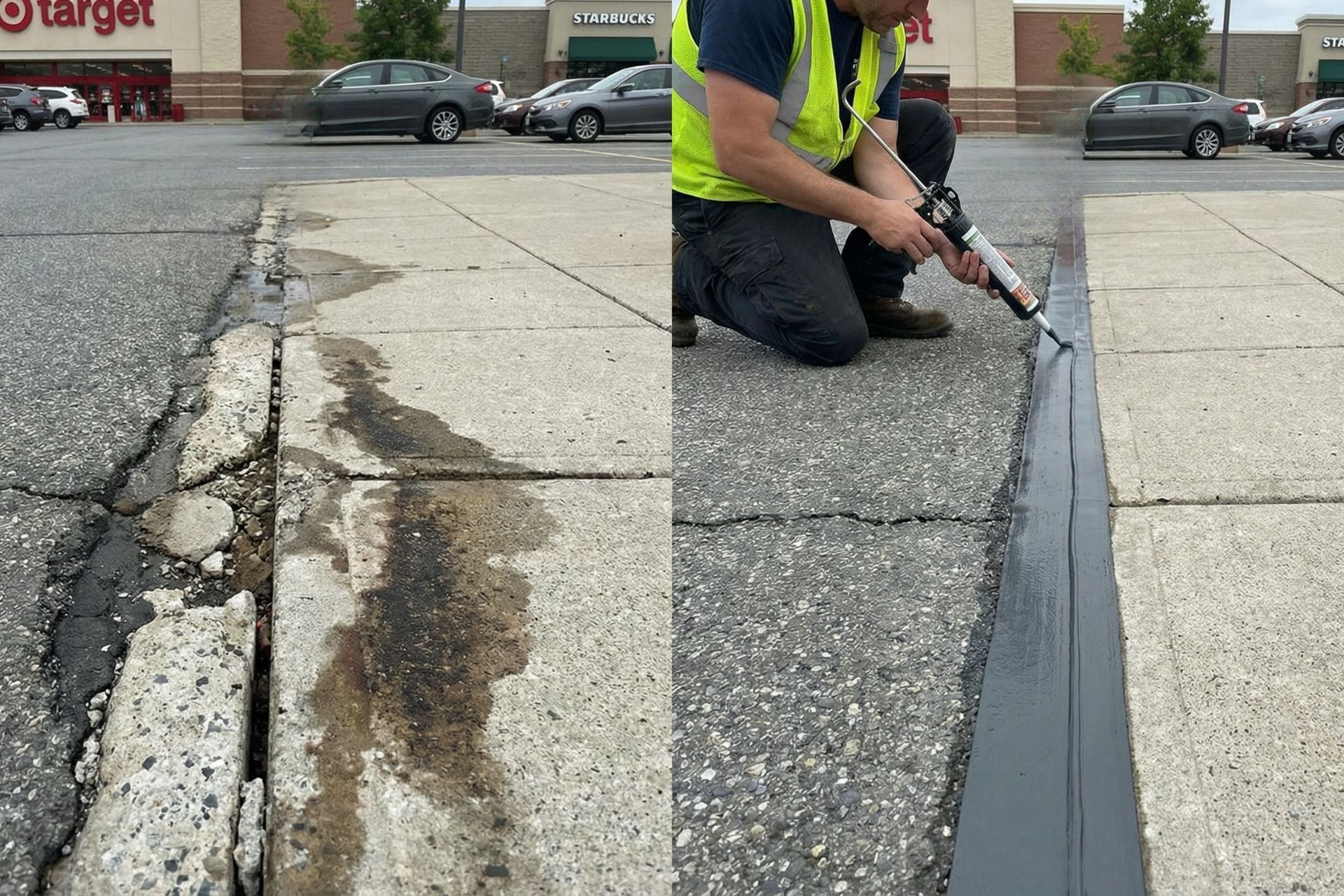
Expansion joints accommodate concrete’s natural expansion and contraction with temperature changes, preventing stress cracks. When joint material deteriorates—common after 10–15 years of weather exposure and vehicle traffic in parking areas—concrete sections contact directly during expansion cycles, creating cracks adjacent to failed joints. Water infiltrates these cracks, eroding subbase material and causing sections to settle into voids created.
Systematic expansion joint maintenance prevents this failure cascade. Annual inspections identify deteriorating joint material; prompt replacement using appropriate flexible fillers costs $50–100 per joint for material and labor. This modest investment prevents the $800–2,000+ slab repairs required when deferred joint maintenance leads to cracking and settling.
Integration with comprehensive programs
Precision Concrete Cutting offers expansion joint maintenance alongside our patented horizontal slicing services. During scheduled property maintenance visits addressing existing trip hazards, our team also inspects and replaces compromised joint material—maximizing efficiency while providing comprehensive sidewalk system care that extends infrastructure life.
Documentation for Liability Protection
Inspection records demonstrate duty of care
Detailed records of regular property inspections—dates, findings, photos, measurements—demonstrate the reasonable care California law requires from commercial property operators. When trip-and-fall claims arise despite good-faith maintenance efforts, this documentation shows you met your duty to identify and address hazards.
Repair documentation and response times
Maintain invoices, work orders, before-and-after photos, and professional assessments for all sidewalk repairs. Documentation showing hazards were corrected promptly once identified—ideally within days or weeks, not months—proves responsible property management and contradicts claims of negligent indifference to dangerous conditions.
Incident reporting and investigation
When trip-and-fall incidents occur despite maintenance efforts, immediate investigation and documentation protect your legal position. Photographs of the incident location, witness statements, and incident reports create contemporaneous evidence often crucial in defending claims filed months or years after injuries occur.
Managing Tree-Related Sidewalk Damage
Balancing aesthetics and safety
Mature trees provide valuable shade, aesthetic appeal, and environmental benefits that enhance shopping center attractiveness. However, trees lifting sidewalk sections create ongoing retail sidewalk safety challenges requiring balanced solutions. Horizontal slicing removes immediate trip hazards created by root pressure while preserving both trees and concrete infrastructure.
Root management strategies
For locations with recurring root-related heaving, root barriers installed between trees and sidewalks can prevent future displacement. While this work typically requires landscape contractors rather than concrete specialists, coordinating barrier installation with trip hazard removal through slicing provides comprehensive long-term solutions.
Strategic landscape planning for new developments or renovations should select appropriate tree species, provide adequate root space, and maintain sufficient distance between trees and heavily-trafficked walkways.
What Precision Concrete Cutting Offers Retail Properties
Commercial property expertise
We understand retail environments’ unique requirements: minimal disruption to ongoing business operations, safety protocols in customer areas, budget constraints, and rigorous compliance standards. Our patented horizontal slicing method addresses these needs through rapid repairs with minimal dust and low environmental impact, meeting compliance standards through precision cutting, and cost efficiency allowing broader hazard correction within property budgets.
Note: While some repairs (like complex drainage issues or large-scale concrete pouring) may require general contractors, Precision Concrete Cutting specializes in patented horizontal slicing and also offers patching and expansion joint maintenance. We do not perform grinding or full concrete replacement.
Property-wide service contracts
Retail properties benefit from establishing ongoing service relationships providing consistent quality, predictable pricing, and priority response when urgent hazards develop. Annual maintenance contracts create scheduled inspection and repair cycles that maintain safe conditions proactively rather than waiting for problems to escalate.
Volume pricing for multi-location portfolios
Property management companies overseeing multiple retail centers receive competitive pricing reflecting efficiency gains from consolidated scheduling across properties. This volume approach reduces total portfolio maintenance costs while ensuring consistent safety standards across all managed locations.
Protect Your Retail Investment
Proactive shopping center maintenance addressing trip hazards protects customers, prevents costly liability claims, ensures ADA compliance, and supports successful tenant relationships. Strategic programs combining systematic inspections, risk-based prioritization, appropriate use of horizontal slicing, preventive expansion joint care, and multi-year capital planning outperform reactive emergency approaches in both safety outcomes and cost efficiency.
Call Precision Concrete Cutting at 760-334-8921 to discuss your retail property sidewalk maintenance needs. We’ll assess your shopping center or plaza, identify current hazards, and develop comprehensive retail sidewalk safety recommendations aligned with your property’s operational requirements and budget. Our specialized expertise in horizontal slicing and targeted repairs helps Southern California retail properties maintain safe, compliant walkways without the operational disruption and budget strain of unnecessary full replacements.

