

If you own commercial property in San Diego, a notice from the City’s Safe Sidewalks Program requiring sidewalk replacement can feel like a financial ambush. The reality is clear: that single notice is rarely a one-time event. While you must address the specific panel identified by the City with a licensed contractor, you have a powerful opportunity right now to prevent the next notice. By proactively identifying and mitigating other trip hazards across your property, you can avoid being forced into multiple high-cost replacements and take strategic control of your maintenance budget.
Key Takeaways
- San Diego’s Safe Sidewalks Program issues unpredictable notices requiring full panel replacement, which is 70–90% more expensive than proactive trip hazard removal.
- You must comply with the City’s notice for the specific flagged panel, but you can prevent future notices by addressing other hazards now.
- Proprietary horizontal slicing techniques create an ADA-compliant, flush finish without the need for demolition, concrete pouring, or curing time.
- Tree root uplift and dry-climate soil shifting are primary causes of San Diego sidewalk hazards, often affecting multiple panels on a single property.
- A proactive site assessment identifies all existing hazards, allowing property owners to budget strategically and avoid compounding liability.
- California ADA compliance and premises liability laws make property owners responsible for safe sidewalks, increasing legal and financial risks.
- Precision Concrete Cutting specializes exclusively in trip hazard removal through patented horizontal slicing—we do not perform grinding or replacement.
Understanding San Diego’s Safe Sidewalks Program
The City of San Diego’s Safe Sidewalks Program places the responsibility for sidewalk maintenance directly on adjacent property owners. This includes commercial properties, HOAs, apartment complexes, and businesses. When a hazard is identified—often through city inspections or citizen complaints—the property owner receives a notice requiring the removal and replacement (R&R) of the affected panel. According to the City’s published guidelines, a temporary asphalt patch applied by the City does not satisfy the requirement; full replacement by a licensed contractor is mandatory.
These notices arrive without a predictable schedule. A property owner might receive one notice for a single uplifted panel this month, and another for a different section six months later. The cumulative financial impact can be devastating, especially for properties with mature trees or aging infrastructure. Understanding this mechanism is the first step in shifting from a reactive to a proactive maintenance strategy.
The True Cost of Reactive Sidewalk Replacement
The notice from the City generally requires the property owner to complete permanent repairs in accordance with City standards, often through removal and replacement of the affected panel. This process involves demolition, debris hauling, forming, pouring new concrete, and a curing period that can disrupt business operations for days. The cost per panel typically ranges from $1,500 to $3,000, depending on access, size, and location. For a commercial property with multiple hazards, the total bill can quickly escalate into tens of thousands of dollars.
Beyond the direct construction costs, reactive replacement carries hidden expenses. Business interruption, potential ADA litigation from unaddressed hazards, and increased insurance premiums all compound the financial strain. Research from the Urban Land Institute indicates that proactive property maintenance can reduce long-term capital expenditures by up to 25% compared to deferred, reactive repairs. The key is to separate the City-mandated replacement from the rest of your property’s needs.
Why One Notice Signals More Problems
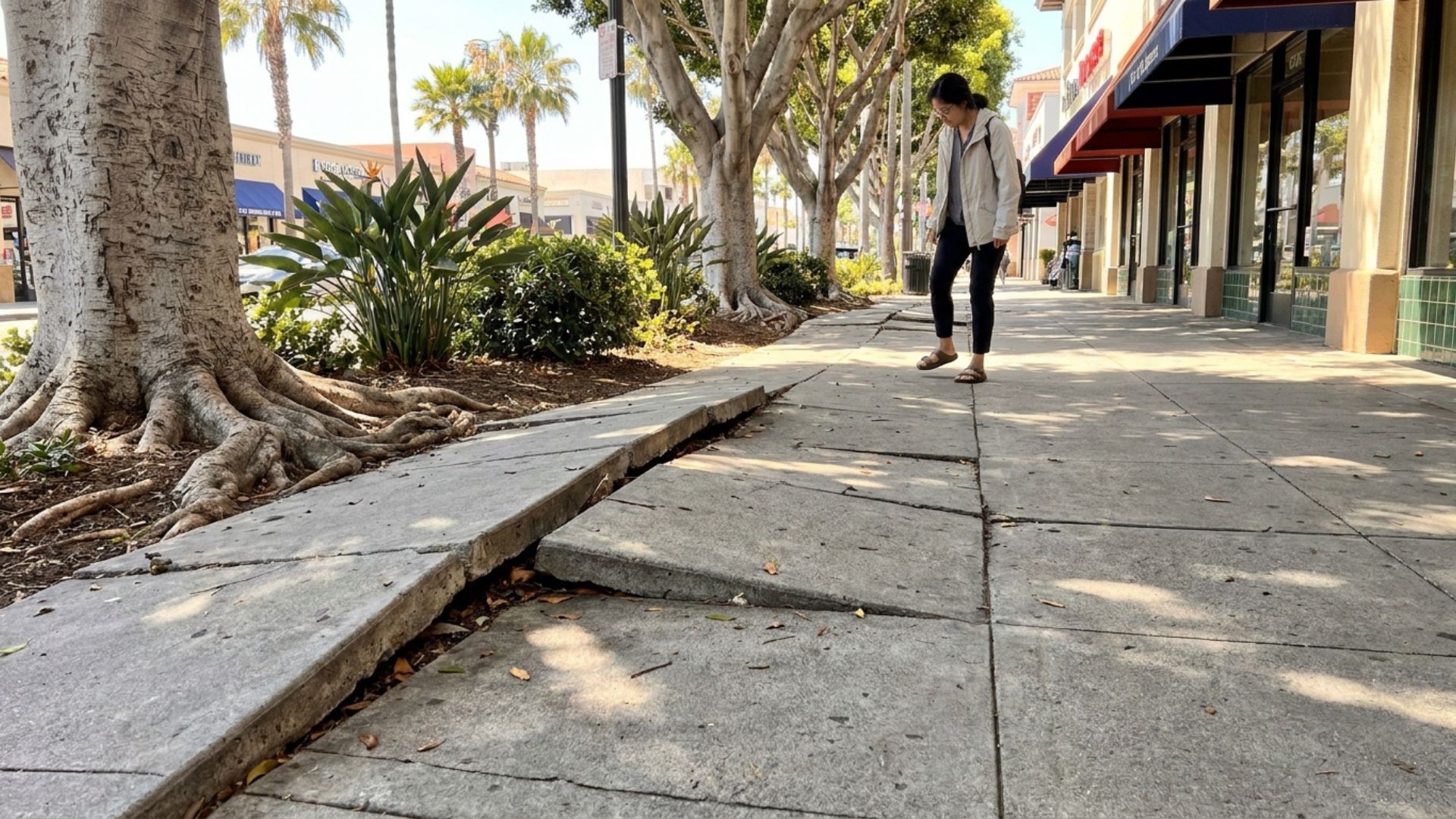
Sidewalk hazards rarely occur in isolation. The same environmental factors that caused one panel to uplift—such as root intrusion from a mature ficus tree or soil expansion from San Diego’s clay-heavy earth—are almost certainly affecting adjacent panels.
Tree roots are the predominant cause in Southern California. Species like Indian laurel fig and eucalyptus, common in San Diego landscaping, exert tremendous lateral pressure on concrete. Combined with the region’s dry summers and occasional heavy rains, the soil expands and contracts, creating differential settlement. This leads to the vertical displacements that trigger City notices. A proactive scan of your entire property reveals these vulnerabilities before they become official violations.
Proactive Trip Hazard Removal: A Strategic Alternative
This is where a specialized approach changes the equation. Precision Concrete Cutting does not perform full removal and replacement, and we do not compete with the City-mandated process for a flagged panel. Instead, we serve as a proactive partner who helps you address every other hazard on your property before it generates a new notice. Our patented horizontal slicing technique removes the raised edge of a sidewalk panel, creating a smooth, ADA-compliant transition without demolition.
How Horizontal Slicing Works
Horizontal slicing is a precision concrete cutting method that removes the uplifted portion of a sidewalk panel at its root cause. Unlike grinding, which abrades the surface and can leave a rough, sloped finish, horizontal slicing makes a clean, vertical cut at the base of the raised edge. The result is a flush, even surface that meets ADA slope requirements for accessible routes. The process does not involve pouring, or leveling with mud or foam.
This technique is particularly effective for the types of hazards common in San Diego. Tree root uplift creates a distinct vertical lip at a joint or crack. Horizontal slicing removes that lip precisely, leaving the rest of the panel undisturbed. The process is fast—most hazards are resolved in under an hour—and does not require the extended curing time of new concrete. For commercial properties, this means minimal disruption to tenants, customers, and operations.
Cost Comparison: Slicing vs. Replacement
The financial advantage of proactive trip hazard removal is dramatic. The cost to slice a hazard is consistently 70–90% less than full replacement.
California ADA Compliance and Liability
Under the Americans with Disabilities Act (ADA) and California’s Unruh Civil Rights Act, property owners must maintain accessible pedestrian routes. A vertical displacement of just one-quarter inch can constitute a trip hazard and a violation. The California Building Code (Title 24) incorporates these standards, and recent litigation in Southern California has resulted in settlements exceeding $20,000 per incident for commercial property owners who failed to address known hazards.
Common San Diego Sidewalk Hazards
Southern California’s unique environment creates specific failure patterns in concrete sidewalks. Understanding these helps property owners spot sidewalks that are likely to trigger a notice. The most prevalent hazards include:
- Tree Root Uplift: Lateral roots from mature trees push panels upward at joints, creating vertical lips of 0.5 to 2 inches.
- Differential Settlement: Clay soils expand when wet and shrink when dry, causing adjacent panels to settle at different rates.
- Spalling and Edge Deterioration: San Diego’s coastal salt air accelerates concrete surface degradation, creating uneven, crumbling edges.
- Utility Cut Settlement: Trenches dug for water, gas, or fiber lines often settle over time, leaving a depressed or raised patch in the sidewalk.
Each of these hazards can be addressed through horizontal slicing, provided the panel itself is structurally sound. For panels that are severely cracked or have lost subgrade support, replacement may be the only option.
A 5-Step Proactive Plan for Property Owners
If you have received a City notice—or want to get ahead of one—follow this strategic plan to protect your property and budget.
- Comply with the Notice: Engage a licensed contractor to perform the required removal and replacement of the specifically flagged panel. This is non-negotiable and must be completed within the City’s timeline.
- Schedule a Comprehensive Site Assessment: Have a trip hazard specialist survey your entire property to identify all other vertical displacements, not just the one the City found. This assessment should measure each hazard and document its location.
- Prioritize Hazards by Severity: Rank identified hazards by their vertical displacement and location. Those in high-traffic paths or exceeding 0.5 inches should be addressed first to minimize liability.
- Implement Proactive Removal: Use horizontal slicing to eliminate the prioritized hazards. This can often be done in a single day, even for properties with multiple issues, without disrupting business operations.
- Establish an Annual Inspection Cycle: Create a recurring maintenance plan that includes a yearly walkthrough to catch new hazards before they trigger a City notice. This transforms sidewalk maintenance from a crisis into a predictable budget line item.
The Role of Tree Roots in San Diego Sidewalk Damage
Tree roots are the single largest contributor to sidewalk hazards in San Diego. The city’s urban forest includes thousands of street trees planted decades ago, many of which have root systems that now extend well beyond their planting strips. When roots grow beneath concrete, they exert upward pressure that can lift a panel by an inch or more.
While some property owners consider root pruning or removal, this approach carries significant risks. Improper root cutting can destabilize a tree, leading to fall hazards and expensive tree replacement costs. Horizontal slicing addresses the symptom—the raised concrete—without disturbing the tree’s root system. It is a solution that balances pedestrian safety with urban canopy preservation. Note: For root management or tree health concerns, consult a certified arborist; Precision Concrete Cutting focuses exclusively on the concrete hazard itself.
Why Speed Matters for Commercial Properties
For businesses, every day a trip hazard exists is a day of potential liability. Unlike residential properties, commercial locations see high volumes of pedestrian traffic, including customers, employees, and delivery personnel. A hazard in front of a retail storefront or restaurant patio is not just a safety issue—it is a customer experience problem. Proactive removal using horizontal slicing can resolve hazards in under an hour, often without the need for barricades or detours.
Integrating Trip Hazard Removal into Your Maintenance Budget
Smart property owners treat sidewalk maintenance as a capital planning item, not an emergency expense. By conducting an initial comprehensive assessment and addressing all identified hazards, you establish a baseline. Annual inspections thereafter typically reveal only a few new hazards, which can be budgeted at a fraction of the cost of replacement. This approach aligns with the principles outlined in our sidewalk maintenance planning guide.
For HOAs and multi-tenant commercial properties, this proactive strategy also simplifies reserve fund planning. Instead of facing a special assessment for a sudden $30,000 replacement project, the association can allocate a predictable annual amount for trip hazard removal. This financial predictability is a key benefit of moving from reactive to proactive maintenance, as detailed in our resource on preventative sidewalk care.
Choosing the Right Trip Hazard Removal Partner
Not all concrete contractors offer the same services. When selecting a partner for proactive trip hazard removal, verify that they specialize in horizontal slicing and do not simply offer grinding as a substitute. Grinding creates a sloped surface that can become slippery when wet and may not meet ADA cross-slope requirements. True horizontal slicing, performed with patented equipment, produces a clean, vertical cut that leaves a flush, durable surface.
Key questions to ask a potential contractor include: “Do you use horizontal slicing or grinding?” “Is your method ADA-compliant for both slope and cross-slope?” “Can you provide a comprehensive property assessment before work begins?” A qualified specialist will answer these clearly and provide documentation of their process. For more guidance, review our article on how to choose trip hazard removal contractors in California.
Case Study: A San Diego Office Park Avoids $45,000 in Replacements
Consider the experience of a 12-building office park in Sorrento Valley. After receiving a City notice for a single uplifted panel near the main entrance, the property manager commissioned a full-site assessment. The assessment identified 31 additional trip hazards across the campus, primarily caused by mature eucalyptus trees. The estimated cost for full replacement of all 31 panels was $46,500, with an estimated six weeks of disruption.
By addressing the 29 hazards suitable for horizontal slicing proactively, the property owner spent $8,700—an 81% savings. The work was completed over two days with no tenant complaints. The two panels that required replacement due to severe cracking were budgeted for the following quarter. The property manager now conducts annual assessments and has not received another City notice in three years. This outcome reflects the core message: we cannot remove the hazard the City identified, but we can help you avoid the next one.
Environmental and Sustainability Benefits
Proactive trip hazard removal through horizontal slicing also aligns with sustainability goals. Full replacement generates significant concrete waste—approximately 400 pounds per panel—that ends up in landfills. Concrete production is responsible for roughly 8% of global CO2 emissions, according to research from Chatham House. By preserving the existing panel and removing only the raised edge, slicing eliminates demolition waste and the carbon footprint of new concrete production.
For San Diego property owners pursuing LEED certification or corporate sustainability targets, this method offers a documented reduction in construction waste. It also preserves mature trees by avoiding root disturbance, maintaining the shade and aesthetic benefits that contribute to property value. Learn more about this approach in our guide to sustainable solutions for eco-friendly sidewalk repair.
Legal Precedents and California Sidewalk Laws
California law is clear on sidewalk liability. Under the Streets and Highways Code, property owners are responsible for maintaining sidewalks adjacent to their property and can be held liable for injuries caused by negligent maintenance. The California Court of Appeal has upheld this in multiple decisions, reinforcing that property owners cannot defer maintenance indefinitely. Our detailed analysis of California sidewalk laws provides further context.
The combination of state law and local ordinances like San Diego’s Safe Sidewalks Program creates a regulatory environment where proactive maintenance is the only financially prudent path. Ignoring a known hazard is not just risky—it can be considered negligence. A documented program of annual inspections and prompt trip hazard removal demonstrates a commitment to safety that can be a powerful defense in liability cases.
Frequently Asked Questions
What should I do immediately after receiving a sidewalk notice from the City of San Diego?
First, read the notice carefully to identify the specific panel that must be replaced. You are required to hire a licensed contractor to perform full removal and replacement of that panel. Simultaneously, schedule a comprehensive assessment of your entire property to identify other hazards that could generate future notices.
Can horizontal slicing be used on the panel the City flagged?
No. The City’s Safe Sidewalks Program requires full removal and replacement of the specifically identified panel. Horizontal slicing is a proactive solution for other hazards on your property that have not yet been cited, helping you avoid future notices and forced replacements.
How much can I save by using trip hazard removal instead of replacement?
Proactive trip hazard removal using horizontal slicing typically costs 70–90% less than full panel replacement. While replacement can range from $1,800 to $3,000 per panel, slicing generally costs between $150 and $450 per hazard, depending on severity and access.
Is horizontal slicing compliant with ADA requirements?
Yes. When performed correctly, horizontal slicing creates a flush, vertical transition that meets ADA slope requirements for accessible pedestrian routes. The resulting surface is smooth and does not create the cross-slope issues often associated with grinding methods.
How long does trip hazard removal take?
Most individual hazards are resolved in 30 to 60 minutes. A commercial property with multiple hazards can often be fully addressed in a single day, with no curing time required. This minimizes disruption to business operations compared to the multi-day process of concrete replacement.
What causes most sidewalk trip hazards in San Diego?
Tree root uplift is the leading cause, followed by differential soil settlement due to San Diego’s expansive clay soils. Coastal salt air also accelerates concrete spalling. These environmental factors often affect multiple panels on a single property, making a comprehensive assessment essential.
Does Precision Concrete Cutting handle tree roots or drainage issues?
No. Precision Concrete Cutting specializes exclusively in trip hazard removal through patented horizontal slicing. We do not perform root pruning, drainage work, grinding, or concrete pouring. For those services, you would need to engage a general contractor or arborist.
How often should I inspect my commercial sidewalks for hazards?
We recommend a formal inspection at least annually, with additional walkthroughs after major weather events or construction activity. Regular inspections allow you to identify and address hazards before they trigger a City notice or cause an injury, as outlined in our guide for property managers.
Conclusion
Receiving a sidewalk notice from the City of San Diego is a stressful and expensive experience, but it does not have to define your property’s future. By complying with the notice for the specific panel and then taking immediate proactive action on the rest of your property, you can break the cycle of reactive, high-cost replacements. Horizontal slicing offers a proven, ADA-compliant, and budget-friendly method to eliminate trip hazards before they become official violations. The key is to act now—before the next notice arrives. Protect your property, your budget, and the people who walk on your sidewalks every day.
Note: While some repairs (like complex drainage issues or large-scale concrete pouring) may require general contractors, Precision Concrete Cutting specializes in patented horizontal slicing and also offers patching and expansion joint maintenance. We do not perform grinding or full concrete replacement.
Ready to identify and address the hazards on your property before the City does? Schedule a free site assessment today and take the first step toward a proactive, cost-effective sidewalk maintenance strategy.
References
- City of San Diego Safe Sidewalks Program: https://www.sandiego.gov/street-div/services/roadways/sidewalk
- Urban Land Institute: Proactive Property Maintenance and Capital Expenditure Reduction
- California Department of Forestry and Fire Protection: Urban Forest Sidewalk Damage Statistics
- Chatham House: Concrete Production and Global CO2 Emissions Research
- California Building Code (Title 24): Accessibility Requirements for Pedestrian Routes
- California Streets and Highways Code: Property Owner Sidewalk Maintenance Obligations
- ADA Standards for Accessible Design: Slope and Cross-Slope Requirements

