
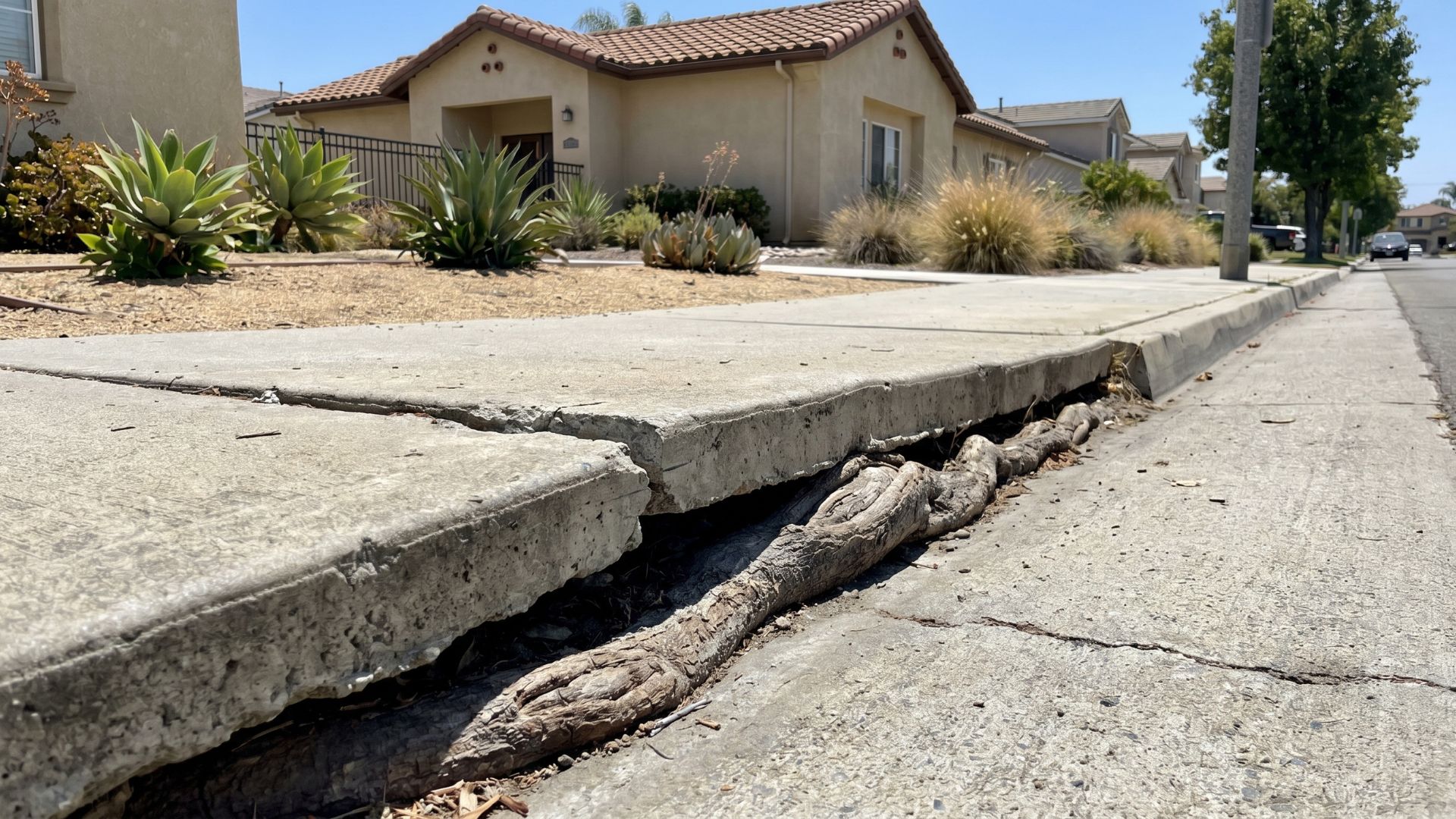
If your homeowners association (HOA) or property management company in San Diego has received a notice from the City’s Safe Sidewalks Program, you are facing a requirement to complete permanent repairs, to remove and replace the specific sidewalk panel flagged as a hazard. This obligation falls squarely on the adjacent property owner, and for HOAs, that means the collective membership bears the financial burden. However, while you cannot avoid the immediate replacement order, you can absolutely prevent the next one. This guide explains exactly what the notice means, why costs spiral, and how a strategic, proactive approach to trip hazard removal protects your community’s budget.
Key Takeaways
- San Diego property owners, including HOAs, are legally responsible for repairing sidewalk hazards adjacent to their land under the Safe Sidewalks Program.
- City-issued notices require full removal and replacement (R&R) of the flagged panel, costing significantly more than other repair methods.
- Receiving one notice is a strong indicator that additional trip hazards exist on the property and will likely be flagged in the future.
- Proactive trip hazard removal using patented horizontal slicing costs 70–90% less than full replacement and helps reduce the risk of future notices
- Precision Concrete Cutting specializes in ADA-compliant horizontal slicing—not replacement—helping HOAs address the majority of trip hazards across their property before the City intervenes.
- California ADA compliance and liability laws make proactive sidewalk maintenance a critical risk management strategy.
Understanding San Diego’s Safe Sidewalks Program and HOA Obligations
The City of San Diego’s Safe Sidewalks Program places the legal responsibility for sidewalk maintenance directly on adjacent property owners. This includes single-family homes, commercial properties, apartment complexes, and—critically—common-interest developments managed by HOAs. When a sidewalk panel presents a vertical displacement of a quarter-inch or more, it qualifies as a trip hazard under California law and the Americans with Disabilities Act (ADA). The City’s inspectors, often responding to citizen complaints or conducting periodic assessments, issue a formal notice requiring the property owner to hire a licensed contractor and complete a full removal and replacement of the offending panel.
For HOAs, this responsibility is typically defined in the community’s Covenants, Conditions, and Restrictions (CC&Rs). Most governing documents assign maintenance of common area sidewalks—and sometimes even sidewalks on member lots—to the association. Failure to comply with a City notice within the specified timeframe can result in liens, fines, or the City performing the work and billing the property owner, often at a premium rate. According to the City of San Diego’s Transportation Department, the goal is to eliminate hazards across the city’s 5,000 miles of sidewalks, and enforcement has become increasingly systematic since the program’s expansion.
What the Notice Actually Requires: Removal and Replacement
When that envelope arrives from the City, it contains a specific directive: the identified panel must be removed and replaced (R&R). This is not a suggestion for general maintenance. The notice pinpoints an exact location—often with photographs—and sets a compliance deadline. The property owner must obtain the necessary permits, hire a contractor licensed by the California Contractors State License Board, and complete the work to City standards. In many cases, the City applies a temporary asphalt patch to mitigate immediate danger, but this does not satisfy the replacement requirement. The patch is a stopgap, and the clock continues ticking.
This R&R process involves demolishing the existing concrete panel, preparing the subgrade, setting forms, pouring new concrete, and finishing it to match the surrounding grade. The cost per panel typically ranges from $800 to $2,500, depending on access, tree root involvement, and prevailing wage requirements for public works-adjacent projects. For an HOA with multiple panels flagged over time, the financial impact is substantial.
Why Costs Escalate: The Domino Effect of Reactive Repairs
The primary reason sidewalk repair costs spiral for HOAs is the unpredictable, one-off nature of City notices. A single notice today does not preclude another tomorrow. In fact, it significantly increases the likelihood. Sidewalk damage is rarely isolated. The same soil conditions, tree root systems, and aging concrete that caused one panel to lift have likely affected adjacent panels and other walkways throughout the property. The City’s inspection process is not comprehensive; it targets specific reported hazards. This means your community could receive a notice for a panel near the clubhouse in March, another for a panel near the pool in June, and a third for a walkway by the mail kiosk in September.
Each notice triggers a separate mobilization cost, permit fee, and contractor minimum charge. There is no volume discount when you are forced to react to individual citations. Research from the Urban Land Institute indicates that planned, programmatic concrete maintenance costs less per unit than emergency or compliance-driven repairs. For San Diego HOAs, this reactive cycle is the single biggest threat to long-term sidewalk budgets. The alternative—a proactive, community-wide trip hazard assessment—identifies every existing vertical displacement before the City does, allowing for bulk, cost-effective treatment.
Proactive Prevention: How Horizontal Slicing Avoids Future Notices
Precision Concrete Cutting provides a specialized service that directly addresses the root cause of City notices: vertical trip hazards. Our patented horizontal slicing technique removes the raised lip of a displaced panel without demolition, pouring new concrete, or disrupting landscaping. The process uses a diamond-blade cutting system that slices the uplifted edge flush with the adjacent panel, creating a smooth, ADA-compliant transition. This is not grinding or leveling—it is a precise mechanical cut that eliminates the trip hazard while preserving the existing concrete.
The critical advantage for HOAs facing City notices is this: while we cannot perform the required removal and replacement of the panel the City has already identified, we can treat every other hazard on the property before it triggers another notice. Our comprehensive site walks identify all vertical displacements of ¼-inch or more, and our slicing method resolves them at a cost typically 70–90% less than full replacement. For a community with 20 potential hazards, replacing even five panels under City order could cost $10,000 or more. Slicing all 20 hazards proactively might cost $3,000–$5,000 total, effectively neutralizing the risk of future notices
Note: While some repairs (like full panel replacement or large-scale concrete pouring) may require general contractors, Precision Concrete Cutting specializes in patented horizontal slicing and also offers patching and expansion joint maintenance. We do not perform grinding or full concrete replacement.
The True Cost Comparison: Replacement vs. Horizontal Slicing
HOAs operate on fixed annual budgets, and reserve studies allocate funds for long-term capital improvements. Unplanned, required sidewalk replacements are a direct hit to those reserves. The table below illustrates the financial contrast between reactive replacement and proactive slicing for a typical 100-unit San Diego HOA community.
| Factor | City-Mandated R&R (Per Panel) | Proactive Horizontal Slicing (Per Hazard) |
|---|---|---|
| Average Cost | $1,200 – $2,500 | $150 – $350 |
| Mobilization & Permits | Included or additional $200+ | None required |
| Time to Complete | 2–5 days (curing time) | 15–30 minutes per hazard |
| Landscape Disruption | Significant (demo, forms, pour) | Minimal (no excavation) |
| ADA Compliance | Yes (new panel) | Yes (flush transition) |
| Prevents Future Notice? | Only for that panel | Yes, eliminates hazard |
These figures reflect real-world pricing in the San Diego market as of 2026. The cost differential is not marginal—it is transformative for HOA budget planning.
California ADA Compliance and Liability: Why HOAs Must Act
Beyond City notices, California law imposes strict liability on property owners for injuries caused by dangerous conditions on their sidewalks. Under the California Government Code and related case law, a vertical displacement of as little as ½-inch can constitute a dangerous condition, exposing the HOA to significant legal damages. The ADA sets an even stricter standard for accessible routes, requiring that changes in level not exceed ¼-inch. For HOAs with common area sidewalks serving pools, clubhouses, and recreational facilities, these are not optional guidelines—they are legal mandates.
A single trip-and-fall lawsuit can cost an HOA hundreds of thousands of dollars in settlements, legal fees, and increased insurance premiums. The Insurance Information Institute reports that the average slip-and-fall claim severity has risen to over $45,000 nationally, with California claims trending higher due to favorable plaintiff laws. Proactive trip hazard removal is not merely a maintenance decision; it is a liability mitigation strategy. Our guide to California sidewalk liability explores these risks in detail.
San Diego-Specific Sidewalk Challenges: Tree Roots and Dry Climate Deterioration
Southern California’s unique environment creates specific sidewalk failure patterns that HOAs must understand. The region’s expansive clay soils, combined with drought-wet cycles, cause significant ground movement. During dry periods, soil contracts and pulls away from concrete edges; when winter rains arrive, the soil swells, lifting and shifting panels. This cyclical movement is the primary driver of vertical displacement in San Diego, distinct from freeze-thaw damage common in colder climates.
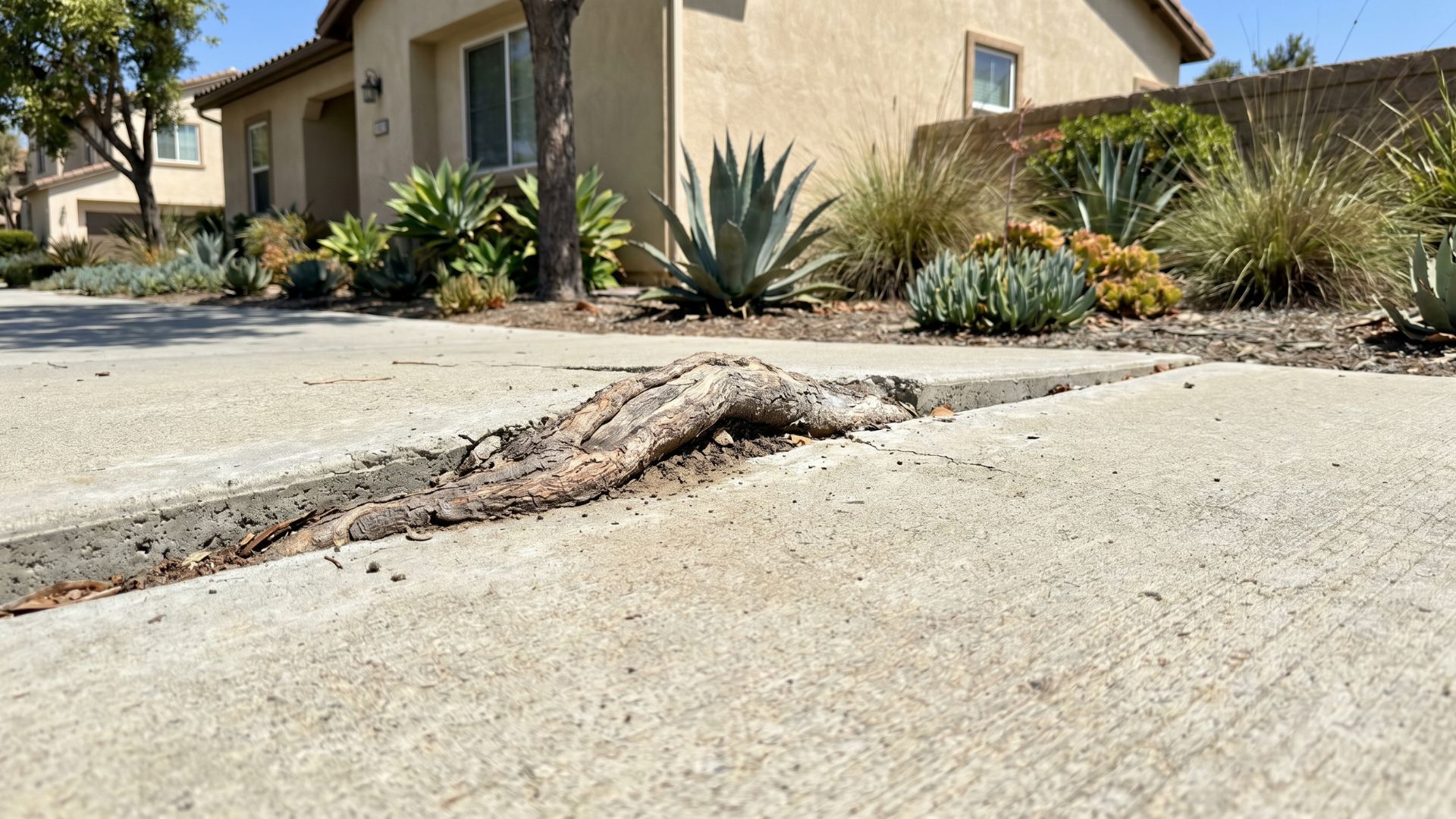
Tree roots are the other dominant factor. San Diego’s urban forest—including ficus, eucalyptus, and liquidambar species—features aggressive root systems that seek moisture beneath sidewalks. As roots grow, they exert upward pressure, creating the classic lifted panel. The City’s Safe Sidewalks Program frequently cites tree root damage as the cause of hazards. While your HOA may need an arborist or general contractor to manage tree root systems or drainage issues, the resulting trip hazards themselves can be resolved immediately through horizontal slicing. Our article on tree root sidewalk damage provides further context.
Step-by-Step: What to Do After Receiving a Sidewalk Notice
If your HOA has received a notice, follow this sequence to manage the immediate requirement while setting up long-term protection.
- Read the Notice Carefully: Identify the exact panel location, the compliance deadline, and any specific contractor licensing requirements. The City of San Diego’s sidewalk repair page provides official guidance.
- Engage a Licensed Contractor for R&R: Obtain at least three quotes from contractors experienced with City sidewalk replacement. Verify their license status on the California Contractors State License Board website.
- Document Everything: Photograph the hazard before and after the temporary asphalt patch (if applied). Keep copies of all correspondence, permits, and contractor invoices for HOA records.
- Commission a Comprehensive Trip Hazard Assessment: Contact Precision Concrete Cutting for a free site walk. We identify every vertical displacement across the property, not just the one the City flagged.
- Prioritize and Budget for Proactive Slicing: Using our assessment report, the HOA board can approve a single project to address all non-noticed hazards, helping reduce the risk of future notices at a fraction of replacement cost.
- Update the Reserve Study: Incorporate the proactive slicing schedule into the HOA’s long-term capital plan, reducing the reserve allocation needed for emergency replacements.
Common Mistakes HOAs Make with Sidewalk Notices
In our experience working with San Diego communities, several recurring errors compound the cost and stress of sidewalk management.
- Ignoring the Notice: The City will eventually perform the work and bill the property owner, often with administrative fees and without competitive pricing.
- Assuming One Notice Is the End: Treating the notice as an isolated incident ignores the systemic nature of sidewalk deterioration. A second notice is likely within 12–18 months.
- Using Temporary Patching: DIY asphalt patches or cold-pour fillers do not meet City requirements and do not eliminate the trip hazard. They create a false sense of security.
- Delaying a Full Property Assessment: The window between receiving a notice and the compliance deadline is the ideal time to assess the entire property. Waiting until multiple notices arrive costs more.
- Confusing Slicing with Replacement: Horizontal slicing is not a substitute for the City-mandated R&R on the flagged panel. It is the solution for every other panel on the property.
How Precision Concrete Cutting Partners with San Diego HOAs
Our role is clear: we are the proactive partner that helps HOAs avoid the next notice. We do not compete with the City’s required replacement process. Instead, we provide a strategic, budget-conscious pathway to community-wide sidewalk safety. Our patented horizontal slicing technique is ADA-compliant, leaves a clean flush finish, and requires no concrete pouring, no demolition, and no extended curing time. A typical hazard is resolved in under 30 minutes, allowing residents full use of the walkway immediately.
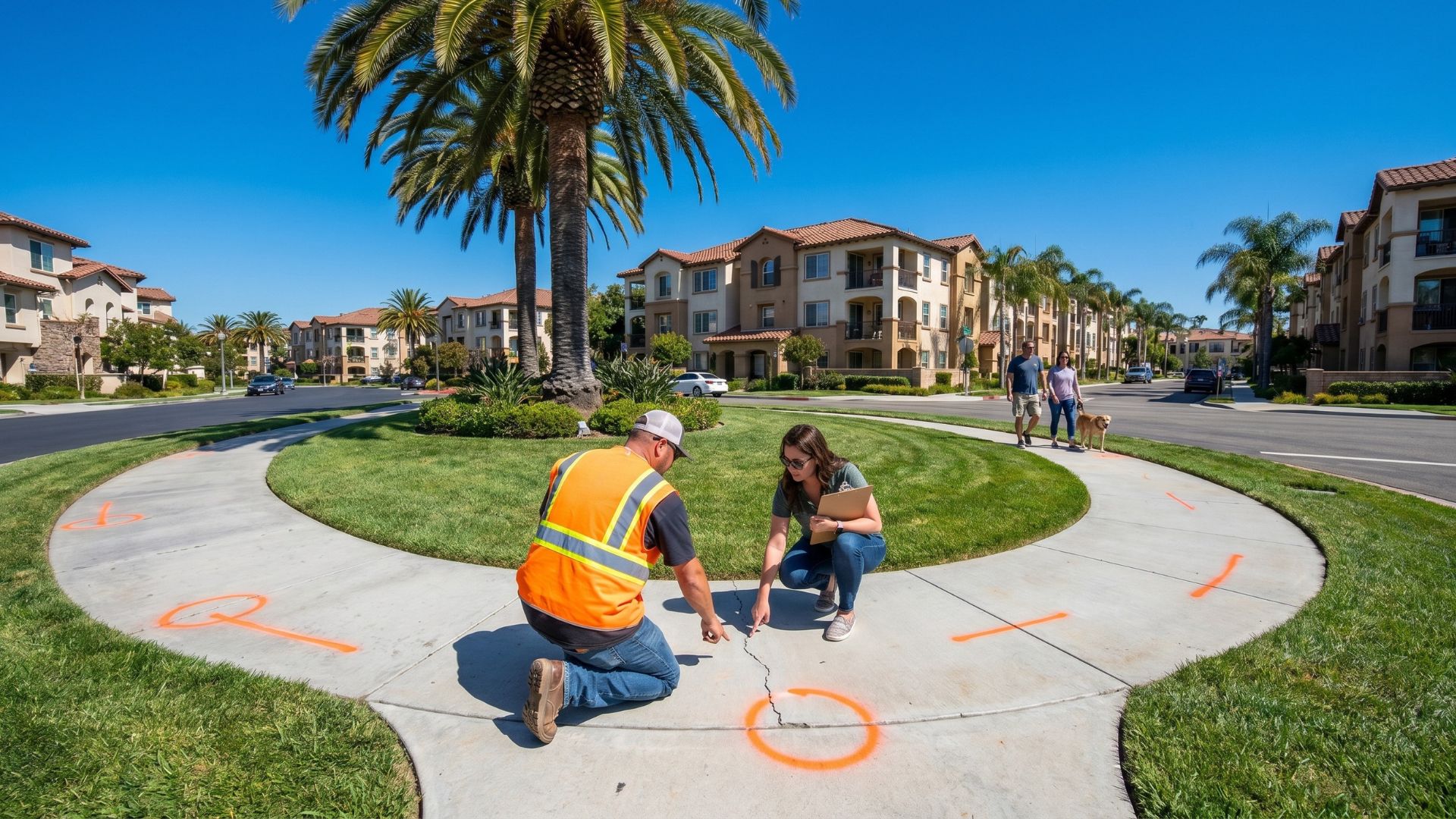
We work directly with HOA boards and property managers to conduct free site walks, generate detailed hazard maps, and provide fixed-price proposals for addressing all identified trip hazards. This allows communities to convert an unpredictable, reactive expense into a planned, single-year maintenance line item. For more on this approach, read our guide to smart HOA sidewalk maintenance.
Building a Long-Term Sidewalk Maintenance Plan
Effective sidewalk management for HOAs extends beyond responding to City notices. A sustainable plan incorporates regular inspections, prioritized hazard removal, and reserve fund alignment. The ultimate guide to sidewalk inspection provides a framework for establishing an annual assessment cycle. Key components include:
- Annual Professional Assessments: Engage a trip hazard removal specialist to measure and document every vertical displacement. This creates a baseline and tracks progression.
- Prioritization by Risk: Address hazards in high-traffic areas, near amenities, and along accessible routes first. These pose the greatest liability and are most likely to trigger City complaints.
- Budget Integration: Allocate a dedicated line item for proactive slicing in the annual operating budget, reducing reliance on reserve funds for emergency replacements.
- Resident Communication: Educate homeowners about the HOA’s responsibility and the cost benefits of proactive maintenance. Transparency builds support for assessment increases if needed.
According to the Community Associations Institute, HOAs that implement preventive maintenance programs report fewer special assessments over a 10-year period compared to those relying on reactive repairs. For San Diego communities, sidewalk slicing is a textbook preventive measure.
Frequently Asked Questions
Who is responsible for sidewalk repair in San Diego—the city or the property owner?
In San Diego, the adjacent property owner—including HOAs—is legally responsible for maintaining sidewalks in a safe condition. The City’s Safe Sidewalks Program enforces this by issuing notices requiring the owner to repair identified hazards at their own expense.
Can Precision Concrete Cutting fix the panel the City flagged in the notice?
No. We do not perform full removal and replacement, which is what the City requires for the specifically flagged panel. Our service addresses all other trip hazards on the property to help reduce the risk of future notices. You must hire a licensed general contractor for the mandated R&R.
How much does horizontal slicing cost compared to replacement?
Horizontal slicing typically costs 70–90% less than full panel removal and replacement. While replacement averages $1,200–$2,500 per panel, slicing a trip hazard usually ranges from $150–$350, depending on the severity and location.
Does horizontal slicing meet ADA requirements?
Yes. Our patented slicing technique creates a flush, smooth transition between displaced panels, eliminating the vertical lip that constitutes a trip hazard. The result complies with ADA standards for changes in level on accessible routes.
How long does a typical trip hazard removal take?
Most individual hazards are resolved in 15–30 minutes. There is no concrete curing time, so the sidewalk is immediately usable. A full community assessment and treatment can often be completed in a single day, depending on the number of hazards.
Will the City accept horizontal slicing instead of replacement for a notice?
No. The City’s current program requires full removal and replacement for the panel specified in the notice. Slicing is a proactive measure for hazards not yet cited. Always comply with the notice requirements for the flagged panel.
How often should an HOA inspect its sidewalks for trip hazards?
We recommend a professional assessment at least annually. High-traffic communities or those with mature trees may benefit from semi-annual inspections. Regular assessments catch new displacements before they become City-notice triggers.
Is Precision Concrete Cutting’s method noisy or disruptive to residents?
Our horizontal slicing process is efficient and contained. While we do not claim to be dust-free or silent, the work is completed quickly with minimal disruption compared to demolition and concrete pouring. Residents can typically remain in their homes during service.
Conclusion
A sidewalk hazard notice from the City of San Diego is a serious matter that demands immediate compliance. But it is also a clear signal that your HOA’s sidewalks need a comprehensive, proactive strategy. You cannot avoid the required replacement of the flagged panel, but you can absolutely prevent the next notice—and the one after that. By partnering with Precision Concrete Cutting for a community-wide trip hazard assessment and horizontal slicing treatment, you protect your reserve fund, reduce liability, and create a safer environment for residents. The cost savings are substantial, the process is fast, and the peace of mind is invaluable.
Take the first step toward predictable sidewalk management. Contact us today to schedule a free site walk and discover how many future notices you can eliminate before they arrive.
References
- City of San Diego – Safe Sidewalks Program: https://www.sandiego.gov/street-div/services/roadways/sidewalk
- California Contractors State License Board: https://www.cslb.ca.gov
- Americans with Disabilities Act (ADA) Standards for Accessible Design: https://www.ada.gov
- Community Associations Institute – Preventive Maintenance Research: https://www.caionline.org
- Insurance Information Institute – Slip and Fall Claim Statistics: https://www.iii.org
- Urban Land Institute – Infrastructure Maintenance Cost Analysis: https://www.uli.org

