
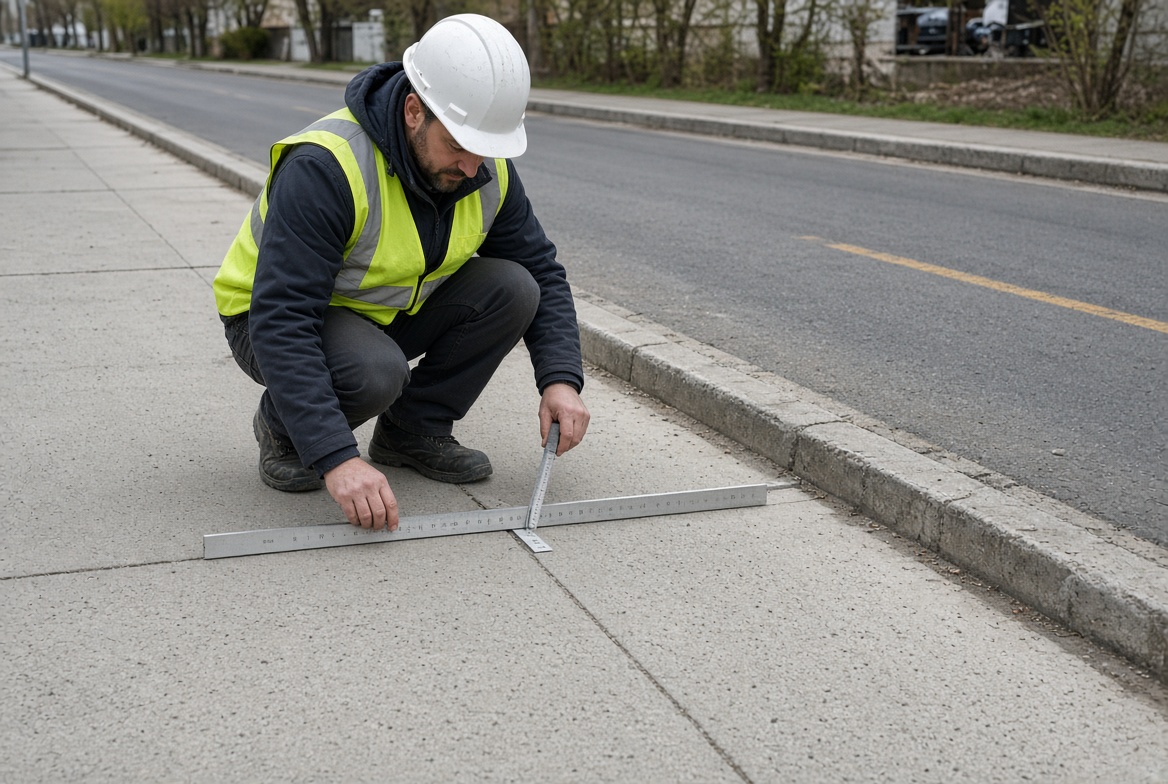
Sidewalk inspection software organizes, maps, and reports sidewalk conditions, but its results are only as accurate as the measurements fed into it. A measured field survey produces those measurements, joint by joint. For most properties, the practical choice is not one or the other: use a field survey to get reliable numbers, and use software or GIS mapping to keep them organized.
This article is for HOA boards, facilities teams, and public agencies comparing tools. It does not rank vendors. It explains what software does well, where accuracy tends to slip, and what to ask before you trust a score. If you would rather have the walking and measuring done for you, start with our sidewalk inspection program.
Key Takeaways
- “Software” covers several things: mobile data-entry apps, GIS asset systems, and automated capture using sensors or imagery. Compare them separately.
- The published thresholds are small. A 1/4-inch lip is about 6.4 mm, so the capture method must be able to detect a difference of that size at the worst point of a joint.
- The ADA Standards publish dimensions. They do not publish an accessibility score, and no score proves compliance by itself.
- Data ages. Roots and soil keep moving, so a survey needs a date and a re-inspection plan.
- Whatever you choose, keep the raw values, photos, and locations, and make sure you can export them.
What Sidewalk Inspection Software Actually Does
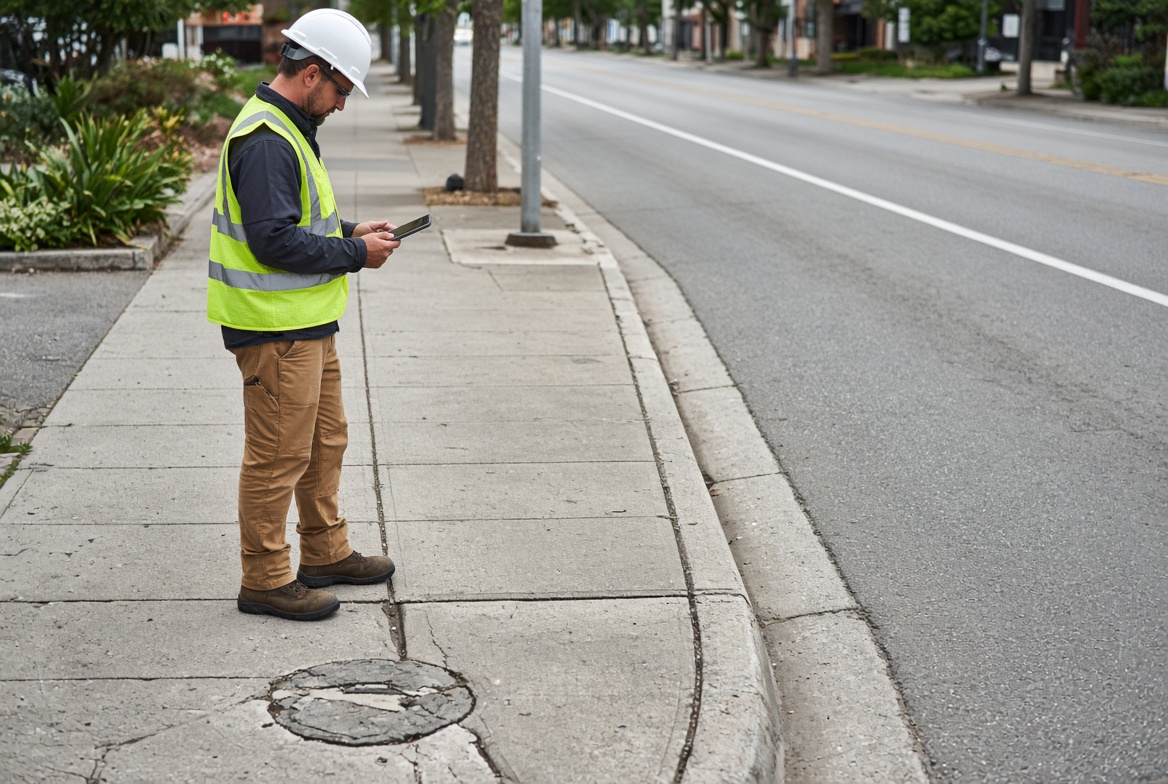
Most products fall into three groups, and many combine them:
- Mobile inspection apps: forms on a phone or tablet. An inspector enters a defect type, photo, and location. The person still does the measuring.
- GIS and asset management platforms: maps, dashboards, work orders, and history. These organize data but do not create it.
- Automated capture: rolling profilers, phone or tablet sensors, LiDAR, or street-level imagery processed by software. These can cover a lot of ground quickly, and how well they read a single joint varies.
Knowing which group a product belongs to answers the first question: where does the measurement come from?
The Numbers the Tool Has to Resolve
Any method should be judged against the figures it claims to check. These come from the 2010 ADA Standards:
| Item | Published figure | What it asks of the tool |
|---|---|---|
| Vertical change | 1/4 in. (6.4 mm) | Detect the highest point of a lip, not an average along the joint |
| Beveled change | 1/4 to 1/2 in. (13 mm), at 1:2 | Tell a square edge from a beveled one |
| Cross slope | 1:48 (about 2.1%) | Report slope to a fraction of a percent, panel by panel |
| Running slope | 1:20 (5%) | Flag segments that cross into ramp territory |
| Ramp slope | 1:12 (about 8.3%) | Measure short runs such as curb ramps |
| Clear width | 36 in.; PROWAG and California sidewalks and walks use 48 in. | Measure around poles, boxes, and planters |
The table shows why a general “condition: fair” label is not enough. A joint can look fine at walking speed and still measure 3/8 inch at one corner.
Where Software Accuracy Tends to Slip
These are the questions to raise, whichever product you are considering:
- Sampling: Lips are short and often worst at one corner. A sensor that reads along one wheel line, or at intervals, can pass over the worst point.
- Averaging: Smoothing that helps with noise can also shrink a sharp edge. Ask how a sudden lip is reported.
- Calibration: Phones, levels, and profilers all drift or vary. Ask how often devices are checked and how that is documented.
- Imagery limits: Shadow, parked cars, leaves, and camera angle can hide a defect. Height is hard to judge from a flat photo.
- Location drift: Consumer GPS can place a point on the wrong panel, particularly near buildings and trees. Repair crews need to find the exact joint.
- Stale data: A clean scan from two years ago says little about a slab beside a growing root. Keeping software accurate means re-measuring, not only re-importing.
- Inconsistent inspectors: Two people can enter the same defect differently unless definitions are fixed in advance.
A Note on Accessibility Scores
Some platforms roll findings into an accessibility or condition score. That can help a manager compare segments or report to a board. But the scoring formula belongs to the vendor or agency. The 2010 Standards and PROWAG publish measurements, not a pass mark, so a high score does not establish compliance. Ask to see the values behind every score, and how a single failed item affects the total. A segment with a 1-inch lip should not be hidden by nine clean panels around it.
Curb Ramps Need Their Own Check
If you are looking for curb ramp compliance features, check whether the tool captures each element separately. Under the 2010 Standards, curb ramps have a 1:12 maximum running slope and 1:48 cross slope, flares no steeper than 1:10 where provided, a counter slope no steeper than 1:20, and a top landing at least 36 inches long. PROWAG section R304 has its own curb ramp requirements, including a 48-inch minimum width, and California Chapter 11B adds further details. A single “ramp present” checkbox will not capture any of that.
When Each Approach Fits
| Situation | Good fit | Why |
|---|---|---|
| Single site or small HOA | Measured field survey and a clear report | A software subscription adds little over a dated list with photos |
| Campus or multi-site portfolio | Field survey delivered with GIS mapping or a dashboard | Teams need to filter by location, severity, and timeline |
| City-wide network | Automated screening, then field verification of flagged segments | Coverage first, followed by measurements that support work orders |
| Complaint, claim, or notice | Field measurement of the specific location | The record needs a dated, documented reading at that joint |
A software purchase also comes with recurring work. Someone has to own the data, train the users, and schedule the next inspection. If your organization does not have that person, a professional report may serve you better.
Questions to Ask Before You Buy
- Which measurements does the product capture itself, and which are typed in?
- What is the stated accuracy for height and slope, and how was it tested?
- Does it record the worst point of a joint or an average?
- Can I see raw values and photos behind each score?
- Which standard do its checks use: the 2010 Standards, PROWAG, or California Chapter 11B? Can that be changed?
- Can I export everything in a usable format if I stop paying for it?
- Does the output give a repair crew enough information to find the joint?
How a Measured Survey Feeds a Repair Plan
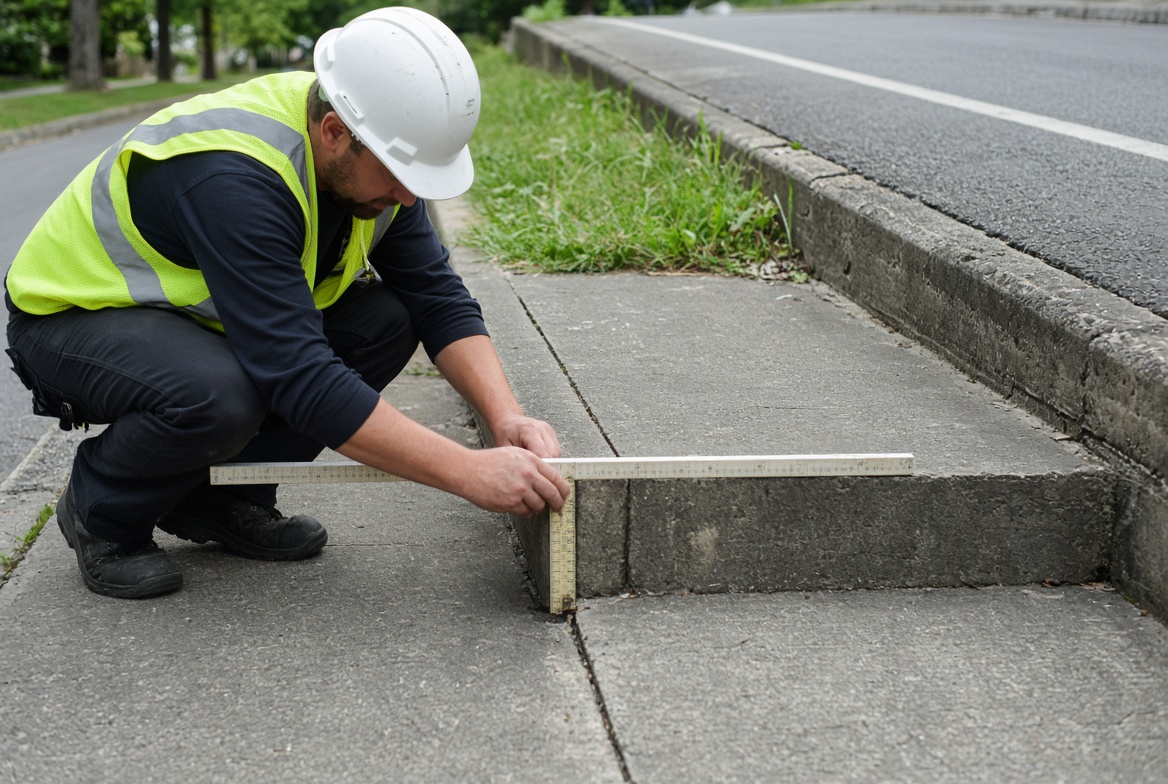 Our inspection program produces a detailed report with measurements, photos, and repair priorities. For multi-site clients, we can deliver findings with GIS mapping and dashboards. You do not need to buy a platform to get usable data, and the report can be entered into a system you already have. See why regular sidewalk inspections matter and how GIS planning supports HOA sidewalk maintenance.
The findings can then go directly to repairs. Raised lips on sound panels are candidates for patented horizontal slicing. Other defects are noted separately so that you can decide the right path. A professional sidewalk inspection gives you a dated baseline, whether or not you later buy software.
Frequently Asked Questions
What is the best sidewalk inspection software for ADA compliance?
It depends on your scale and on who will maintain the data. We do not rank vendors. Look for a tool that captures worst-point measurements, shows the raw values, applies the standard that fits your property, and exports cleanly.
Can software certify that a sidewalk is ADA compliant?
A report from software is only evidence of the conditions it recorded. A compliance determination depends on which standards apply and on the facts of the site, which is a question for a qualified specialist or counsel.
Is a phone app accurate enough to measure a trip hazard?
An app is fine for logging a measurement taken with a ruler or gauge. Before relying on a phone sensor to read a lip or slope directly, ask for its tested accuracy and compare it with a physical measurement on a few known joints.
How often should sidewalk data be updated?
We recommend a thorough sidewalk inspection at least once a year. Busy or tree-lined routes may need checks more often.
Talk to an Inspector
SoCal PCC inspects and repairs sidewalks for HOAs, municipalities, school districts, hospitals, retail centers, and property managers across San Diego, Orange, Riverside, and Imperial counties. To scope a survey, call or text (760) 334-8921.
References
- U.S. Department of Justice, 2010 ADA Standards for Accessible Design, sections 303, 403, 405, and 406
- U.S. Access Board, PROWAG technical requirements, sections R302 and R304

