
For commercial property owners in Southern California, ADA sidewalk compliance isn’t a one-time
achievement—it’s an ongoing responsibility. Parking lots, walkways, and building approaches are in constant use, and
conditions that meet accessibility standards today can develop into violations within months due to settling, tree
root growth, or weathering.
The stakes are significant: ADA violations can trigger lawsuits with statutory damages starting at $4,000 per
occurrence under California’s Unruh Civil Rights Act, plus attorney fees that often exceed the damages themselves.
Beyond legal exposure, inaccessible pathways exclude customers, create liability for injuries, and damage your
business reputation.
This guide outlines practical strategies for maintaining year-round ADA sidewalk compliance through
proactive commercial maintenance—protecting your business while ensuring all visitors can safely
access your property.
Understanding ADA Requirements for Commercial Properties
The Americans with Disabilities Act requires places of public accommodation to provide accessible pathways. For
sidewalks and walkways, key standards include:
Critical Thresholds
- Vertical displacement: Maximum ¼ inch between adjacent surfaces
- Cross slope: Maximum 2% perpendicular to direction of travel
- Running slope: Maximum 5% in direction of travel (unless designed as ramp)
- Clear width: Minimum 36 inches, with passing spaces for longer routes
- Surface conditions: Firm, stable, and slip-resistant
California’s Enhanced Requirements
California’s accessibility standards often exceed federal ADA minimums. The California Building Code and Unruh Civil
Rights Act create additional obligations:
- Stricter enforcement mechanisms
- Higher statutory damages
- Private right of action for accessibility violations
- Requirement for Certified Access Specialist (CASp) inspections for certain properties
What This Means for Your Property
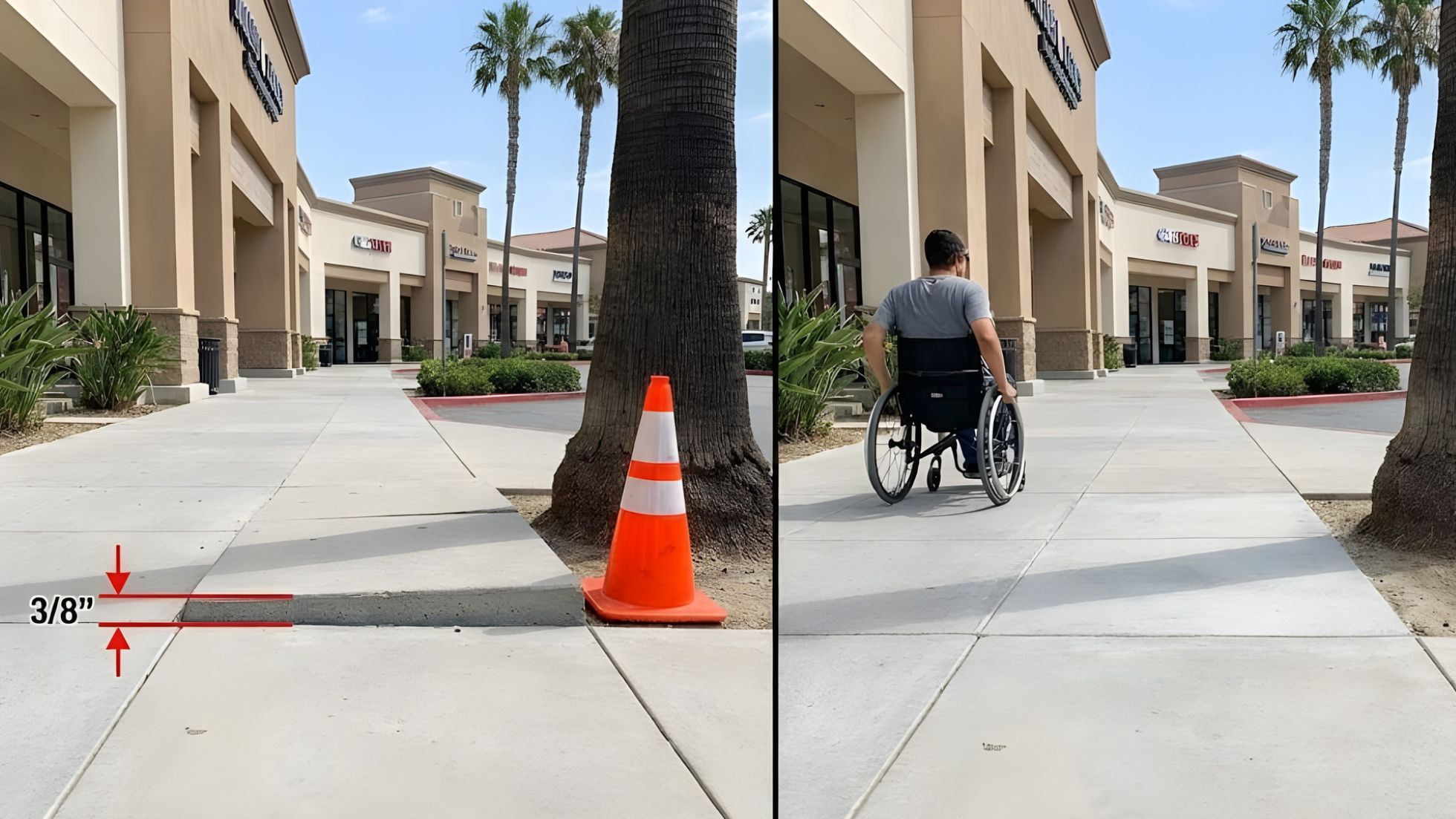
A sidewalk section that settles just ⅜ inch above an adjacent slab violates ADA standards. Tree roots that lift a
walkway ½ inch create both a trip hazard and an accessibility barrier. These seemingly minor changes can trigger
lawsuits and exclude customers with mobility challenges.
 Creating a Year-Round Compliance Program
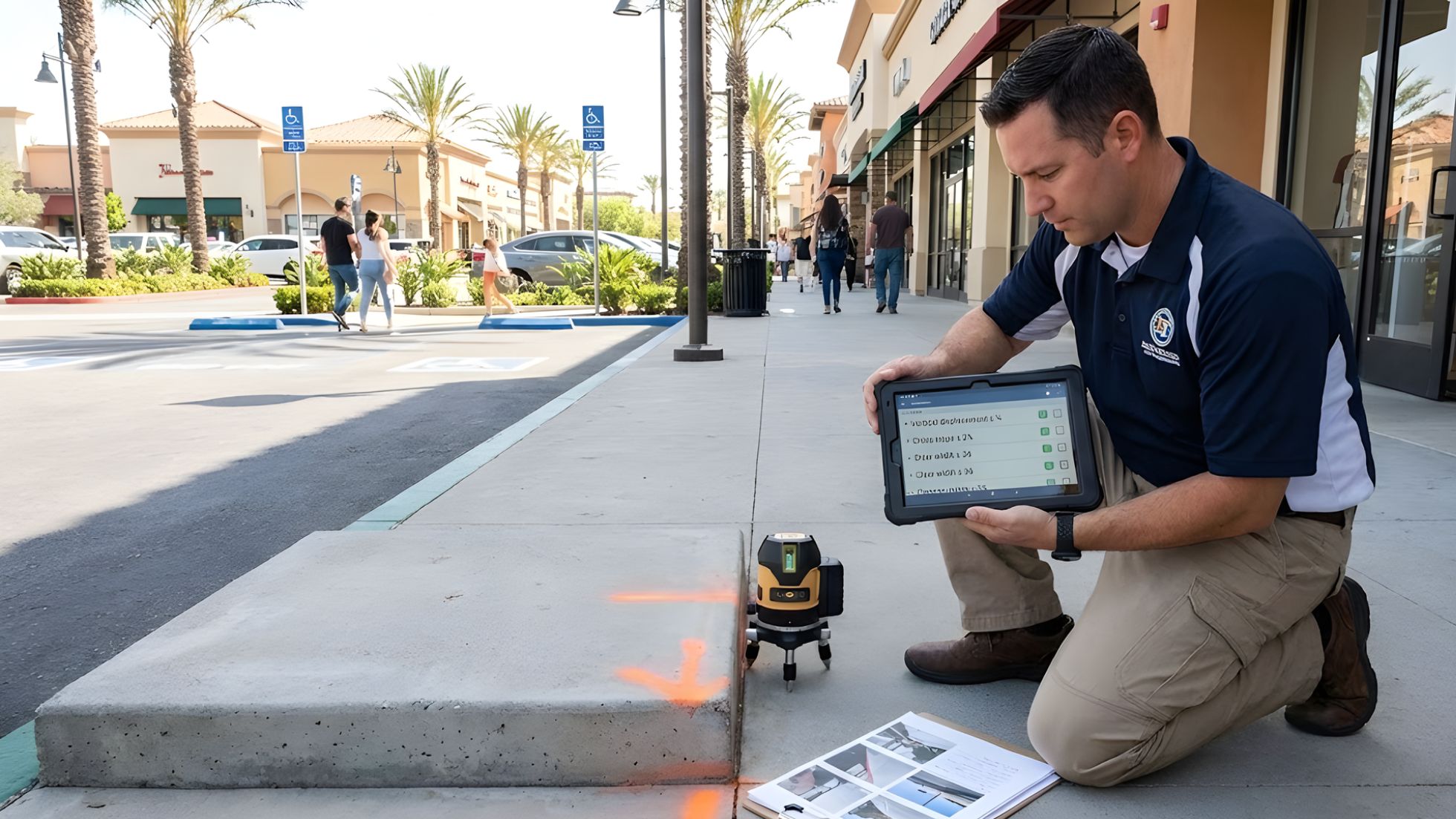
Consistent commercial maintenance keeps your property compliant between professional inspections.
Quarterly Visual Inspections
Assign property management staff to conduct quarterly walkway assessments:
What to check:
- Height differences between sidewalk sections
- Cracks wider than ¼ inch
- Deteriorating expansion joints
- Settlement near trees or landscaping
- Pooling water indicating drainage/slope issues
- Damaged or missing curb ramps
Priority areas:
- Building entrances and ADA parking access routes
- Paths from public sidewalks to entrances
- Connections between buildings on campus properties
- Outdoor dining and gathering areas
Document Everything
Create records demonstrating ongoing compliance efforts:
- Inspection dates and findings
- Photos with date stamps
- Repair work orders and completion dates
- Professional inspection reports
This documentation provides legal protection by showing reasonable care if an incident occurs.
Establish Repair Triggers
Define clear thresholds that trigger immediate action:
- Immediate: Any vertical displacement exceeding ¼ inch on primary access routes
- 30-day: Secondary pathway hazards, minor cracks progressing
- Quarterly: Cosmetic issues, preventive joint maintenance
Cost-Effective Compliance Solutions
Budget constraints don’t excuse non-compliance, but smart approaches maximize your investment.
Horizontal Slicing for Trip Hazard Removal
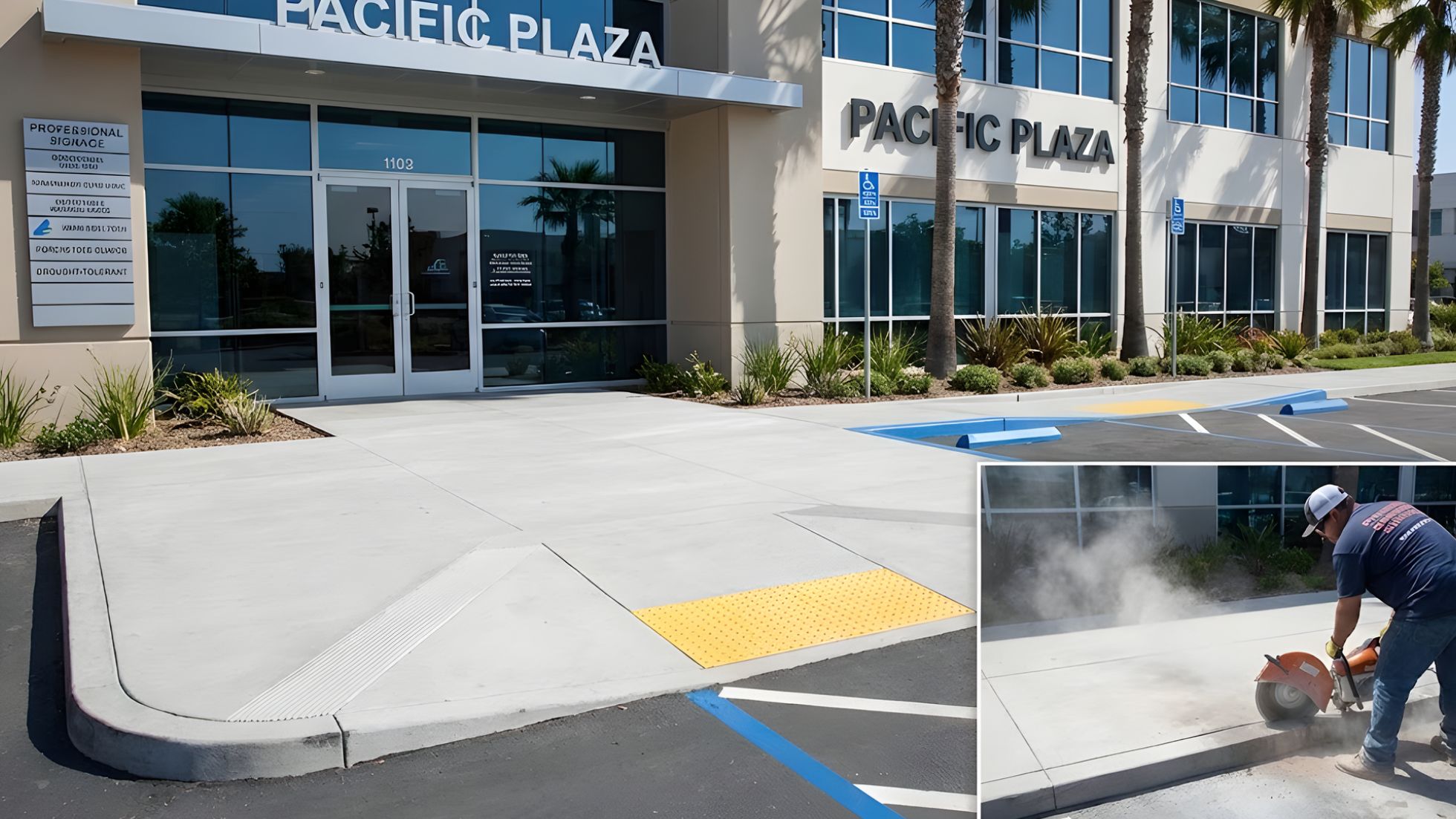
Precision Concrete Cutting’s patented horizontal slicing technique removes raised concrete sections flush with
adjacent slabs—restoring compliance at a fraction of replacement costs.
Commercial advantages:
- Minimal business disruption: Work completed quickly, no curing time required
- Immediate accessibility: Pathways open for use right after work completes
- Cost efficiency: Typically 40-60% less than full-depth replacement
- Clean finish: Meets compliance standards with minimal visible alteration
- Low environmental impact: Minimal dust, no large-scale concrete disposal
Preventive Joint Maintenance
Expansion joints prevent cracking by allowing concrete to expand and contract. When joints fail:
- Adjacent slabs crack
- Sections settle unevenly
- What was preventive maintenance becomes costly repair
Regular joint maintenance extends sidewalk life and prevents compliance violations before they develop.
Strategic Patching
For surface cracks and minor defects, professional patching prevents progression into trip hazards or accessibility
barriers.
Note: While some repairs (like complex drainage issues or large-scale concrete pouring) may
require general contractors, Precision Concrete Cutting specializes in patented horizontal slicing and also
offers patching and expansion joint maintenance. We do not perform grinding or full concrete replacement.
 High-Risk Areas Requiring Extra Attention
Focus commercial maintenance efforts on areas where violations develop most frequently:
ADA Parking Areas
Accessible parking spaces and their access aisles require smooth, level pathways to building entrances. Check:
- Curb ramp approaches and transitions
- Cross slopes in parking areas
- Path of travel from designated spaces to entrances
- Surface conditions in access aisles
Tree Root Zones
Southern California’s mature trees add value to commercial properties but commonly lift adjacent sidewalks. Monitor
these areas closely and address lifting before it exceeds compliance thresholds.
Building Entrances
Primary entrances experience the highest traffic and scrutiny. Ensure:
- Smooth transitions at door thresholds
- Level landing areas
- Compliant approach slopes
- No settlement causing height differences
Public Sidewalk Connections
Where your private walkways connect to public sidewalks, settlement and differential movement commonly create
compliance issues.
Responding to Identified Issues
When inspections reveal problems, act quickly:
Temporary Measures
While awaiting permanent repair:
- Use compliant warning cones or barriers
- Create temporary alternative accessible routes if possible
- Document the hazard and your response
- Schedule permanent repair promptly
Temporary measures show good faith but don’t substitute for actual repair—they only buy time.
Prioritize by Risk
When multiple issues exist:
- Primary accessible routes first
- High-traffic areas second
- Secondary pathways third
Choose Appropriate Solutions
Match the repair method to the problem:
- Raised sections: Horizontal slicing removes trip hazards and restores compliance
- Surface cracks: Patching prevents progression
- Joint deterioration: Joint maintenance prevents future problems
- Structural failure: Refer to general contractors for major reconstruction
Working with CASp Inspectors
Certified Access Specialists (CASp) provide authoritative assessments of ADA sidewalk compliance.
Benefits of CASp Inspections
- Detailed compliance reports identifying specific issues
- Prioritized remediation recommendations
- Legal benefits under California’s Construction-Related Accessibility Standards Compliance Act
- Credible documentation for demonstrating compliance efforts
Using CASp Reports Effectively
When you receive a CASp report:
- Review findings immediately
- Prioritize items by severity and location
- Get quotes for recommended repairs
- Address highest-risk items first
- Document all completed work
- Schedule follow-up inspection to verify compliance
Lease Considerations for Multi-Tenant Properties
For shopping centers, office parks, and multi-tenant commercial properties, clarify maintenance responsibilities:
Common Area Maintenance (CAM)
Typically, landlords maintain common walkways through CAM charges. Ensure:
- Sidewalk inspection and repair is explicitly included
- ADA compliance responsibility is clearly assigned
- Response timeframes for identified hazards are defined
- Documentation requirements are specified
Tenant Responsibilities
Individual tenants may be responsible for immediate storefront areas. Lease provisions should address:
- Scope of tenant maintenance obligations
- Standards for acceptable condition
- Notification requirements when issues are identified
- Landlord’s right to repair and charge back if tenant fails to act
Budgeting for Ongoing Compliance
Build commercial maintenance costs into your operating budget:
Annual Allowances
Estimate based on property size, age, and condition:
- Newer properties (0-10 years): Minimal repair needs, focus on preventive joint maintenance
- Mid-age properties (10-25 years): Budget for periodic trip hazard removal and patching
- Older properties (25+ years): Higher repair frequency, consider comprehensive assessment
Reserve for Compliance Issues
Set aside funds specifically for accessibility repairs to ensure quick response when issues are identified.
Compare Total Costs
Consider the complete picture:
- Cost of proactive maintenance vs. lawsuit defense
- Horizontal slicing efficiency vs. full replacement expense
- Prevention vs. emergency repair premiums
- Insurance implications of claims history
Avoiding Common Compliance Mistakes
Learn from issues that frequently create problems for commercial properties:
Ignoring “Minor” Issues
A ⅜-inch height difference seems trivial but exceeds ADA standards. What’s minor to an able-bodied person can be a
significant barrier for wheelchair users or create a fall risk for those with visual impairments.
Assuming New Construction Stays Compliant
Even recently poured concrete settles. Soil conditions, tree roots, and normal use cause changes over time. Continue
monitoring regardless of installation date.
Relying on Complaints to Identify Issues
By the time someone complains—or worse, files a lawsuit—you’ve already missed proactive opportunities. Regular
inspections catch issues before they become legal problems.
Deferring Repairs to “Next Budget Cycle”
ADA compliance isn’t optional based on budget timing. The liability exposure from a single lawsuit typically far
exceeds the repair cost that could have prevented it.
Why Partner with Precision Concrete Cutting
Precision Concrete Cutting helps Southern California commercial property owners maintain ADA sidewalk
compliance through:
Specialized Expertise
Our patented horizontal slicing technique is specifically designed for trip hazard removal and ADA
compliance—delivering durable results that meet accessibility standards.
Commercial Property Experience
We understand the unique needs of commercial properties: scheduling around business hours, minimizing disruption, and
working efficiently across large properties.
Comprehensive Services
Beyond trip hazard removal, we offer patching and expansion joint maintenance—addressing multiple needs through a
single vendor relationship.
Documentation for Your Records
We provide before/after documentation supporting your compliance records and demonstrating reasonable care.
Take Action: Schedule Your Compliance Assessment
Year-round ADA sidewalk compliance requires ongoing attention, but it doesn’t have to be
overwhelming. With systematic inspections, prompt repairs using cost-effective methods, and proactive
commercial maintenance, you can protect your business from liability while ensuring all customers
can safely access your property.
Don’t wait for a lawsuit or complaint to reveal compliance issues. Take proactive steps now to assess your property’s
condition and address any problems before they become legal and financial liabilities.
Get Started with Precision Concrete Cutting
Call 760-334-8921 to schedule a free assessment of your commercial property’s sidewalks and
walkways. We’ll identify trip hazards, provide clear recommendations, and offer transparent pricing for bringing
your property into compliance.
Contact us today at 760-334-8921 or visit socalpcc.com. Protect your business with proactive ADA compliance
from Precision Concrete Cutting.

