

When it comes to hospital safety, sidewalk hazard prevention is a non-negotiable priority for facility managers and property owners. Healthcare facilities serve the most vulnerable populations, including elderly patients, individuals using mobility aids, and individuals recovering from surgeries. A single uneven concrete panel can lead to catastrophic injuries, massive liability claims, and severe disruptions to emergency access routes. In 2026, maintaining flawless pedestrian pathways is not just about aesthetics; it is a critical component of comprehensive patient care and strict California ADA compliance.
Note: While some maintenance strategies discussed here (e.g., drainage work, tree root management, or concrete pouring) may require general contractors, Precision Concrete Cutting specializes specifically in trip hazard removal using patented horizontal slicing. We do not perform patching, grinding, slab replacement, or concrete pouring.
Southern California presents unique environmental challenges for concrete infrastructure. From the dry-climate soil shifting in San Diego to the aggressive root systems of native and imported trees, sidewalks in this region are highly susceptible to lifting and displacement. Addressing these issues requires specialized knowledge and precise interventions. This comprehensive guide outlines the five essential steps to ensure your healthcare facility’s walkways remain perfectly flush, accessible, and compliant with state and federal regulations.
Step 1: Conduct Routine, ADA-Focused Walkway Audits
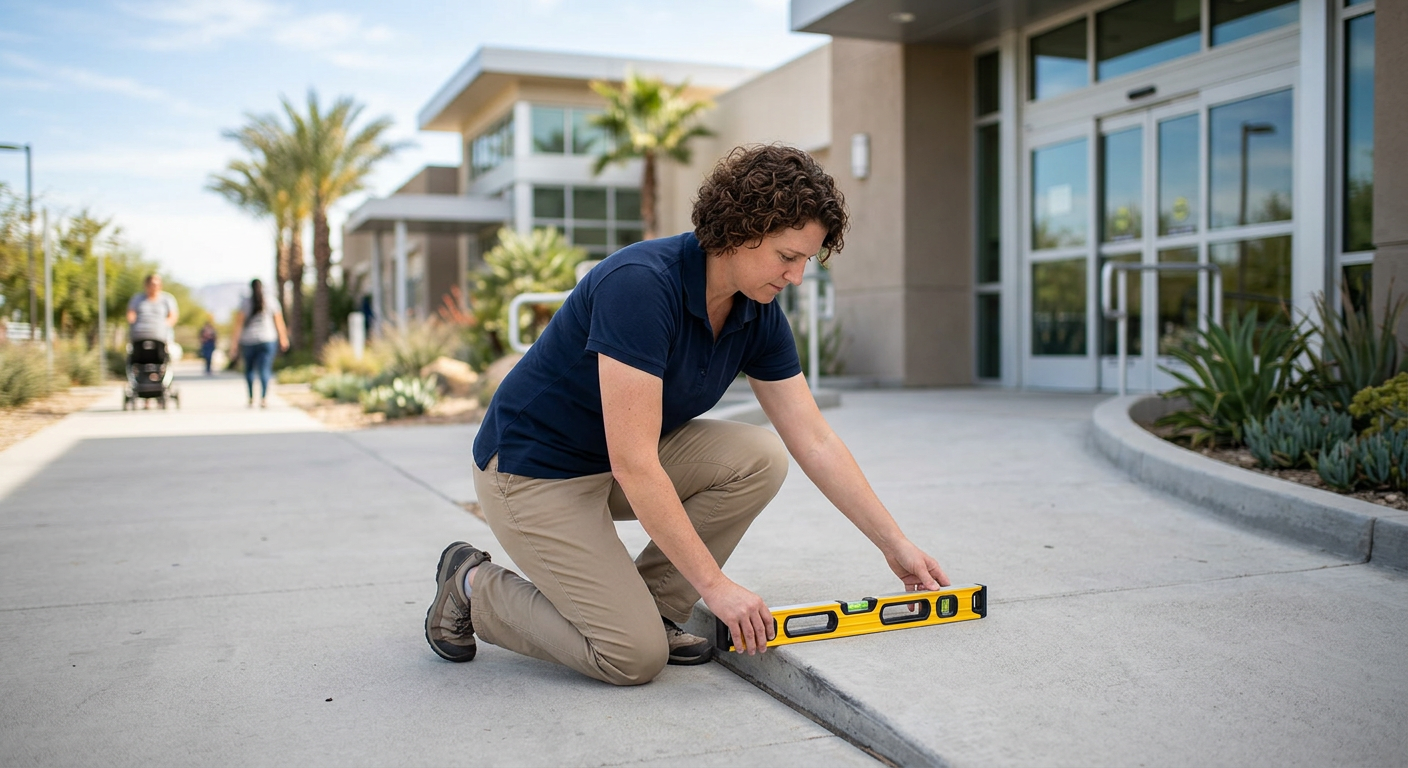
The foundation of any effective maintenance program is consistent, documented inspections. For healthcare environments, these audits must go beyond casual visual checks. They require precise measurements to ensure strict adherence to the Americans with Disabilities Act (ADA) and the California Building Code (CBC).
According to ADA.gov guidelines, any vertical change in level exceeding 1/4 inch is legally classified as a trip hazard. In a hospital setting, where patients frequently use wheelchairs, walkers, and gurneys, even a 1/4-inch lip can cause a severe jarring impact or a complete halt in momentum.
As Dr. Elena Rostova, Director of Patient Safety at a major San Diego healthcare network, explains: “In a clinical environment, patient care begins at the property line. If our exterior pathways are compromised, we are failing our patients before they even reach the lobby.”
To implement an effective audit system:
- Use Precision Tools: Utilize digital levels and specialized measuring devices to check cross-slopes and vertical displacements.
- Map the Campus: Document every hazard using GPS coordinates or facility maps to prioritize interventions.
- Schedule Quarterly Checks: Southern California’s seismic activity and soil expansion require frequent monitoring.
For more detailed guidance on healthcare-specific audits, review our top 5 sidewalk safety tips for hospitals and healthcare facilities.
Step 2: Identify SoCal-Specific Deterioration Factors
Understanding why concrete fails is crucial for long-term hospital safety, sidewalk hazard prevention. In Southern California, the climate and landscaping choices play a massive role in walkway deterioration. Unlike regions that deal with freeze-thaw cycles, San Diego and the surrounding areas face a different set of environmental stressors.
Tree Root Lifting
Many hospital campuses feature mature landscaping to create a calming environment. However, species like Ficus, Eucalyptus, and certain pines possess aggressive, shallow root systems. As these roots seek moisture in Southern California’s arid climate, they exert immense upward pressure on concrete slabs, causing severe heaving and sudden trip hazards.
Dry-Climate Soil Shifting
Prolonged droughts followed by intense, concentrated rainfall cause the expansive clay soils common in Southern California to contract and expand violently. This subterranean movement removes the supportive base beneath concrete panels, leading to settling, cracking, and uneven joints.
While managing tree roots or installing subterranean drainage systems requires the expertise of a general contractor or arborist, identifying these root causes early allows facility managers to coordinate comprehensive solutions. Proactive identification is key to keeping your sidewalks safe year-round in Southern California.
Step 3: Choose the Right Intervention (Horizontal Slicing)
When a trip hazard is identified, selecting the correct mitigation method is critical. Historically, property managers relied on inferior methods like concrete grinding, patching, or total slab replacement. However, these outdated approaches are highly disruptive, environmentally wasteful, and often fail to achieve true ADA compliance.
Today, the industry standard for healthcare facilities is trip hazard removal via patented horizontal slicing. This ADA-compliant slicing technique utilizes specialized equipment to cut the concrete horizontally, creating a perfectly flush, zero-point-of-differential transition between panels.
Comparing Mitigation Methods
| Feature | Patented Horizontal Slicing | Total Slab Replacement |
|---|---|---|
| Disruption Level | Minimal. Walkways remain open; no heavy demolition. | High. Requires jackhammers, pouring, and curing time. |
| ADA Compliance | Guaranteed. Leaves a clean, flush, slip-resistant finish. | Variable. Depends heavily on the contractor’s pouring skill. |
| Environmental Impact | Eco-friendly. Preserves existing concrete; zero landfill waste. | High carbon footprint from new cement production and debris. |
| Cost Efficiency | Highly cost-effective. Saves up to 70-90% over replacement. | Expensive. Involves high labor, material, and disposal costs. |
Research from the National Safety Council indicates that the average cost of a slip-and-fall worker’s compensation claim exceeds $48,000 in 2026. Investing in precise, patented concrete cutting methods is a fraction of the cost of a single liability claim. If you are unsure which method your campus requires, learn more about the signs it’s time for sidewalk slicing, not replacement.
Step 4: Coordinate with Specialized Contractors
Healthcare facilities are complex ecosystems that operate 24/7/365. Maintenance interventions cannot interfere with ambulance bays, emergency room access, or patient transport routes. Therefore, partnering with specialized contractors who understand the nuances of clinical environments is essential.
As noted in our disclaimer, general concrete repair, structural resurfacing, and root barrier installations are tasks for general contractors. However, when it comes to the precise elimination of vertical displacements, you need a specialist in concrete cutting using patented methods.
When vetting a trip hazard removal specialist in California, ensure they offer:
- Dust Mitigation Technology: Hospitals require strict air quality control. The contractor must use advanced vacuum systems during the horizontal cutting process to capture silica dust instantly, protecting patients with respiratory vulnerabilities.
- Noise Management: The ADA-compliant slicing technique should be executed with specialized equipment designed to minimize decibel levels, preventing disruption to recovering patients.
- Verifiable Compliance: The contractor must guarantee that their horizontal slicing method meets all California ADA slope requirements (typically a maximum running slope of 1:20 and a cross slope of 1:48).
By utilizing specialized services, hospitals can drastically reduce their liability exposure. Discover more about how San Diego property owners can prevent costly sidewalk injury lawsuits through proactive vendor partnerships.
Get a free assessment to identify sidewalk hazards on your healthcare property today.
Step 5: Document and Maintain Compliance Records
The final step in mastering hospital safety, sidewalk hazard prevention is meticulous documentation. In the event of a slip-and-fall incident, a hospital’s best defense is a comprehensive paper trail proving that proactive, ADA-compliant maintenance was regularly performed.
According to the Centers for Disease Control and Prevention (CDC), over one million Americans suffer slip, trip, and fall injuries annually. When these occur on commercial or healthcare properties, the burden of proof often falls on the property owner to demonstrate they were not negligent.
Your compliance documentation should include:
- Pre-Intervention Data: Photographs and measurements of the trip hazards before removal.
- Service Records: Detailed invoices and reports from your trip hazard removal specialist, explicitly stating that the ADA-compliant slicing technique was utilized.
- Post-Intervention Verification: Measurements confirming the newly sliced concrete transition is perfectly flush and meets California Building Code standards.
Forward-thinking facility managers are now integrating this data into Geographic Information Systems (GIS) to track the lifecycle of their campus walkways. This data-driven approach allows for predictive maintenance budgeting. Read more about smart sidewalk maintenance and GIS planning to elevate your facility’s operational efficiency.

The Financial and Ethical Imperative of Sidewalk Safety
Maintaining hazard-free walkways is an ethical obligation for healthcare providers. Patients arriving at a hospital are often already in physical distress; the last thing they should encounter is an architectural barrier that threatens their safety. Furthermore, the financial implications of neglecting concrete maintenance are staggering. Beyond direct lawsuit payouts, hospitals face increased insurance premiums, negative public relations, and potential fines from the California Division of the State Architect (DSA) for accessibility violations.
By abandoning outdated methods and embracing precision horizontal cutting, Southern California healthcare facilities can achieve permanent ADA compliance efficiently and sustainably. The patented slicing method not only removes the immediate danger but also leaves a clean, aesthetically pleasing finish that reflects the high standard of care provided inside the building.
Don’t wait for an injury to prompt action. Proactive management is the only reliable strategy for mitigating risk and ensuring uninterrupted access for all patients, staff, and visitors.
Conclusion: Patient Care Starts at the Property Line
In a healthcare environment, safety and accessibility cannot be compromised. Uneven sidewalks pose an immediate physical threat to vulnerable patients and expose your facility to massive liability, compliance fines, and operational disruptions. By moving away from noisy, dusty, and inefficient traditional repair methods, hospital facility managers can ensure their campuses remain fully accessible 24/7. Utilizing patented horizontal slicing provides a clean, eco-friendly, and perfectly flush solution that meets strict California ADA standards without interrupting critical emergency routes or patient care. Proactive trip hazard removal isn’t just a routine maintenance task—it is a fundamental extension of your commitment to patient well-being
Schedule Your Free Assessment
Call 760-334-8921 to have our team evaluate your healthcare facility’s sidewalks. We’ll identify any existing trip hazards, recommend our patented horizontal slicing solutions, and provide transparent pricing for any needed work.
Contact Precision Concrete Cutting today at 760-334-8921. Keep your hospital walkways safe, ADA-compliant, and your campus fully accessible!

