

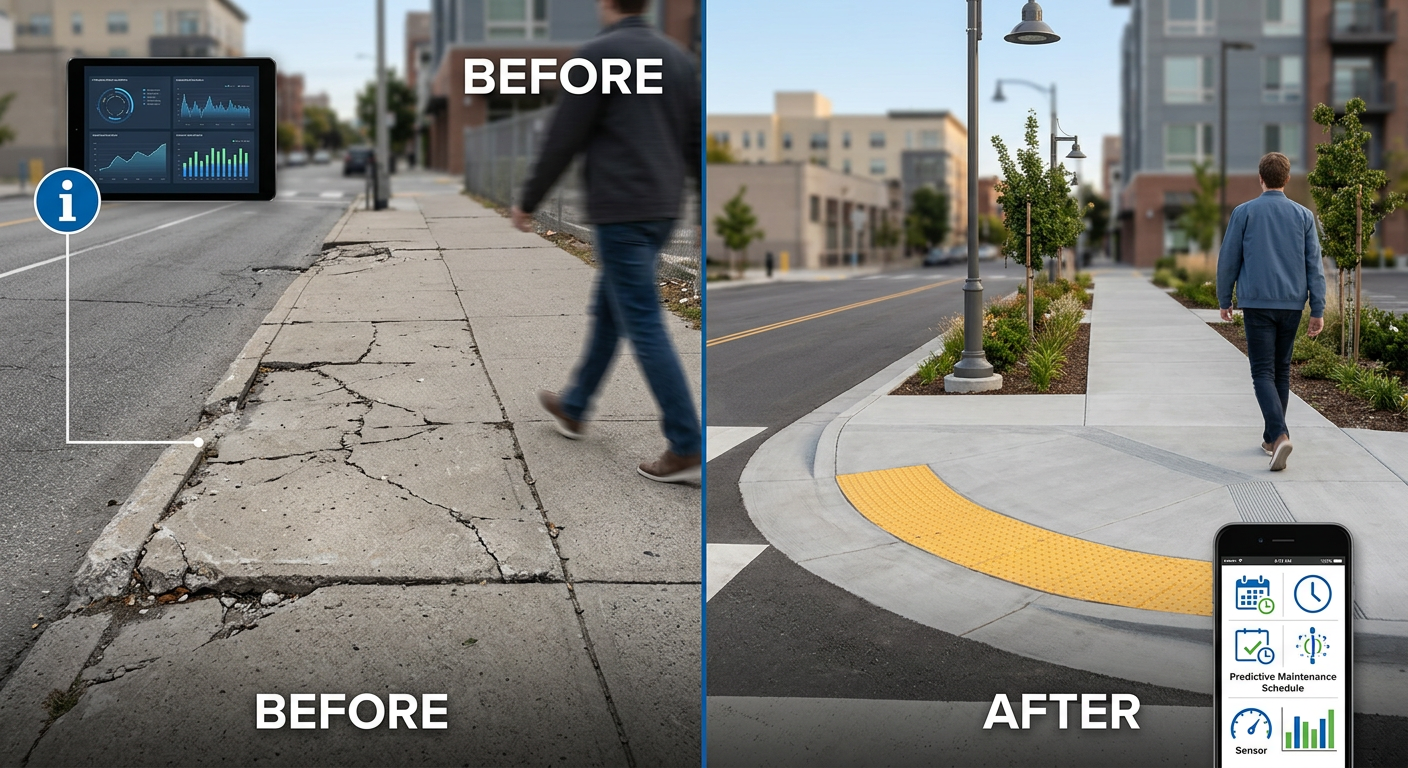
Ensuring city sidewalk safety requires a proactive approach that combines predictive analytics, rapid response repair techniques, and continuous infrastructure monitoring. In 2026, municipalities are moving away from reactive patching and instead leveraging smart city maintenance frameworks to identify and eliminate trip hazards before they cause injuries. By integrating IoT sensors, geographic information systems (GIS), and precision concrete slicing, urban planners can reduce trip-and-fall liabilities by up to 73% while extending the lifespan of pedestrian pathways.
The Evolution of Urban Infrastructure in 2026
The landscape of urban infrastructure management has shifted dramatically over the past decade. Historically, public works departments relied heavily on citizen complaints or manual annual surveys to identify broken concrete. This reactive model often resulted in delayed repairs, increased municipal liability, and disrupted pedestrian flow.
Today, the integration of artificial intelligence and automated data collection has revolutionized how municipalities operate. According to a 2026 report by the Smart Cities Council, over 65% of mid-to-large metropolitan areas have adopted predictive algorithms to manage their pedestrian infrastructure. These technologies allow administrators to forecast where concrete upheaval is most likely to occur based on soil composition, tree root growth patterns, and historical weather data.
As Dr. Elena Rostova, Director of Urban Infrastructure at the Global Urban Planning Institute, explains: “The transition from reactive patching to predictive analytics is the defining characteristic of modern municipal management. We are no longer waiting for a pedestrian to trip; we are identifying the micro-faults in the concrete months before they become non-compliant hazards.”

Core Technologies Driving Smart City Maintenance
To fully understand the modern approach to pedestrian infrastructure, it is essential to examine the specific technologies enabling these advancements. The deployment of these tools ensures that resources are allocated efficiently and high-risk zones are prioritized.
Geographic Information Systems (GIS) and LiDAR
A Geographic Information System (GIS) serves as the central nervous system for modern infrastructure tracking. By mapping every linear foot of pavement, cities can create a dynamic digital twin of their pedestrian networks. When combined with Light Detection and Ranging (LiDAR) data collected by municipal vehicles or drones, public works departments receive millimeter-accurate topographical maps of pavement conditions.
This level of detail is crucial for GIS planning for sidewalks, allowing decision-makers to visualize exactly which panels exceed the Americans with Disabilities Act (ADA) maximum allowable vertical displacement of 1/4 inch.
IoT Sensors and Crowdsourced Data
Internet of Things (IoT) sensors embedded in smart streetlights and municipal vehicles continuously gather environmental data. These sensors monitor ground moisture levels and temperature fluctuations—two primary catalysts for concrete spalling and thermal expansion. Furthermore, modern municipal apps allow citizens to snap geo-tagged photos of emerging hazards, feeding directly into the city’s automated triage system.
Traditional vs. Modern Infrastructure Management
The shift toward data-driven methodologies offers stark contrasts to legacy systems. The following table illustrates the operational differences between outdated approaches and contemporary frameworks.
| Metric | Traditional Management (Pre-2020) | Smart City Maintenance (2026) |
|---|---|---|
| Hazard Identification | Citizen complaints, manual walking audits | LiDAR scanning, AI image recognition, IoT sensors |
| Repair Methodology | Costly full-panel replacement or temporary grinding | Precision concrete slicing (zero-dust, ADA compliant) |
| Response Time | 6 to 18 months average backlog | 14 to 30 days for high-priority ADA violations |
| Financial Impact | High capital expenditure, high lawsuit payouts | Optimized budgets, 90% savings via slicing vs. replacement |
| Environmental Impact | High carbon footprint from new concrete pouring | Sustainable preservation of existing infrastructure |
The Financial and Legal Impact of City Sidewalk Safety
Financial stewardship is a primary driver behind the adoption of advanced infrastructure management. Trip-and-fall lawsuits cost U.S. municipalities billions of dollars annually. When a pedestrian is injured due to a non-compliant walkway, the burden of proof often falls on the property owner or the city to demonstrate that they were actively maintaining the area.
The Federal Highway Administration (FHWA) strictly mandates that pedestrian access routes remain free of vertical changes in level exceeding 1/4 inch. Failing to meet these standards not only invites personal injury litigation but also risks the loss of federal transportation funding. By implementing rigorous ADA compliance assessments, municipalities can shield themselves from predatory lawsuits.
Research from the National League of Cities indicates that municipalities utilizing proactive hazard removal strategies reduce their legal payout expenditures by an average of $2.4 million annually. This capital can then be reinvested into community enrichment programs rather than legal defense funds.
Step-by-Step Guide to Implementing a Proactive Strategy
Transitioning to a modernized infrastructure framework requires strategic planning and execution. Municipal leaders and public works directors should follow these structured steps to optimize their pedestrian networks.
- Conduct a Comprehensive Baseline Audit: Deploy LiDAR-equipped vehicles to scan all pedestrian pathways. This establishes a definitive baseline of current conditions and identifies all existing ADA violations.
- Integrate Data into a Centralized GIS Platform: Upload the audit data into a municipal GIS database. Categorize hazards by severity (e.g., Priority 1 for displacements over 1 inch, Priority 3 for minor cracking).
- Adopt Precision Repair Techniques: Move away from expensive demolition. Utilize precision concrete slicing to bring uneven panels back into ADA compliance. This method is highly effective for budget-friendly trip hazard fixes, saving up to 90% compared to full replacement.
- Establish a Predictive Maintenance Schedule: Use historical data to predict future failures. Areas with mature, aggressive tree roots or poor drainage should be inspected quarterly rather than annually. Developing smart sidewalk maintenance schedules ensures resources are deployed efficiently.
- Engage the Community: Launch a public awareness campaign encouraging citizens to report minor issues through the city’s official mobile application before they escalate into severe hazards.

Overcoming Common Edge Cases and Challenges
Even with the best technology, urban environments present unique, unpredictable challenges. Addressing these edge cases is vital for maintaining comprehensive city sidewalk safety year-round.
Urban Canopy and Tree Root Upheaval
One of the most persistent challenges in urban infrastructure is the conflict between mature street trees and concrete panels. Tree roots naturally seek oxygen and moisture, often growing directly beneath pavement and exerting immense upward pressure. Traditional solutions involved either cutting the roots (which destabilizes and often kills the tree) or removing the concrete entirely.
In 2026, arborists and engineers collaborate using ground-penetrating radar (GPR) to map root systems before repairs begin. By utilizing flexible paving materials or employing specialized concrete slicing that tapers the concrete without disturbing the root bed, cities can preserve their vital urban canopy while ensuring pedestrian safety.
Extreme Weather and Concrete Spalling
Climate volatility introduces rapid freeze-thaw cycles and extreme heat events. These temperature fluctuations cause concrete to expand and contract, leading to micro-fissures and surface spalling. Implementing cost-effective sidewalk maintenance requires applying advanced elastomeric sealants to vulnerable joints, preventing water ingress and subsequent thermal damage.
Real-World Case Studies in 2026
Theoretical frameworks are best validated through real-world application. Consider the recent transformation of a mid-sized metropolitan area in Southern California. Facing a $15 million backlog in concrete repairs and rising injury claims, the city overhauled its public works approach.
By shifting from reactive replacement to proactive slicing and GIS tracking, the municipality cleared its high-priority hazard backlog in just 14 months. They achieved a 100% ADA compliance rate in their downtown commercial district. As Marcus Thorne, Chief Engineer of Public Works, noted: “The data didn’t just tell us where the problems were; it told us how to fix them efficiently. We maximized our budget, minimized pedestrian disruption, and fundamentally transformed our approach to infrastructure.”
This success highlights the profound safety benefits of sidewalk repairs when executed through a modernized, data-first lens.
Key Takeaways for Municipal Leaders
- Data is the Foundation: Utilizing LiDAR and GIS mapping provides an accurate, actionable baseline for infrastructure health.
- Precision Saves Capital: Concrete slicing is significantly more cost-effective and environmentally friendly than traditional panel replacement.
- Proactive Trumps Reactive: Identifying micro-faults before they exceed the 1/4-inch ADA threshold prevents costly litigation and injuries.
- Cross-Departmental Collaboration: Prioritizing sidewalk safety requires seamless communication between public works, urban forestry, and risk management departments.
Frequently Asked Questions (FAQs)
What defines a trip hazard under current ADA guidelines?
Under the Americans with Disabilities Act, any vertical change in level exceeding 1/4 inch on a pedestrian pathway is classified as a trip hazard. Changes between 1/4 inch and 1/2 inch must be beveled with a slope no greater than 1:2, while anything over 1/2 inch requires immediate remediation.
How does smart city maintenance differ from traditional public works?
Smart city maintenance relies on predictive analytics, continuous IoT sensor data, and automated GIS mapping to identify infrastructure degradation before it becomes critical. Traditional public works historically relied on reactive measures, such as waiting for citizen complaints or conducting infrequent manual audits.
Why is concrete slicing preferred over full panel replacement?
Concrete slicing is preferred because it is up to 90% more cost-effective, generates zero silica dust, and can be completed in minutes without closing the walkway. Full panel replacement requires heavy demolition, new concrete pouring, and days of curing time, causing significant pedestrian disruption.
How do municipalities manage tree root upheaval without harming the trees?
Municipalities use ground-penetrating radar to map root systems and apply precision concrete slicing to level the pavement without disturbing the soil beneath. In severe cases, flexible paving alternatives or bridging techniques are used to accommodate root growth while maintaining a flat surface.
What role do citizens play in modern city sidewalk safety?
Citizens act as a vital crowdsourced data network by using municipal mobile applications to report and geo-tag minor concrete cracks or drainage issues. This real-time feedback loop allows public works departments to triage and address localized hazards rapidly.
How often should a city conduct a comprehensive infrastructure audit?
In 2026, best practices dictate that high-traffic commercial and transit corridors should be scanned via LiDAR semi-annually. Residential and lower-traffic areas should undergo comprehensive digital audits every 12 to 18 months to ensure continuous ADA compliance.
Conclusion: The Future of Municipal Sidewalk Safety
Transitioning to a smart city model for sidewalk maintenance is no longer a futuristic concept—it is a present-day necessity. By abandoning outdated, reactive patching in favor of data-driven GIS tracking, IoT monitoring, and predictive analytics, municipalities can efficiently pinpoint vulnerabilities before they become costly liabilities. When these advanced identification methods are paired with the precision of patented horizontal concrete slicing, cities can eliminate ADA violations rapidly, with zero downtime, and at a fraction of the cost of full panel replacement. Embracing this proactive, technology-first approach not only maximizes public works budgets but also ensures safe, accessible, and inclusive pathways for all residents.
Schedule Your Free Assessment
Call 760-334-8921 to have our team evaluate your municipal sidewalks. We’ll identify any existing trip hazards, recommend our patented horizontal slicing solutions, and provide transparent pricing for any needed work.
Contact Precision Concrete Cutting today at 760-334-8921. Keep your city’s walkways safe, ADA-compliant, and your public spaces looking great!

