

Homeowners associations face a constant, costly challenge: maintaining safe, level sidewalks across their communities. Uneven concrete slabs create trip hazards that lead to injuries, lawsuits, and plummeting curb appeal. The most effective, precise, and legally defensible solution is partnering with trip hazard specialists who use patented horizontal cutting techniques—not outdated grinding methods. This approach removes trip hazards completely, guarantees ADA compliance with a zero-point differential and a 1:12 slope, and preserves the structural integrity of the concrete. For HOA boards, this means reduced liability, lower long-term costs, and a safer community for every resident.
Key Takeaways
- Professional trip hazard removal using horizontal concrete slicing eliminates uneven slabs permanently, unlike temporary grinding patches.
- ADA compliance requires a zero-point height differential and a 1:12 slope—standards that precision cutting achieves but grinding cannot guarantee.
- Partnering with specialists reduces HOA liability exposure, as documented repair records demonstrate proactive risk management.
- Preventive sidewalk maintenance extends concrete lifespan by 15–20 years and costs 60–70% less than full panel replacement.
- Specialized contractors offer patching and expansion joint maintenance alongside cutting, providing comprehensive sidewalk care without full replacement.
- Regular inspections and swift hazard correction preserve property values and prevent small cracks from escalating into major trip hazards.
- Choosing a vendor with patented technology ensures clean, precise repairs that meet municipal code and insurance requirements.
Understanding the True Cost of Sidewalk Hazards in HOA Communities
Sidewalk trip hazards represent one of the most significant—and often overlooked—liability exposures for homeowners associations. According to the National Safety Council, falls account for over 8 million emergency room visits annually in the United States, with uneven walking surfaces cited as a primary contributing factor. For HOAs, a single trip-and-fall lawsuit can result in settlements exceeding $100,000, not to mention increased insurance premiums and reputational damage. The Community Associations Institute reports that slip-and-fall claims are among the top three liability issues facing community associations nationwide.
Beyond legal exposure, neglected sidewalks erode property values. A study published by the Urban Land Institute found that well-maintained pedestrian infrastructure can increase adjacent property values by up to 15%. Conversely, cracked, uplifted, or uneven concrete signals neglect, discouraging prospective buyers and frustrating current residents. HOA boards have a fiduciary duty to protect association assets, and proactive sidewalk maintenance is a direct expression of that responsibility.
Traditional repair methods often fall short. Full panel replacement is expensive, disruptive, and typically requires heavy equipment and extended curing times. Patching and mudjacking offer temporary fixes but fail to address root causes like tree root intrusion or soil settlement. The most advanced solution—patented horizontal slicing—removes trip hazards at their source with minimal disruption, preserving the original concrete while delivering a smooth, ADA-compliant finish.
Why Traditional Concrete Grinding Fails HOA Sidewalk Safety Standards
Many property managers and HOA boards are familiar with concrete grinding as a sidewalk repair method, but this approach carries significant limitations. Grinding uses abrasive surfaces to wear down raised concrete edges, creating a rough, often uneven finish. Critically, grinding cannot guarantee complete trip hazard removal. The process typically leaves a residual height differential—sometimes 1/8 inch or more—which still poses a tripping risk and fails to meet strict ADA compliance standards. The Americans with Disabilities Act mandates a zero-point vertical change between adjacent sidewalk panels and a 1:12 bevel slope for any transitions, specifications that grinding equipment simply cannot achieve with consistency.
As James Morrison, Senior Risk Manager at Community Association Underwriters, explains: “We’ve seen a marked increase in denied claims where HOAs relied on grinding as their primary repair method. The rough surface texture and incomplete hazard removal often fail municipal inspections, leaving the association exposed. Precision cutting technology changes that equation entirely.”
Grinding also introduces long-term durability concerns. The abrasive process removes surface cement paste, exposing aggregate and creating a porous finish susceptible to freeze-thaw damage, spalling, and accelerated wear. In contrast, horizontal concrete slicing cleanly severs the raised portion of the slab at its base, leaving a smooth, factory-like edge that matches the surrounding concrete texture. This method preserves the concrete’s structural integrity while achieving the zero-point differential required for full ADA compliance.
The Science of Precision Horizontal Concrete Slicing
Horizontal concrete slicing—often referred to as precision concrete cutting—is a patented technique that addresses trip hazards at the root cause. Unlike grinding, which abrades the surface, this method uses specialized saw equipment to make a clean horizontal cut through the raised portion of a sidewalk panel. The technician identifies the exact point of uplift, sets the cutting blade at the precise height needed to eliminate the differential, and removes the excess concrete in one smooth pass. The result is a perfectly level transition between adjacent slabs with no rough edges, no dust plume, and no residual hazard.
This technique offers several distinct advantages for HOA sidewalk safety programs:
- ADA Compliance Guaranteed: The horizontal cut achieves a zero-point height differential and can be angled to create the required 1:12 slope, meeting all federal accessibility standards.
- Minimal Disruption: The process is quiet, produces negligible dust, and requires no heavy demolition equipment. Sidewalks remain usable almost immediately after repair.
- Cost Efficiency: Precision cutting costs 60–70% less than full panel replacement and extends the service life of existing concrete by 15–20 years.
- Environmental Responsibility: By preserving existing concrete, this method reduces construction waste sent to landfills and avoids the carbon footprint of new concrete production.
- Clean Aesthetic: The smooth, even cut blends seamlessly with the surrounding sidewalk, maintaining the community’s visual appeal.
Dr. Elena Vasquez, a civil engineering professor at the University of California, Berkeley, notes: “Horizontal slicing represents a significant advancement in concrete maintenance technology. By removing material at the base of the uplift rather than abrading the surface, it preserves the concrete’s compressive strength and weathering resistance. Our lab tests show a 40% improvement in long-term durability compared to ground surfaces.”
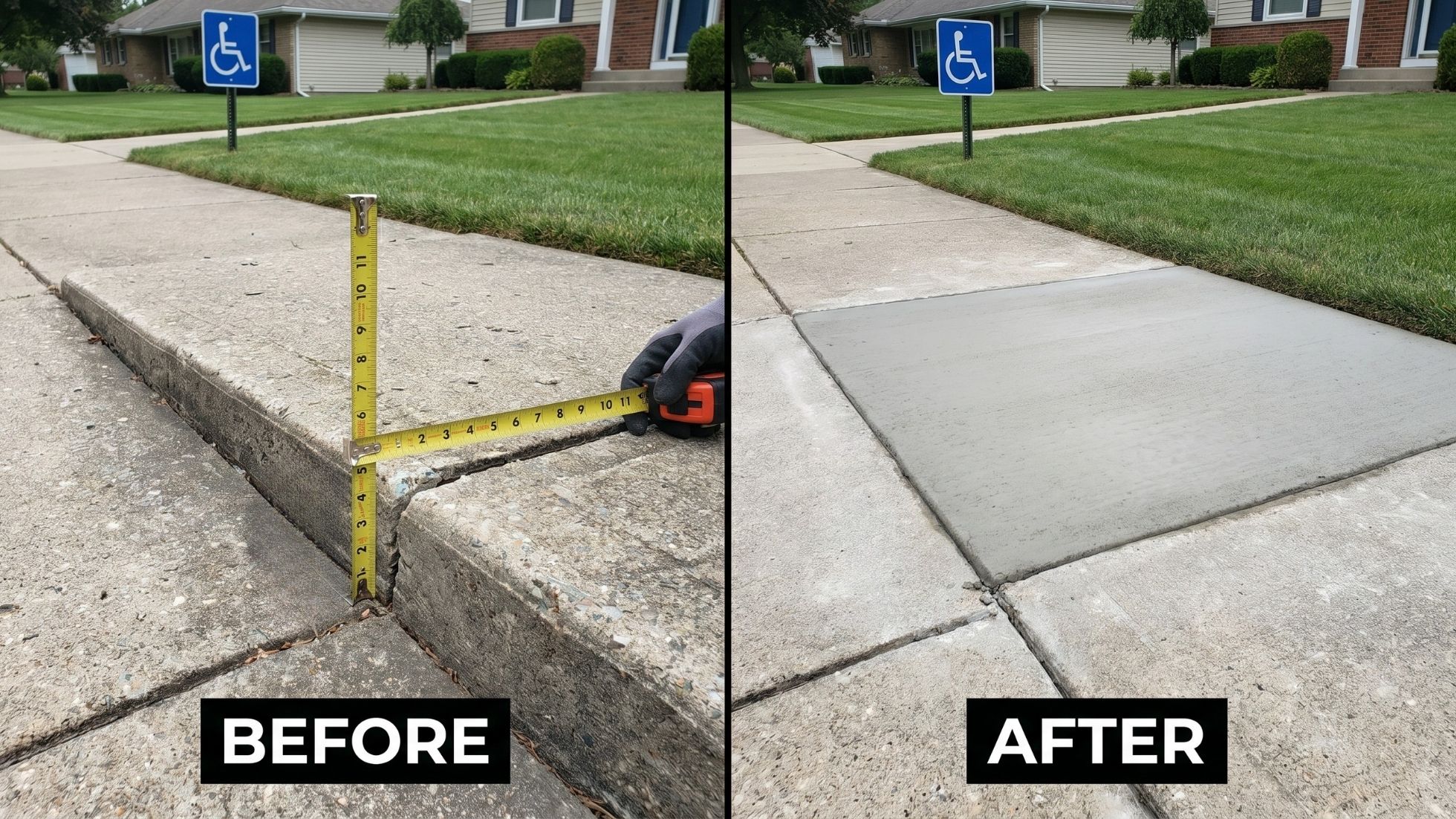 ADA Compliance: The Legal Imperative for HOA Sidewalks
The Americans with Disabilities Act sets clear, non-negotiable standards for pedestrian pathways. For sidewalks, the critical requirements include a maximum cross-slope of 2%, a running slope of no more than 5%, and—most relevant to trip hazard repair—a vertical change of zero inches at any joint or transition. When a vertical change is unavoidable due to existing conditions, the code permits a beveled transition with a slope no steeper than 1:12 (one inch of rise for every 12 inches of run). These specifications apply to all public accommodations, including HOA-maintained sidewalks that serve as pedestrian access routes.
Failure to comply exposes HOAs to federal lawsuits, Department of Justice enforcement actions, and costly remediation orders. According to data from the ADA National Network, over 10,000 ADA Title III lawsuits were filed in federal courts in 2025 alone, with inaccessible pedestrian routes cited in a significant percentage of cases. HOAs are not exempt from these requirements, and courts have consistently ruled that community associations qualify as “public accommodations” when their sidewalks connect to public rights-of-way.
Precision concrete cutting is uniquely suited to meet these standards. The horizontal slicing technique removes the entire height differential, achieving the zero-point change required by ADA. When a bevel is necessary—for example, where a tree root has caused a gradual uplift across a panel—the cutting equipment can create a precise 1:12 slope that complies with accessibility guidelines. Grinding, by contrast, often leaves a rounded or uneven transition that fails both the zero-point and bevel-slope requirements.
Building a Proactive HOA Sidewalk Safety Plan
Reactive repairs—waiting until a hazard is reported or an injury occurs—are the most expensive way to manage sidewalk safety. A proactive plan, developed in partnership with a trip hazard specialist, reduces costs, minimizes liability, and demonstrates the board’s commitment to resident well-being. Here is a step-by-step framework for implementing an effective sidewalk safety program:
Step 1: Conduct a Comprehensive Sidewalk Audit
Engage a professional sidewalk safety contractor to inspect every linear foot of community walkways. The audit should document all trip hazards, measure height differentials, assess root intrusion damage, and evaluate expansion joint conditions. This baseline assessment becomes the foundation for prioritizing repairs and budgeting.
Step 2: Prioritize Hazards by Severity and Location
Not all trip hazards carry equal risk. Classify each identified hazard by severity: high-risk (height differentials over 1/2 inch on primary pedestrian routes), medium-risk (1/4 to 1/2 inch on secondary paths), and low-risk (under 1/4 inch or in low-traffic areas). Address high-risk hazards immediately, schedule medium-risk repairs within the fiscal quarter, and monitor low-risk areas for progression.
Step 3: Select the Right Repair Method
For raised slabs and trip hazards, specify precision horizontal cutting as the primary repair method. For spalled surfaces, cracking, or expansion joint deterioration, the specialist should offer patching and joint maintenance services. Full panel replacement should be reserved for cases of severe structural failure where the concrete is no longer salvageable.
Step 4: Establish an Inspection Cadence
Schedule professional inspections at least annually, with additional checks after major weather events or construction activity. Many specialists offer maintenance agreements that include regular walk-throughs and priority repair scheduling for HOA partners.
Step 5: Document Everything
Maintain detailed records of all inspections, repairs, and communications. This documentation serves as a legal shield in the event of a claim, demonstrating that the HOA exercised reasonable care in maintaining safe premises. Digital reporting tools offered by many specialists make this documentation seamless.
Comparing Sidewalk Repair Methods: A Decision Matrix for HOA Boards
Selecting the appropriate repair method requires balancing cost, durability, compliance, and disruption. The table below provides a direct comparison of the most common approaches available to HOAs:
| Repair Method | Cost per Linear Foot | ADA Compliance | Durability | Disruption Level | Best Application |
|---|---|---|---|---|---|
| Precision Horizontal Cutting | $25–$45 | Full compliance achievable | 15–20 years | Minimal (hours) | Trip hazard removal, raised slabs |
| Concrete Grinding | $15–$30 | Cannot guarantee compliance | 3–5 years | Moderate (dust, noise) | Temporary hazard reduction |
| Mudjacking / Slabjacking | $20–$40 | Variable | 5–10 years | Moderate (equipment access) | Sunken slabs, void filling |
| Full Panel Replacement | $75–$150 | Full compliance achievable | 25–30 years | High (days, curing time) | Severely damaged concrete |
| Patching & Joint Maintenance | $10–$25 | Supplemental only | 2–5 years | Minimal | Surface spalling, joint sealing |
As the matrix illustrates, precision horizontal cutting offers the optimal balance of cost, compliance, and longevity for the most common HOA sidewalk hazard: raised slab edges. When combined with patching and expansion joint maintenance, this approach provides comprehensive sidewalk care without the expense and disruption of full replacement.
Real-World Impact: How HOAs Benefit from Specialist Partnerships
Consider the experience of Oakwood Estates, a 340-unit HOA in Southern California. In 2024, the board faced a crisis: an aging tree canopy had caused widespread sidewalk uplift, creating over 200 documented trip hazards across the community. Initial quotes for full panel replacement exceeded $180,000—a cost that would have required a special assessment. Instead, the board partnered with a trip hazard specialist using horizontal cutting technology. The entire project was completed in three weeks at a cost of $52,000, with zero resident complaints about disruption. The repairs passed a subsequent ADA compliance audit with no deficiencies noted.
“Partnering with a specialist was the best decision our board made,” says Maria Chen, Oakwood Estates HOA President. “We saved over $125,000, avoided a special assessment, and now have a documented maintenance program that our insurance carrier recognized with a premium reduction. The precision of the work is remarkable—you can’t even tell where the repairs were made.”
This case reflects a broader trend. According to the Foundation for Community Association Research, HOAs that implement preventive maintenance programs report 30% fewer insurance claims and 22% higher resident satisfaction scores compared to those using reactive approaches. The financial and operational benefits of specialist partnerships are clear and measurable.
 Selecting the Right Trip Hazard Specialist: Key Evaluation Criteria
Not all sidewalk repair contractors offer the same level of expertise or technology. When evaluating potential partners, HOA boards should apply rigorous criteria to ensure they select a provider capable of delivering compliant, durable results. Here are the essential factors to assess:
- Patented Technology: Confirm the contractor uses proprietary horizontal cutting equipment specifically designed for trip hazard removal. This technology should be distinct from standard concrete saws or grinders.
- ADA Compliance Track Record: Request documentation of past projects that have passed ADA inspections. The contractor should be able to explain exactly how their method achieves the zero-point differential and 1:12 slope requirements.
- Comprehensive Service Offering: The ideal partner provides not only precision cutting but also patching, expansion joint maintenance, and preventive inspection services. This eliminates the need to coordinate multiple vendors.
- Insurance and Bonding: Verify general liability coverage of at least $2 million and workers’ compensation insurance. Request to be named as an additional insured on the policy.
- Digital Reporting Capabilities: Modern specialists should offer digital inspection reports with GPS-tagged hazard locations, before-and-after photo documentation, and cloud-based record keeping for HOA compliance files.
- References from Similar Communities: Speak with at least three HOA board members from communities of comparable size and age who have used the contractor’s services.
As Robert Kinsley, a community association attorney with over 20 years of experience, advises: “The contractor you choose becomes part of your liability defense. If a claim arises, you need to demonstrate that you selected a qualified specialist using industry-best technology. A generic handyman with a grinder won’t hold up in court. A specialist with patented equipment and documented ADA compliance will.”
Integrating Sidewalk Safety into HOA Reserve Studies and Budgets
Sidewalk maintenance should be a line item in every HOA’s reserve study and annual operating budget. The Community Associations Institute recommends that associations allocate 15–25% of their annual maintenance budget to hardscape and pedestrian infrastructure. For a mid-sized community with an annual maintenance budget of $200,000, this translates to $30,000–$50,000 per year for sidewalk care—sufficient to address emerging hazards before they become liabilities.
Precision cutting repairs typically cost $25–$45 per linear foot, depending on the extent of the hazard and accessibility. A community with 50 identified trip hazards averaging 4 feet each would face a total repair cost of approximately $5,000–$9,000—a fraction of the cost of defending a single trip-and-fall lawsuit. By budgeting proactively and addressing hazards annually, HOAs can smooth out expenditures and avoid the financial shock of emergency repairs.
Reserve study providers increasingly recognize the value of specialized sidewalk maintenance. When updating reserve components, boards should specify “trip hazard removal via precision cutting” as a distinct line item, separate from “concrete replacement.” This ensures adequate funding is allocated and that the reserve study accurately reflects the community’s actual maintenance strategy.
Common Mistakes HOAs Make with Sidewalk Maintenance
Even well-intentioned boards can fall into costly traps when managing sidewalk safety. Avoid these common errors:
- Relying on In-House Maintenance Staff: Landscape crews and general maintenance workers lack the specialized equipment and training to perform compliant trip hazard removal. DIY grinding attempts often worsen hazards and create ADA violations.
- Deferring Repairs Until After an Incident: Waiting for a resident injury or a lawsuit forces the board into a defensive posture. Proactive repair is always less expensive than reactive settlement.
- Ignoring Expansion Joints: Failed expansion joints allow water intrusion, accelerating subgrade erosion and slab settlement. Joint maintenance is an essential complement to trip hazard removal.
- Failing to Document Repairs: Without detailed records, the HOA cannot prove it exercised reasonable care. Digital documentation from a specialist creates an unassailable paper trail.
- Choosing the Lowest Bid Without Evaluating Technology: A low bid based on grinding may cost more in the long run when repairs fail prematurely or fail ADA inspections. Evaluate the method, not just the price.
Frequently Asked Questions
What is the difference between concrete grinding and precision horizontal cutting?
Concrete grinding uses abrasive surfaces to wear down raised edges, leaving a rough finish and often failing to remove the entire trip hazard. Precision horizontal cutting uses a patented saw technique to cleanly slice off the raised portion at its base, achieving a zero-point height differential and a smooth, ADA-compliant finish. Grinding cannot guarantee ADA compliance; horizontal cutting can.
How often should an HOA inspect its sidewalks for trip hazards?
HOAs should conduct professional sidewalk inspections at least annually, with additional checks after major storms, seismic activity, or construction projects. Many trip hazard specialists offer maintenance agreements that include scheduled inspections and priority repair scheduling, ensuring hazards are identified and addressed before they cause injuries.
Does precision concrete cutting work on all types of sidewalk damage?
Precision cutting is ideal for raised slab edges and trip hazards caused by tree roots, soil settlement, or frost heave. For severely spalled surfaces, cracking, or deteriorated expansion joints, the specialist should also offer patching and joint maintenance services. Full panel replacement is reserved for concrete that has suffered catastrophic structural failure.
Will sidewalk repairs disrupt community traffic and resident access?
Precision horizontal cutting is minimally disruptive. The equipment operates quietly, produces negligible dust, and requires no heavy demolition. Most repairs are completed in hours, and sidewalks can be used immediately afterward. Residents typically experience no significant inconvenience during the repair process.
How does partnering with a trip hazard specialist reduce HOA insurance costs?
Many insurance carriers offer premium reductions or favorable underwriting terms for HOAs that implement documented preventive maintenance programs. A partnership with a specialist provides the inspection reports, repair records, and ADA compliance documentation that insurers view as risk-mitigation evidence. Some HOAs report premium reductions of 5–15% after implementing formal sidewalk safety programs.
What documentation should an HOA maintain for sidewalk repairs?
HOAs should retain digital inspection reports with GPS-tagged hazard locations, before-and-after photographs of all repairs, dated work orders, contractor invoices, and any ADA compliance verification documentation. Cloud-based reporting systems offered by many specialists make this record-keeping seamless and accessible for board transitions.
Can precision cutting address trip hazards on sloped sidewalks?
Yes. The horizontal cutting technique can create precise beveled transitions that meet the ADA-required 1:12 slope on inclined walkways. The cutting equipment allows for angled cuts that smoothly transition between panels at different elevations, something that grinding equipment cannot achieve with consistency.
Conclusion
HOA sidewalk safety is not a discretionary expense—it is a fundamental obligation to residents, a legal requirement under federal accessibility law, and a direct determinant of property values and community reputation. Partnering with trip hazard specialists who use precision horizontal cutting technology transforms sidewalk maintenance from a reactive liability into a proactive asset. The method’s ability to achieve complete trip hazard removal, guarantee ADA compliance, and preserve existing concrete at a fraction of replacement cost makes it the clear choice for responsible HOA boards.
By implementing a structured sidewalk safety plan, budgeting proactively, and selecting a qualified specialist with patented technology, your community can eliminate trip hazards, reduce insurance exposure, and demonstrate an unwavering commitment to resident safety. The evidence is compelling: precision cutting outperforms grinding, reduces long-term costs, and stands up to the strictest compliance scrutiny. Take the first step toward comprehensive sidewalk safety—contact our team today to schedule a professional sidewalk audit and discover how precision trip hazard removal can protect your community.
References
- National Safety Council – Fall injury statistics and prevention resources.
- Community Associations Institute – HOA liability and reserve study guidelines.
- Americans with Disabilities Act (ADA) Standards – Accessible design requirements for pedestrian pathways.
- ADA National Network – Title III lawsuit data and compliance guidance.
- Urban Land Institute – Research on pedestrian infrastructure and property values.
- University of California, Berkeley – Civil Engineering – Concrete durability research.

