
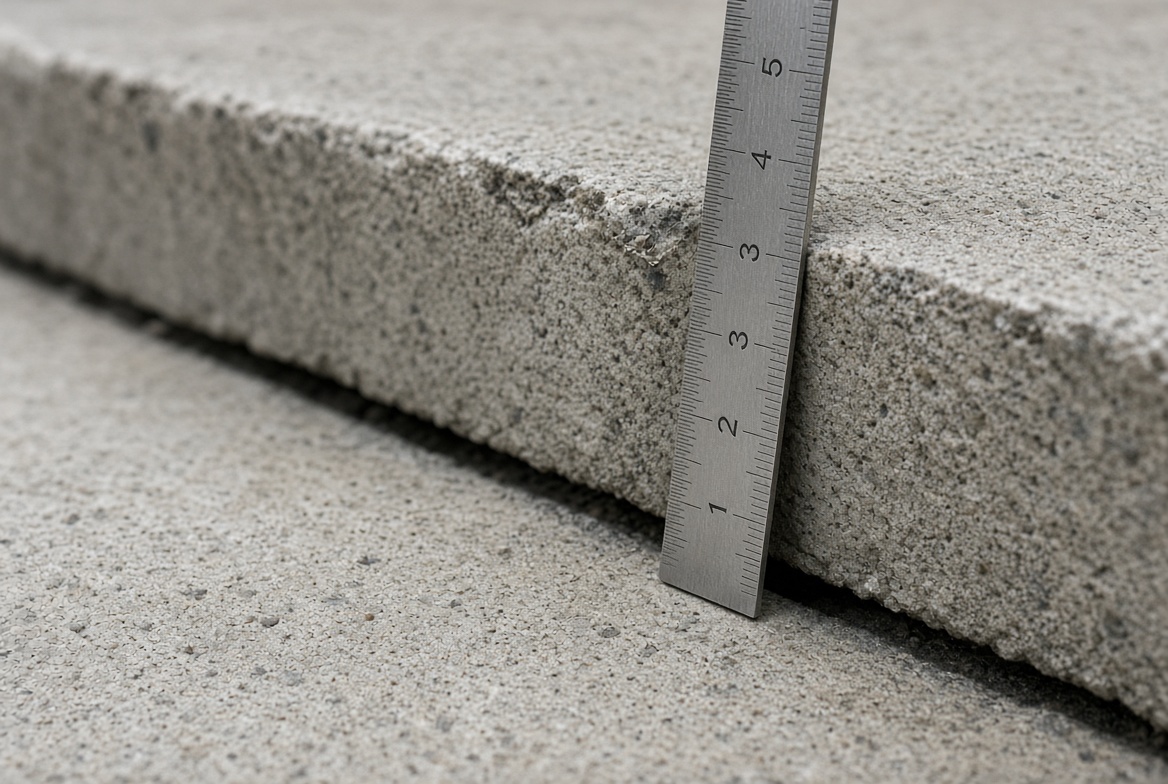
There is no single federal trip hazard height, because the ADA Standards do not use that term. They regulate changes in level instead: up to 1/4 inch may be vertical, 1/4 to 1/2 inch must be beveled at 1:2, and more than 1/2 inch needs a ramped transition. In practice, our inspections flag a lip above 1/4 inch so it can be recorded and scheduled for repair.
That distinction matters when you are writing a work order or answering a resident complaint. This guide explains what each height means, how to measure it, and why height alone does not settle a claim. It is general information rather than legal advice. If a lip on your property has already crossed 1/4 inch, horizontal slicing is often the most direct way to remove it from a sound panel.
Key Takeaways
- “Trip hazard” is common industry language. The published figures are about changes in level.
- The 1/4-inch and 1/2-inch breakpoints appear in the 2010 ADA Standards, PROWAG, and California Chapter 11B.
- A 1/2-inch change can be 1/4 inch vertical plus 1/4 inch beveled. The total may not exceed 1/2 inch under that provision.
- Measure the highest point of the lip, usually at one end of the joint, and record where you measured.
- California has no fixed height that decides liability. Courts look at the size of a defect and the surrounding circumstances.
Trip Hazard Height by the Numbers
| Measured lip | What the standards say | Sensible next step |
|---|---|---|
| Up to 1/4 in. (6.4 mm) | May be vertical, with no edge treatment | Log it if it is close to the limit and re-measure at the next inspection |
| Over 1/4 in. to 1/2 in. (13 mm) | Must be beveled, no steeper than 1:2 | Add to the repair list; a square edge at this height does not match the figure |
| Over 1/2 in. | Must be ramped under the ramp or curb ramp sections | Prioritize the repair, especially on main routes |
| Up to about 1.5 in. | Same as above | Often removable in a single slicing pass if the panel is sound |
| Sunken or failed panel | Same height figures apply | Needs a different repair; slicing removes high concrete only |
The 2010 Standards put these figures in section 303. PROWAG repeats them in R302.6.2 and specifies a 1:12 maximum slope for changes above 1/2 inch and up to 6 inches. California repeats the breakpoints in section 11B-303.
What the 1/4-Inch Rule Means
The 1/4-inch figure is a limit on an untreated vertical edge. It is not a statement that a 3/16-inch lip is safe or that a 5/16-inch lip has caused anyone harm. It gives measurers a consistent line: at or below it, the edge may stay square, and above it, the edge needs treatment.
This is why two sentences you may have read elsewhere need care. “Any lift over 1/4 inch is an ADA violation” skips over beveled edges and over the question of whether the Standards apply to that route. “Anything under 1/4 inch is fine” ignores what the walk is used for. Both are too simple for a maintenance plan.
What the 1/2-Inch Rule Means
A change between 1/4 and 1/2 inch must be beveled no steeper than 1:2, which means 1 unit of rise for every 2 units of run. Under the Standards, a 1/2-inch change can be 1/4 inch vertical with 1/4 inch beveled above it, but the combined height may not exceed 1/2 inch under that provision.
Above 1/2 inch, a bevel at 1:2 no longer fits the provision. The change has to be ramped. For a sidewalk lip, that usually means removing the raised concrete to create a gradual transition, which is why 1:12 appears in repair specifications. A 1:12 slope is the maximum for a ramp run, so a repair designed to that figure is working to the ramp limit rather than the bevel limit.
How to Measure a Lip Without Understating It
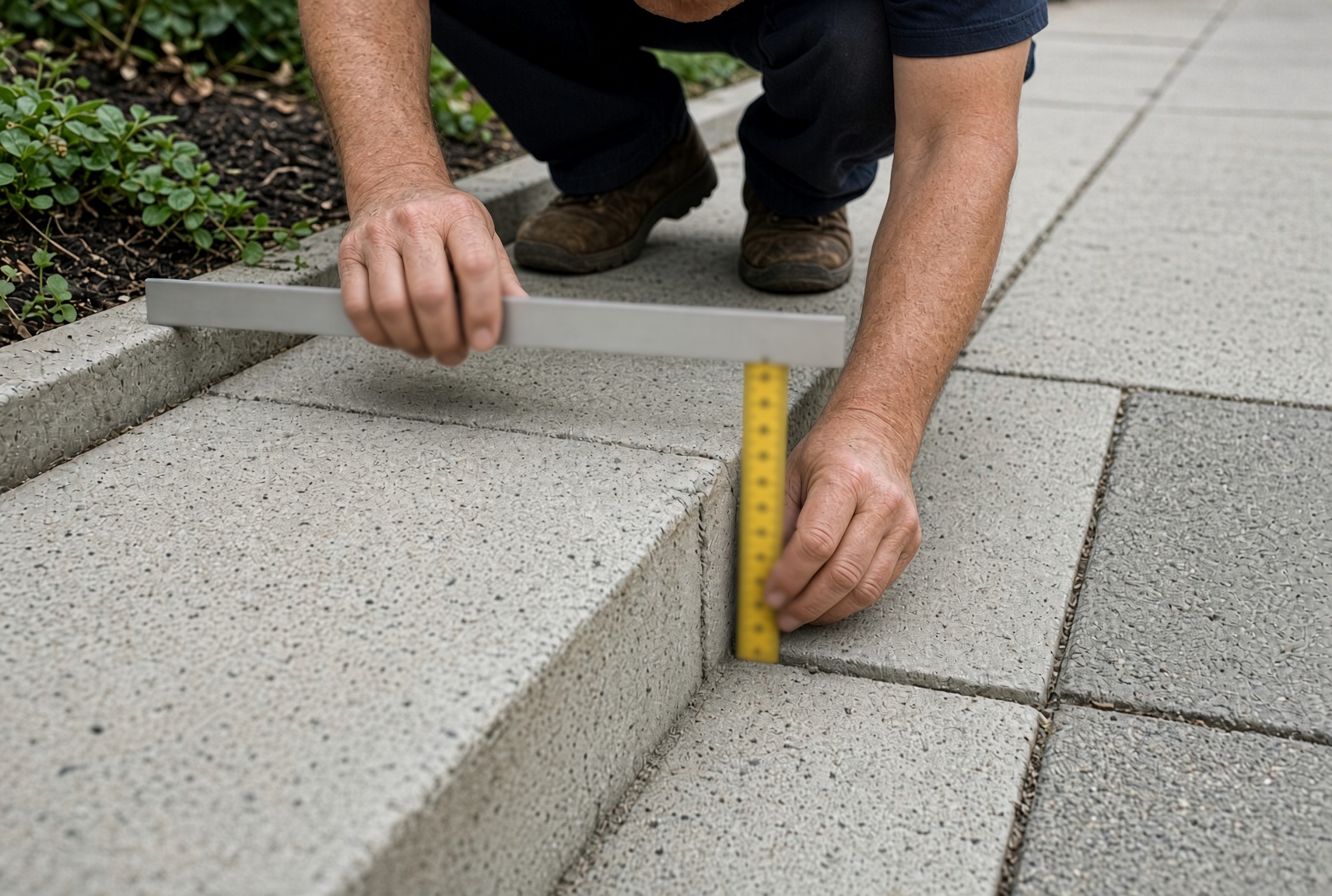 Panels rarely lift evenly. Roots and soil movement tend to tip a slab, so a joint may read 1/8 inch at one edge and 3/4 inch at the other. Take the measurement that reflects the worst point:
- Walk the joint and find its highest point. Low morning or late-afternoon light makes this easier.
- Set a straightedge on the low panel and extend it past the joint, if the surface allows.
- Measure from the top of the raised edge straight down to the lower surface with a ruler or a gauge marked in 1/16-inch increments.
- Photograph the ruler in place, with a second wide photo showing where the joint is.
- Record the date, location, height, and whether the panel rocks or sounds hollow.
For more on reading the condition of a slab, see how to identify vertical sidewalk displacement. For a broader property walk, use our guide to identifying trip hazards in California.
Why Height Is Not the Whole Story
Two identical lips may not carry the same priority. A 3/8-inch edge in the shadow of an entry canopy at a hospital is a different concern from the same edge on a rarely used service path. Consider these factors when you rank work:
- Route: Does it connect accessible parking, transit, or a public sidewalk to an entrance?
- Traffic and users: Older adults, children, and people using mobility devices may meet it every day.
- Visibility: Shade, leaf litter, and poor lighting can hide a lip.
- Trend: A lip that grew between inspections, especially near a tree, is likely to keep moving.
- Width of the edge: A lip across the full width is harder to step around than one at the margin.
Gaps deserve separate notes. A joint can be flush and still open wider than 1/2 inch, which is a separate surface criterion from height.
California: No Single Height Settles Liability
California Streets and Highways Code section 5610 places a maintenance duty on adjoining owners, and sidewalk liability can involve both owners and public agencies. For public property, Government Code section 830.2 addresses conditions whose risk is minor, trivial, or insignificant. Courts weigh the type and size of a defect together with circumstances such as lighting, debris, and prior incidents, so no ruler reading works as a safe harbor. Your counsel can advise you on a particular situation.
Cities also run their own programs and may issue notices with their own criteria. If you received one in San Diego, read our page on Safe Sidewalks program compliance and follow the wording of the notice itself.
Matching the Height to the Repair
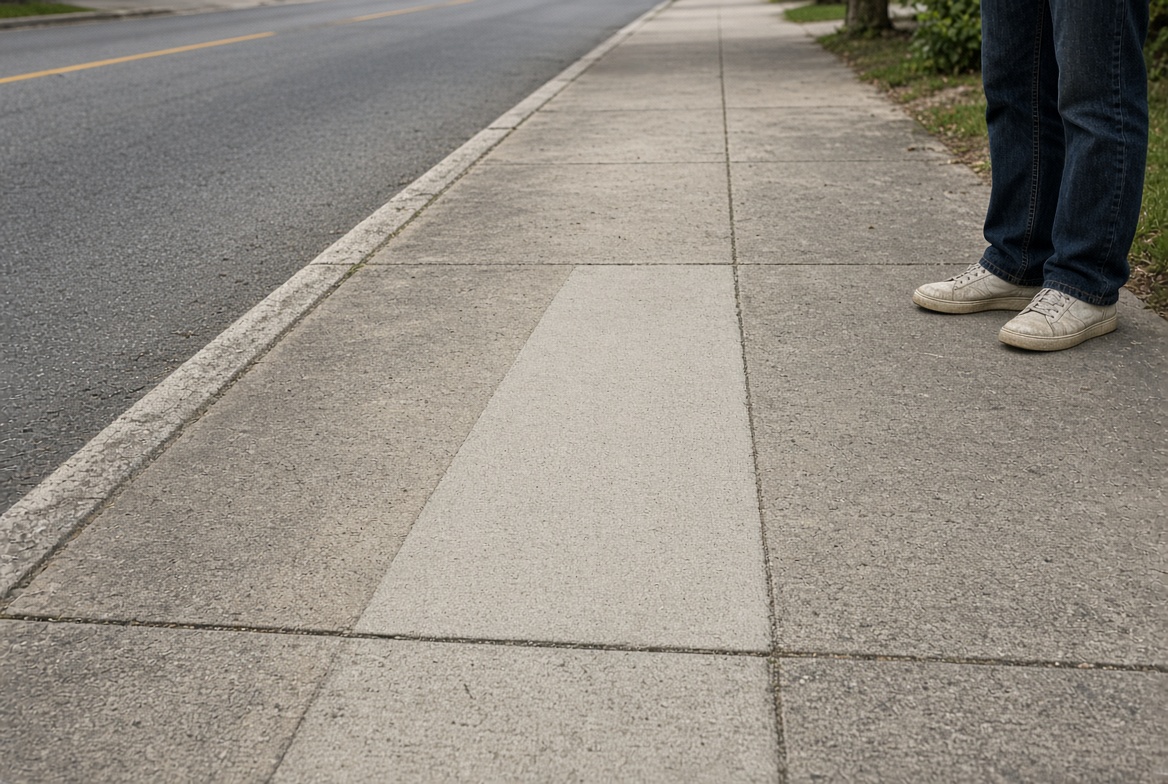 For a raised lip on a sound panel, our patented horizontal slicing process cuts away the high concrete instead of replacing the slab. It removes up to about 1.5 inches in a single pass and is designed to leave no lip at the joint, with a 1:12 slope in the repair zone. A repair averages about 15 minutes, the walk stays open, and the cost runs 70-90% less than remove-and-replace.
Slicing does not lift a sunken panel, and it is not the answer for a broken slab. An inspection will separate those cases so the repair list reflects what each joint needs.
Frequently Asked Questions
What height is considered a trip hazard on a sidewalk?
Inspection programs commonly flag a vertical lip above 1/4 inch, because that is where the standards stop allowing an untreated edge. There is no federal definition of “trip hazard,” and some programs and agencies use their own criteria.
What is the ADA trip hazard height?
The ADA Standards do not state one. Section 303 allows a vertical change of up to 1/4 inch, requires a 1:2 bevel from 1/4 to 1/2 inch, and requires a ramped transition above 1/2 inch.
Is a 1/2-inch lip allowed if it is beveled?
Under section 303, a change of up to 1/2 inch may be beveled at 1:2. Above 1/2 inch, the bevel provision no longer applies and a ramped transition is required.
Should I repair a lip under 1/4 inch?
Usually not right away, unless it sits on a sensitive route or is growing. Record it and re-measure it at your next inspection. Annual checks are a common interval.
Does the same height apply in California?
Yes. California Chapter 11B uses the same 1/4-inch and 1/2-inch breakpoints, though liability questions depend on the facts and are not decided by height alone.
Get Your Walkways Measured
If you have a list of raised joints, or you are not sure which ones matter, SoCal PCC can measure, photograph, and repair them across San Diego, Orange, Riverside, and Imperial counties. Call or text (760) 334-8921 for a free quote.

