

Vertical sidewalk displacement occurs when one concrete panel shifts higher or lower than its adjacent panel, creating a hazardous lip or sudden elevation change. In Southern California, this structural misalignment is primarily driven by expansive clay soil movement, subterranean seismic activity, and invasive tree root growth. Identifying and remediating these trip hazards through professional Sidewalk Inspection Services is not merely a proactive safety measure; it is a strict legal requirement under the Americans with Disabilities Act (ADA), which mandates specific geometric slope and differential standards to ensure accessible pathways for all pedestrians.
Key Takeaways
-
Hazard Threshold: A vertical displacement of just 1/4 inch constitutes a legally recognized trip hazard requiring immediate remediation.
-
Root Causes: Southern California’s unique microclimates and expansive clay soils accelerate differential settlement and concrete shifting.
-
Strict ADA Standards: True ADA compliance demands a 0-point differential at the repair joint and a precise 1:12 running slope.
-
Advanced Solutions: Traditional abrasive removal methods often fail to meet legal slopes. Precision concrete cutting and horizontal slicing guarantee compliance.
-
Cost Efficiency: Patented slicing technology eliminates trip hazards while saving property owners up to 90% compared to total concrete replacement.
The Science Behind Sidewalk Uplift in Southern California
To accurately assess pedestrian walkways, property managers must understand the environmental mechanics driving concrete movement. Geological assessments consistently show that Southern California’s soil composition drastically affects infrastructure stability. Expansive clay soils swell when saturated by seasonal atmospheric rivers and shrink drastically during prolonged summer droughts. This volumetric fluctuation exerts immense upward and downward pressure on concrete slabs, leading to differential settlement.
Furthermore, mature urban canopies contribute heavily to walkway deformation. Aggressive root systems from common municipal trees seek out the moisture trapped beneath concrete panels. As these roots expand in diameter, they easily generate enough mechanical force to lift solid concrete, resulting in extreme vertical shifts. Being vigilant about spotting damage early is the single most effective way to manage long-term repair budgets.
ADA Compliance: Understanding the Legal Thresholds
Evaluating vertical sidewalk displacement in Southern California requires an exact understanding of federal accessibility laws. According to the United States Access Board, public rights-of-way must adhere strictly to established geometric tolerances to accommodate wheelchairs, walkers, and visually impaired individuals safely.
The regulations state that any vertical change in level up to 1/4 inch is permissible without modification. However, any elevation change between 1/4 inch and 1/2 inch must be beveled with a slope no steeper than 1:2. More importantly, any displacement exceeding 1/2 inch must be completely remediated by installing a ramp with a maximum running slope of 1:12 (an 8.33% grade). Understanding these nuances is critical when navigating California sidewalk liability laws.
Step-by-Step Guide: How to Measure and Identify Displacement
Property owners cannot rely on visual estimations alone to determine if a walkway is compliant. Small, seemingly innocuous lips can trigger severe trip-and-fall liabilities. Follow this standardized protocol to evaluate your pathways accurately:
- Conduct Routine Visual Sweeps: Walk the property dynamically. Look for shadows cast across expansion joints during early morning or late afternoon light, which often reveal subtle elevation changes.
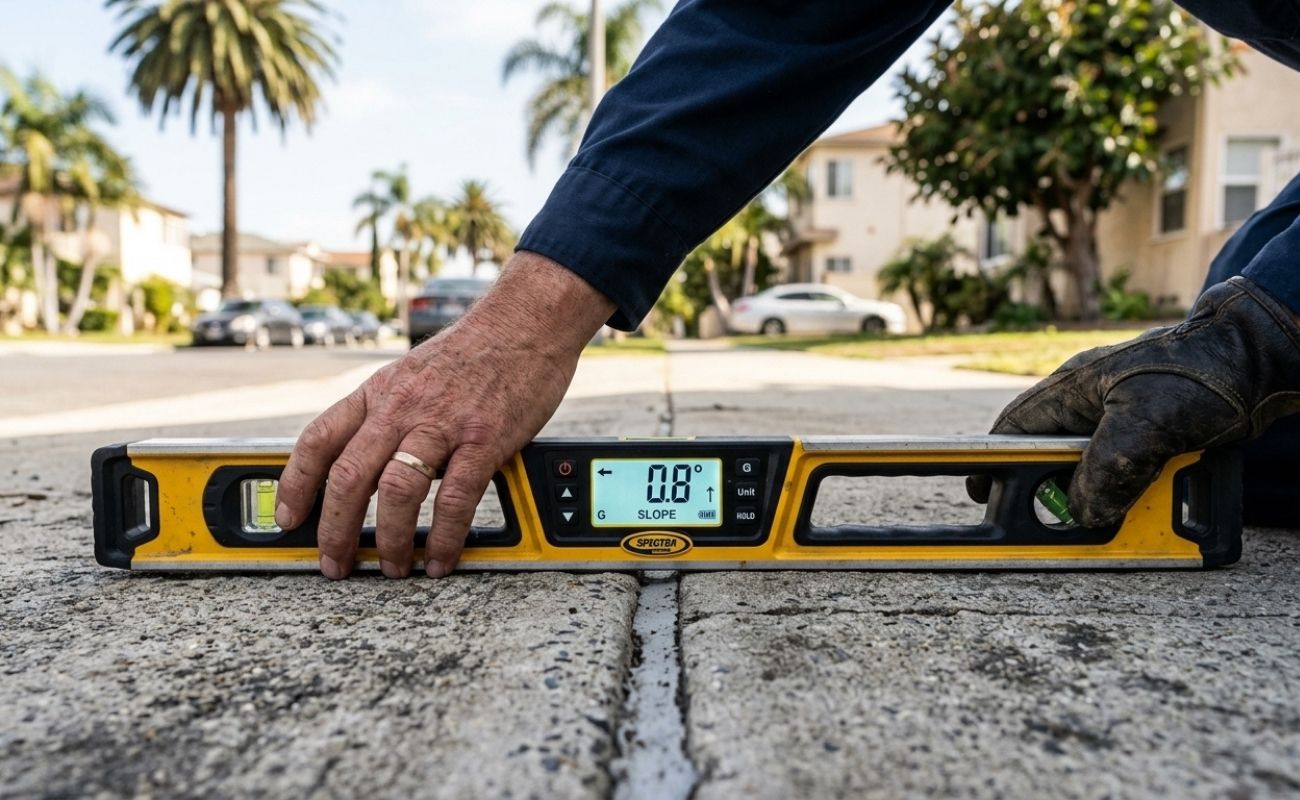
- Deploy a Digital Smart Level: Place a calibrated 24-inch digital smart level across the joint. This tool will instantly calculate the slope percentage and degree of differential settlement.
- Measure the Vertical Lip: Use a specialized trip hazard measuring gauge or a standard metal ruler. Place the ruler vertically against the raised edge to record the exact millimeter or inch height difference. If it exceeds 1/4 inch, it requires intervention.
- Assess the Cross Slope: Ensure the pathway does not tilt sideways toward the street by more than 2.08% (1:48), as transverse displacement is equally regulated under ADA guidelines.
- Document the Findings: Catalog each hazard using GIS tagging or detailed property maps. Proper documentation is essential for prioritizing fixing common sidewalk hazards effectively.
Evaluating Repair Options: The Flaws of Outdated Methods
Historically, property maintenance teams utilized crude abrasive surface scraping or temporary patch-and-fill methods to mitigate walkway lips. However, the accessibility landscape in 2026 requires flawless precision. Older surface-removal techniques inherently leave a rough, scarred texture and rarely remove the entire hazard to a flush 0-point differential. Worse, these antiquated approaches struggle to cut a uniform, gradual 1:12 slope across the entire width of the slab, leaving properties exposed to continued liability.
Similarly, using quick-setting mortar or concrete patching compounds is merely a band-aid. These materials inevitably chip, crack, and dislodge under the stress of foot traffic and thermal expansion, recreating the hazard within months. For municipalities and commercial entities seeking to permanently protect property investments, temporary patches are financially inefficient and legally risky.
The Precision Concrete Cutting Advantage
To eliminate vertical displacement definitively, modern engineering relies on precision concrete cutting. Sidewalk repair using patented cutting techniques represents the gold standard in infrastructure maintenance. This specialized methodology utilizes horizontal concrete slicing to physically cut away the raised portion of the slab.
By slicing horizontally, technicians achieve a smooth, aesthetically pleasing finish while following ADA compliance. This method ensures an absolute 0-point differential at the joint—meaning no lip remains whatsoever—and calibrates a precise 1:12 slope to seamlessly blend the two panels. Because this technique relies on horizontal slicing rather than destructive impact, it protects the underlying sub-base and structural integrity of the existing walkway.
Comparison of Pedestrian Pathway Interventions
| Intervention Strategy | ADA Slope | Point Differential | Longevity & Sustainability |
|---|---|---|---|
| Horizontal Concrete Slicing | Guaranteed exact 1:12 Slope | 0-Point Differential (Flush) | Lasting hazard removal, eco-friendly |
| Patching / Mortar Fill | Highly Variable | Re-appears as mortar chips | Temporary, requires frequent reapplication |
| Full Panel Replacement | Variable based on pour accuracy | Subject to immediate re-settling | High carbon footprint, expensive downtime |
Why Southern California Demands Advanced Techniques
Under the California Streets and Highways Code 5610, adjacent property owners are legally responsible for maintaining the sidewalks fronting their real estate. When you combine this strict legal framework with the severe impact of climate on concrete paths, it becomes clear why relying on advanced horizontal cutting is non-negotiable.
Furthermore, trip hazard removal via horizontal slicing is exceptionally budget-conscious. While we offer essential patching and expansion joint maintenance, it is crucial to recognize that avoiding full-panel demolition saves property owners considerable capital. In fact, choosing precision cutting over tearing out and pouring new cement can yield up to 90% in cost savings, making budget-friendly ADA solutions accessible to HOAs, school districts, and massive commercial complexes alike.
Developing a Proactive Maintenance Plan for 2026
The most successful facility managers treat vertical sidewalk displacement as a manageable operational metric rather than a sudden emergency. Implementing a cyclical maintenance program improves safety and fiscal predictability.
- Annual Audits: Schedule professional inspections every 12 months using smart-level technology to measure new differential settlement.
- Expansion Joint Maintenance: Keep the gaps between concrete slabs free of debris. When incompressible materials fill these joints, thermal expansion forces the slabs to heave vertically.
- Partner with Specialists: Establish an ongoing relationship with a contractor who specializes exclusively in ADA compliance and horizontal concrete slicing, rather than relying on general contractors who default to expensive full-slab replacements.
Frequently Asked Questions
What is vertical sidewalk displacement?
Vertical sidewalk displacement happens when adjacent concrete walkway panels shift out of level, creating a sudden step or raised lip. This occurs due to soil movement, tree roots, or extreme weather conditions.
How much displacement is considered an ADA violation?
Under federal guidelines, an un-beveled vertical change in level exceeding 1/4 inch is considered a non-compliant trip hazard. Displacements over 1/2 inch must be remediated with a specific 1:12 maximum slope.
Can I fix displacement by pouring a concrete patch?
While commonly attempted, mortar patches are generally ineffective for long-term repair. They frequently chip, crack, and detach under foot traffic, meaning they rarely maintain the required 0-point differential.
What makes horizontal slicing better than older methods?
Horizontal concrete slicing utilizes patented machinery to precisely cut the concrete, ensuring a flawless 0-point differential and a mathematically perfect 1:12 slope. This follows ADA compliance cleanly and safely.
Are property owners liable for trip hazards in California?
Yes. Under the California Streets and Highways Code 5610, property owners are responsible for maintaining the sidewalks adjacent to their property in a safe condition, exposing them to significant liability if injuries occur.
Conclusion
Properly identifying vertical sidewalk displacement is the crucial first step in shielding your property from costly legal liabilities while fostering a safe, accessible environment for your community. By understanding ADA thresholds and utilizing precise diagnostic techniques, Southern California property owners can effectively address infrastructure degradation before it escalates. When it’s time to mitigate these hazards, insist on Precision Concrete Cutting to provide ADA compliance, superior aesthetics, and a safe, 0-point differential. If you need expert assistance in auditing or restoring your walkways to perfect ADA standards, contact us today to schedule a comprehensive evaluation.
References
- United States Department of Justice: Americans with Disabilities Act (ADA) Regulations
- United States Access Board: Public Right-of-Way Accessibility Guidelines
- Federal Highway Administration (FHWA): Pedestrian Safety and Infrastructure Guidelines
- California Department of Transportation (Caltrans): Streets and Highways Code Compliance

