
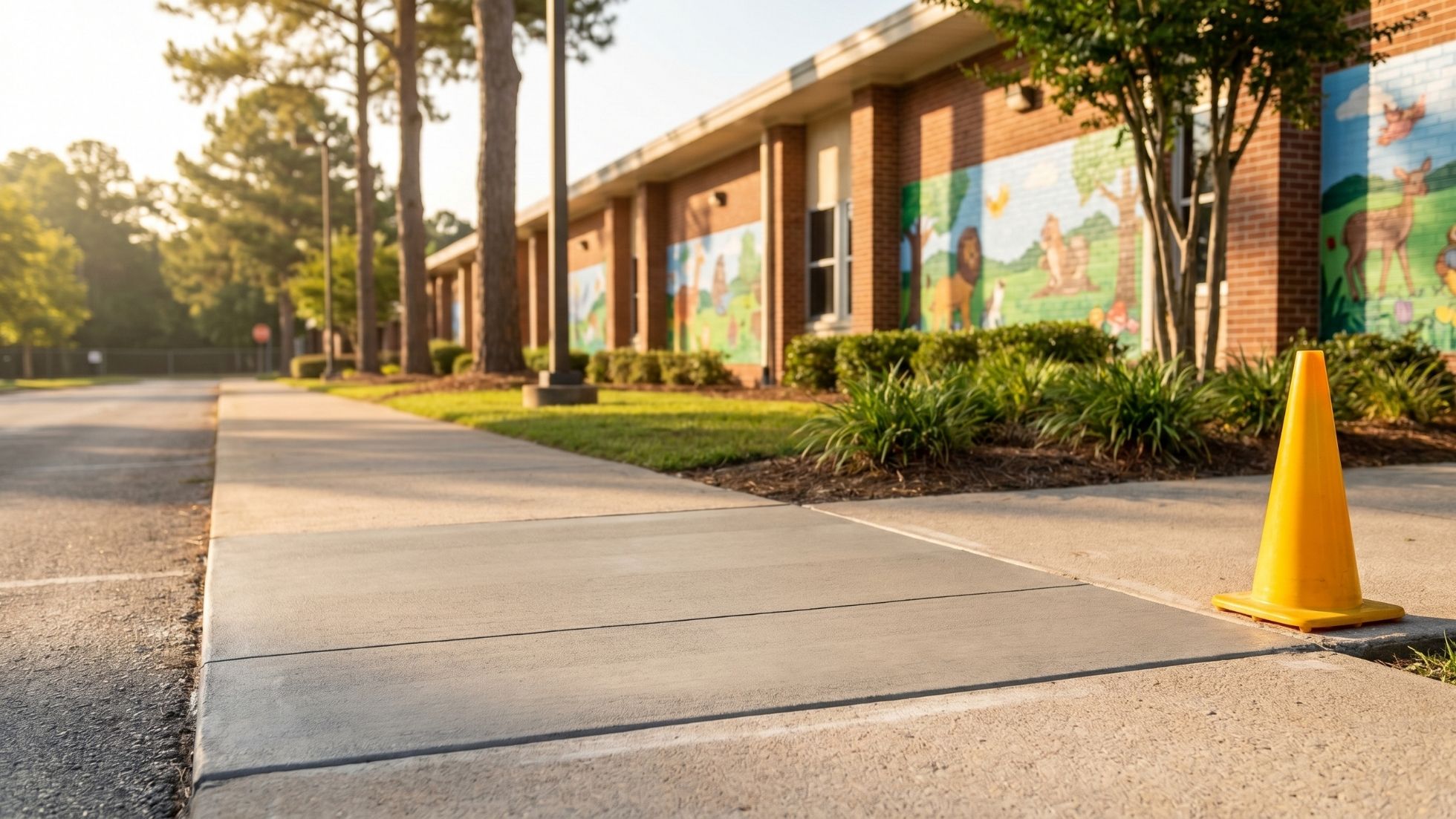
Preventive sidewalk care is not a peripheral maintenance task—it is a foundational element of any comprehensive school safety plan. Uneven concrete, raised slabs, and cracked walkways are predictable sources of student and staff injuries, and they expose districts to significant liability. By integrating professional trip hazard removal and proactive sidewalk assessments into annual safety protocols, schools create a secure, accessible environment that protects everyone on campus. The most effective approach moves beyond reactive patching and instead uses precision concrete cutting to eliminate trip hazards completely, ensuring full ADA compliance and long-term durability.
Key Takeaways
- Sidewalk trip hazards are a leading cause of preventable injuries on school grounds, directly impacting student safety and district liability.
- Precision concrete cutting, not traditional grinding, is the only method that guarantees a zero-point differential and a compliant 1:12 slope for true ADA adherence.
- Integrating sidewalk inspections into a school safety plan reduces long-term costs by addressing root causes before full panel replacement is needed.
- Proactive maintenance includes expansion joint upkeep, patching, and targeted horizontal slicing to prevent water intrusion and root damage.
- Partnering with specialized trip hazard removal experts ensures repairs meet the highest standards of cleanliness, precision, and durability.
- Documented, routine sidewalk care demonstrates a district’s commitment to safety and can lower insurance premiums and legal exposure.
Why Sidewalk Safety Is Central to a School Safety Plan
A school safety plan traditionally covers fire drills, lockdown procedures, and emergency communication. However, the physical environment—particularly pedestrian walkways—is where daily risks accumulate. According to the National Safety Council, falls are the third leading cause of unintentional injury-related deaths, and uneven walking surfaces are a primary contributor. On a bustling campus, a single raised slab can cause a child to trip, leading to fractures, concussions, or worse. School administrators must recognize that a truly effective safety plan addresses these environmental hazards—often starting with a thorough sidewalk inspection—with the same rigor applied to emergency preparedness.
The legal implications are equally pressing. The Americans with Disabilities Act (ADA) mandates that public facilities, including schools, provide accessible routes free of barriers. A sidewalk with a vertical displacement greater than a quarter-inch is considered a tripping hazard and a compliance violation. When a district fails to correct these hazards, it faces not only potential lawsuits but also a loss of public trust. Preventive sidewalk care transforms a reactive, complaint-driven repair model into a systematic, documented safety strategy.
Understanding Trip Hazards: More Than Just Cracks
Trip hazards on school grounds develop from a combination of factors: soil settlement, tree root growth, freeze-thaw cycles, and simple concrete aging. The most dangerous hazards are vertical offsets—where one slab has lifted or sunk relative to its neighbor. Even a half-inch difference is enough to catch a shoe and cause a fall. Traditional repair methods often involve grinding down the raised edge, but this approach has critical limitations. Grinding creates a rough, sloped surface that may still leave a measurable differential, failing to meet the ADA’s strict requirement for a completely flush transition and a 1:12 bevel slope.
Precision concrete cutting, specifically a patented horizontal slicing technique, addresses the root cause. Instead of abrading the surface, a specialized saw blade cuts horizontally through the raised portion of the slab, removing the exact amount of concrete needed to create a perfectly level joint. This method leaves a smooth, clean edge and guarantees a zero-point differential—a standard that grinding simply cannot achieve. For schools, this means a permanent, compliant fix that eliminates the hazard entirely.
Common Types of Sidewalk Damage on School Campuses
- Vertical displacement: Raised edges at joints or cracks, the most common tripping hazard.
- Spalling and scaling: Surface flaking that creates uneven, loose debris.
- Expansion joint failure: Deteriorated filler material allowing water intrusion and further shifting.
- Root heave: Tree roots lifting entire panels, requiring precise cutting rather than full replacement.
- Ponding water: Depressions that become slip hazards when wet or icy.
The ADA Compliance Imperative for Schools
ADA compliance is not optional for public school districts. Title II of the ADA requires that all programs, services, and activities be accessible to individuals with disabilities. This includes the path of travel from parking lots, through campus walkways, to building entrances. The 2010 ADA Standards for Accessible Design specify that changes in level greater than a quarter-inch must be beveled with a slope no steeper than 1:12. More critically, the repaired surface must have no vertical discontinuity—a zero-point differential.
As Sarah Lin, ADA Compliance Specialist at AccessPath Consulting, explains: “Many facilities managers believe that grinding down a raised slab satisfies ADA requirements, but that’s a dangerous misconception. Grinding often leaves a residual lip and an inconsistent slope. Only horizontal cutting techniques can reliably produce the flush, smooth transition that the standards demand. For schools, this distinction is the difference between passing an inspection and facing a costly corrective action plan.”
Research from the National Center on Accessibility at Indiana University confirms that trip hazards are the most frequently cited barrier in ADA compliance reviews of public schools. Proactive sidewalk care, using precision cutting methods, directly mitigates this risk.
Precision Concrete Cutting vs. Traditional Grinding: A Critical Comparison
The terminology used to describe sidewalk repair matters. “Concrete grinding” refers to an abrasive process that wears down the surface using rotating discs. While it can reduce the height of a raised slab, it cannot guarantee complete removal of the vertical offset. The result is often a rough, uneven slope that still poses a tripping risk and fails to meet ADA slope requirements. In contrast, horizontal concrete slicing is a surgical approach. A diamond-tipped blade cuts horizontally through the concrete, removing a precise wedge of material. The finished surface is smooth, level, and visually clean.
| Feature | Traditional Grinding | Precision Horizontal Cutting |
|---|---|---|
| Vertical Offset Removal | Partial; often leaves a residual lip | Complete; zero-point differential guaranteed |
| ADA Slope Compliance (1:12) | Difficult to achieve consistently | Precisely achievable with controlled cuts |
| Surface Finish | Rough, abrasive texture | Smooth, clean, and visually seamless |
| Durability | May spall or deteriorate faster | Maintains structural integrity of the slab |
| Dust and Debris | Significant dust creation | Minimal dust; cleaner process |
| Long-Term Cost | Repeat repairs often needed | Permanent fix; lower lifecycle cost |
For school environments, where cleanliness and minimal disruption are paramount, the advantages of horizontal cutting are clear. The process produces far less dust than grinding, reducing the risk of respiratory irritation for students and staff. It also eliminates the need for extensive cleanup or temporary closures.
Building a Preventive Sidewalk Maintenance Program
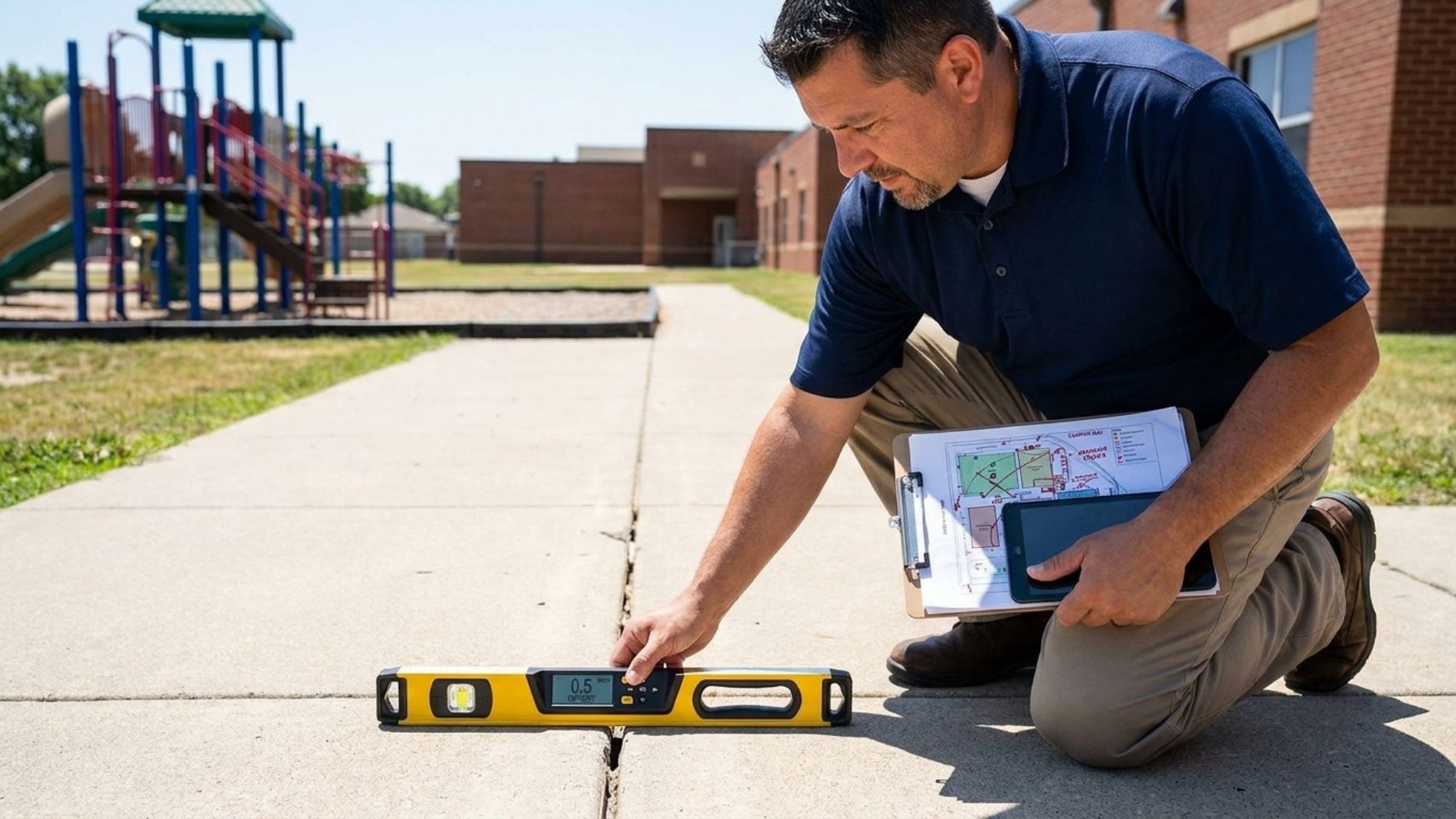
A preventive program shifts the focus from emergency repairs to scheduled, proactive care. The first step is a comprehensive sidewalk audit. Facility managers should walk every paved path on campus, documenting all vertical offsets, cracks, spalling, and joint failures. Each hazard should be photographed, measured, and mapped. This inventory becomes the baseline for a multi-year maintenance plan.
Step-by-Step School Sidewalk Audit
- Assemble a team: Include facilities staff, a safety officer, and a representative from a specialized trip hazard removal company.
- Use a digital level or straightedge: Measure any vertical displacement greater than a quarter-inch. Record exact locations.
- Document with photos and notes: Capture each hazard from multiple angles, noting the cause if identifiable (root, settlement, etc.).
- Prioritize hazards: High-traffic routes, accessible paths, and areas near playgrounds or bus zones should be addressed first.
- Schedule precision cutting repairs: Engage a contractor that uses horizontal slicing, not grinding, to correct all priority hazards.
- Plan for joint and crack maintenance: Seal expansion joints and patch minor cracks to prevent water damage and further shifting.
According to the U.S. Department of Education’s National Center for Education Statistics, the average public school building is over 40 years old, meaning its walkways are likely aging and in need of systematic attention. A documented preventive program not only reduces injuries but also demonstrates fiscal responsibility by avoiding emergency repair costs and potential legal settlements.
 Real-World Impact: A Southern California School District Case Study
In 2024, a K-8 district in Orange County faced a surge in parent complaints about tripping hazards on campus walkways. An initial assessment identified over 80 vertical offsets exceeding a half-inch across three elementary schools. The district’s previous approach had been to grind down the worst offenders, but many of those repairs had failed within two years, leaving rough, uneven patches.
The district partnered with a trip hazard removal specialist using patented horizontal cutting techniques. Over a six-week summer break, crews corrected all 80 hazards. The precision cuts eliminated every vertical offset completely, leaving smooth transitions that met the 1:12 slope requirement. The facilities director reported that the work was completed with minimal dust and no damage to adjacent landscaping. In the two years since, not a single trip-and-fall incident has been attributed to sidewalk conditions on those campuses. The district’s insurance carrier acknowledged the proactive program and reduced the liability premium by 8%.
This case underscores a critical point: the method of repair directly determines the longevity and compliance of the result. Grinding would have provided a temporary cosmetic fix; horizontal slicing delivered a permanent safety solution.
Integrating Sidewalk Care with Other Safety Protocols
Sidewalk maintenance should not exist in a silo. It intersects with several other components of a school safety plan. For example, emergency evacuation routes must be free of obstacles. A raised slab on a designated fire exit path can slow evacuation and increase the risk of a crush injury. Similarly, accessible routes for students with mobility impairments must be continuously clear and level. Integrating sidewalk audits into annual safety reviews ensures that these critical paths are always compliant.
Dr. Michael Torres, Director of Campus Risk Management at SafeSchools Alliance, advises: “We encourage districts to treat sidewalk hazards with the same urgency as broken fire alarms or blocked exits. A trip hazard is a predictable, preventable injury waiting to happen. By including precision concrete cutting in the facilities budget as a line item, schools move from a reactive posture to a genuinely preventive stance.”
Additionally, preventive sidewalk care supports positive community perception. Parents and visitors notice well-maintained walkways. A campus that looks cared for communicates that the district values safety and attention to detail. This intangible benefit reinforces trust and can even influence enrollment decisions.
Common Mistakes Schools Make with Sidewalk Repairs
Despite good intentions, many schools fall into costly traps when addressing sidewalk damage. The most frequent error is relying on grinding as a catch-all solution. As discussed, grinding cannot guarantee ADA compliance and often leads to repeat repairs. Another mistake is delaying repairs until a complaint or injury occurs. This reactive model maximizes liability and disrupts the school year with unplanned construction.
Some districts attempt to use general maintenance staff for sidewalk repairs, using patching compounds or cold asphalt. These temporary fixes deteriorate quickly and can create even worse hazards as they break apart. Full panel replacement is another common overreaction. Replacing an entire slab because of a single raised edge is expensive, time-consuming, and unnecessary when precision horizontal cutting can correct the issue in a fraction of the time and at a fraction of the cost.
Finally, neglecting expansion joints is a silent budget killer. When joint sealant fails, water penetrates the subgrade, accelerating erosion and slab movement. Regular joint maintenance—cleaning and resealing—is one of the most cost-effective preventive measures a school can take.
Expansion Joint Maintenance and Patching: The Supporting Cast
While trip hazard removal via horizontal slicing addresses the most critical safety issues, a complete sidewalk care program includes expansion joint maintenance and targeted patching. Expansion joints allow concrete slabs to expand and contract with temperature changes without cracking. When the sealant in these joints degrades, water, dirt, and debris infiltrate, leading to subgrade washout and eventual slab settlement.
Schools should inspect all expansion joints annually, ideally before the rainy season. Compromised sealant should be removed and replaced with a high-quality, flexible polyurethane or silicone-based product. This simple step prevents the chain reaction that leads to vertical displacement. Similarly, small cracks and surface spalls can be patched with polymer-modified repair mortars to prevent them from widening into trip hazards. These supporting activities extend the life of the concrete and reduce the frequency of major interventions.
Preparing School Sidewalks for Rainy Season and Weather Extremes
In regions like Southern California, the rainy season brings a specific set of challenges. Although the climate is generally dry, intense winter storms can saturate soils, causing slabs to shift and new trip hazards to emerge. Schools should schedule a pre-rainy season sidewalk inspection to identify and correct any vulnerabilities. This includes checking drainage patterns to ensure water flows away from walkways, not ponding on them.
Precision concrete cutting is particularly valuable after weather events. If a storm causes a slab to lift, a quick horizontal cut can restore a level surface without the need for extensive excavation or replacement. This responsiveness keeps campuses safe and operational with minimal downtime. The National Oceanic and Atmospheric Administration (NOAA) climate data indicates that extreme precipitation events are becoming more frequent, making proactive sidewalk care an increasingly critical component of school infrastructure resilience.
 Choosing the Right Partner for School Sidewalk Safety
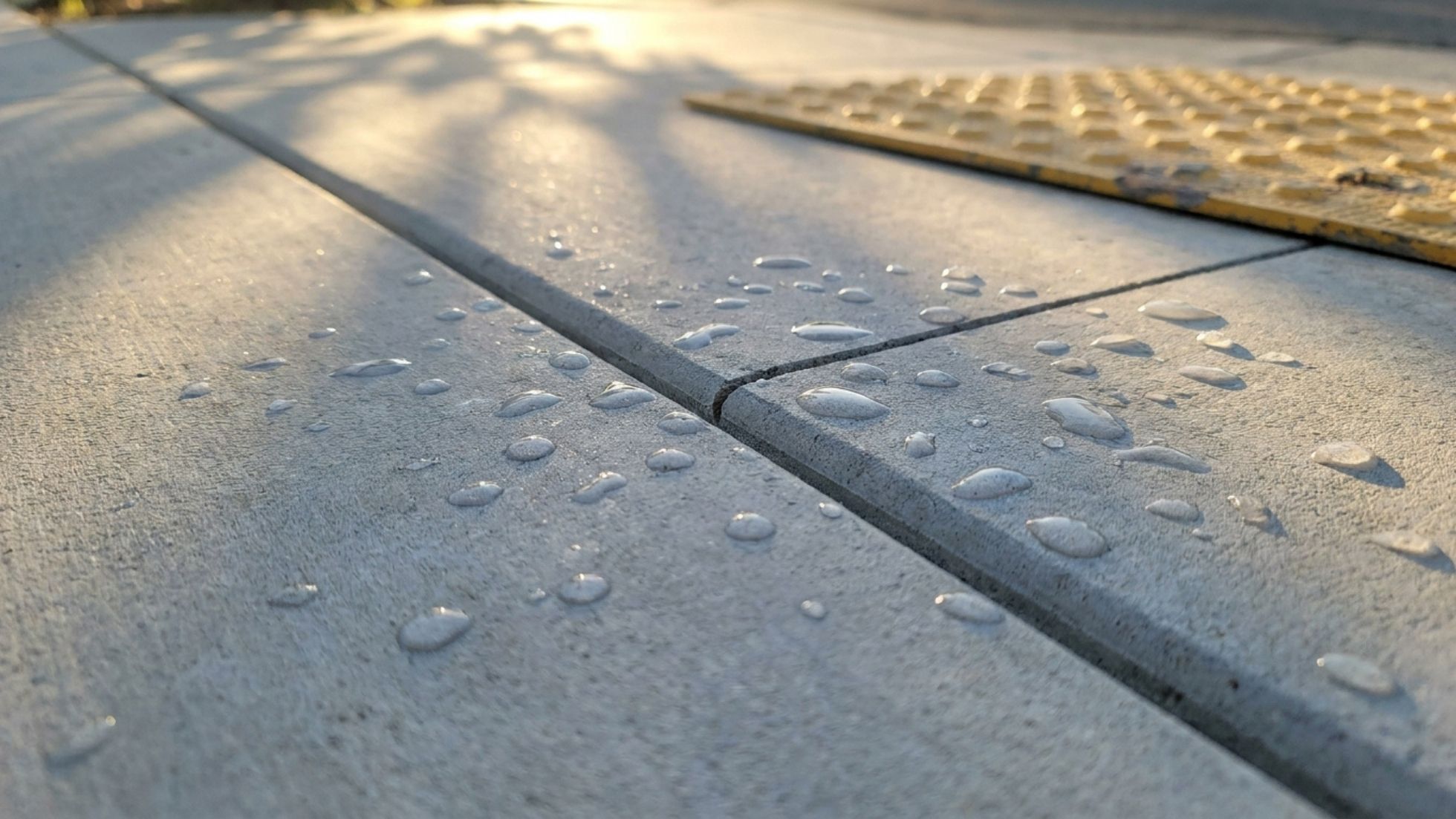
Not all concrete contractors are equipped to deliver the level of precision required for ADA-compliant trip hazard removal. Schools should seek out specialists who use patented horizontal cutting techniques and can provide documentation of compliance. Key questions to ask a prospective partner include:
- Do you use grinding or horizontal slicing for trip hazard removal?
- Can you guarantee a zero-point differential and a 1:12 slope on every repair?
- What is your process for dust control and minimizing disruption to school activities?
- Do you provide before-and-after documentation and compliance reports?
- Can you also handle expansion joint sealing and minor patching?
A qualified specialist will be transparent about their methods and willing to educate facility managers on the differences between grinding and precision cutting. They will also carry appropriate insurance and have experience working in occupied school environments, including background checks for crew members if required.
Budgeting for Preventive Sidewalk Care
School administrators often view sidewalk repair as a capital expense to be deferred. However, preventive care is an operational investment that yields measurable returns. The cost of precision cutting a single trip hazard is a fraction of the cost of defending a personal injury lawsuit, which can easily exceed $100,000. According to the Centers for Disease Control and Prevention (CDC), the average medical cost of a fall-related injury requiring emergency department treatment is over $3,000, not including long-term rehabilitation or lost educational time.
By allocating an annual budget line for sidewalk audits and targeted repairs, districts can spread costs predictably and avoid the financial shock of emergency replacements. Many schools find that redirecting a small portion of their deferred maintenance budget to annual trip hazard removal reduces overall facilities spending within three to five years.
Frequently Asked Questions
What is the difference between concrete grinding and horizontal cutting for trip hazard removal?
Concrete grinding uses abrasive discs to wear down a raised slab edge, often leaving a rough surface and a residual vertical lip. Horizontal cutting, or precision concrete slicing, uses a diamond blade to cut through the raised portion horizontally, removing the exact amount of material needed to create a perfectly flush, smooth transition that meets ADA requirements.
How often should a school inspect its sidewalks for trip hazards?
Schools should conduct a comprehensive sidewalk audit at least annually, with additional inspections after major weather events or construction activity. High-traffic areas and accessible routes may require more frequent monitoring, ideally on a quarterly basis, to catch new hazards early.
Can precision concrete cutting be performed during the school year?
Yes, precision cutting is a low-dust, relatively quiet process that can often be completed during off-hours, weekends, or school breaks with minimal disruption. The work area is typically small and can be safely cordoned off while students are present, though many districts prefer to schedule repairs during summer or winter breaks for convenience.
Does trip hazard removal help with ADA compliance?
Absolutely. Proper trip hazard removal using horizontal cutting is one of the most direct ways to achieve ADA compliance on walkways. It eliminates vertical offsets greater than a quarter-inch and can create the required 1:12 beveled slope, ensuring that paths of travel are accessible to individuals with disabilities.
What is the cost of preventive sidewalk care compared to full panel replacement?
Precision trip hazard removal typically costs 70-90% less than full panel replacement. It also extends the life of the existing concrete, delaying the need for major capital projects. When combined with regular joint maintenance, preventive care significantly reduces total lifecycle costs for campus walkways.
Are there any environmental benefits to precision concrete cutting?
Yes. By preserving existing concrete slabs rather than demolishing and replacing them, horizontal cutting reduces construction waste sent to landfills. It also requires no new concrete production, which is a carbon-intensive process. The minimal dust generation further reduces airborne particulate matter on campus.
How can I tell if a sidewalk repair was done with grinding or precision cutting?
A ground surface will feel rough and may show circular scratch marks. It often has a noticeable slope and may still have a slight lip at the joint. A precision-cut surface is smooth, visually clean, and completely flush with the adjacent slab. The transition is seamless to both sight and touch.
Conclusion
Preventive sidewalk care is a non-negotiable pillar of a modern school safety plan. The days of relying on temporary patches or ineffective grinding are over. Precision concrete cutting offers a permanent, ADA-compliant solution that protects students, reduces liability, and preserves campus infrastructure. By integrating regular audits, prioritizing trip hazard removal, and maintaining expansion joints, school districts demonstrate a genuine commitment to the well-being of their communities.
Every raised slab on a school walkway represents a preventable injury waiting to happen. With the right expertise and a proactive approach, those hazards can be eliminated cleanly, precisely, and permanently. To learn more about how specialized trip hazard removal can strengthen your school’s safety plan, contact our team today for a comprehensive sidewalk assessment.
References
- National Safety Council – Injury statistics and fall prevention resources.
- Americans with Disabilities Act (ADA) Standards for Accessible Design – 2010 guidelines for public facilities.
- Centers for Disease Control and Prevention (CDC) – Fall-related injury data and prevention.
- National Center for Education Statistics – Public school infrastructure age and condition data.
- National Oceanic and Atmospheric Administration (NOAA) – Climate data and extreme precipitation trends.
- National Center on Accessibility, Indiana University – Research on ADA compliance in public schools.

