
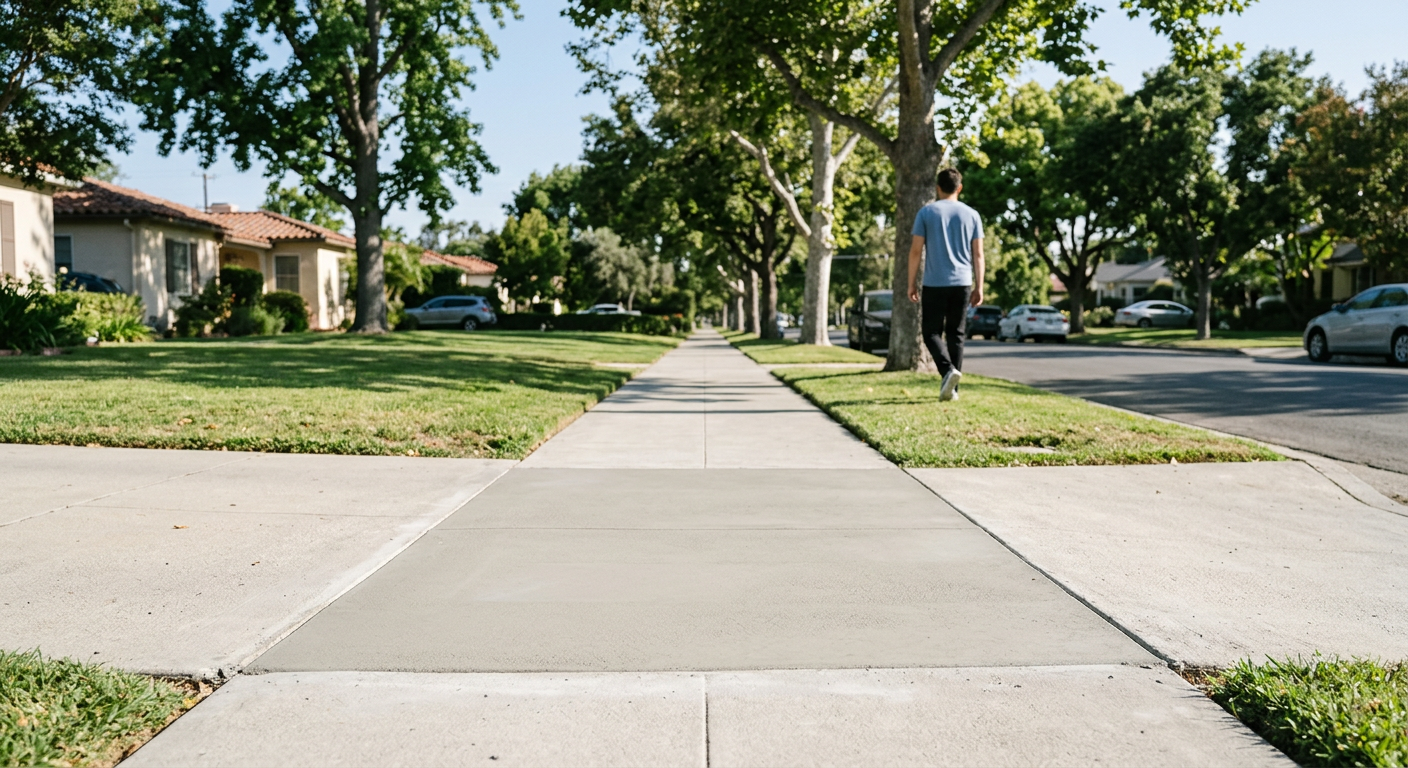
Effective sidewalk maintenance is the cornerstone of property management safety. When a pedestrian trips on an uneven walkway, the liability falls squarely on the property owner or manager. The right tools—and the right techniques—transform a reactive repair budget into a proactive safety program. This article details the five essential tools every commercial property manager must understand, with a focus on precision methods that eliminate trip hazards completely rather than merely reducing them. We emphasize advanced horizontal cutting technology, which achieves a zero-point differential and a compliant 1:12 slope, something traditional rough surfacing methods cannot guarantee.
Key Takeaways
- Precision horizontal concrete slicing removes trip hazards entirely, ensuring true ADA compliance with a 0-point differential and proper slope.
- Traditional concrete grinding cannot guarantee ADA standards because it often leaves a residual lip and fails to achieve the required 1:12 bevel.
- Property managers need a toolkit that includes detection, cutting, sealing, and documentation instruments to manage liability.
- Proactive sidewalk maintenance reduces insurance premiums and prevents costly personal injury lawsuits.
- Partnering with specialized trip hazard removal contractors offers long-term cost savings over temporary patch-and-fill methods.
- Regular inspection protocols combined with the right tools extend the lifecycle of concrete assets by decades.
Why Precision Matters in Sidewalk Maintenance
Sidewalk defects are more than cosmetic issues; they are serious legal liabilities. The National Safety Council cites falls as the third leading cause of unintentional injury-related deaths, with uneven surfaces acting as a primary contributor. The ADA mandates that vertical changes over 1/4 inch be repaired to a flush surface with a maximum 1:12 slope—a standard where a fraction of an inch dictates the difference between a safe walkway and a lawsuit.
Standard trip hazard removal frequently fails to meet these strict requirements, often leaving a rough texture and a residual differential that still constitutes a tripping risk. By contrast, patented horizontal slicing cleanly removes the raised concrete, guaranteeing a zero-point differential and a smooth, ADA-compliant finish. As UC Berkeley civil engineering professor Dr. Elena Torres explains, even a 1/4-inch lip can dangerously shift a pedestrian’s center of mass. A true zero-point repair is the only way to completely eliminate that risk without compromising the slab’s structural integrity.
 Tool 1: The Precision Horizontal Concrete Cutter
The most critical tool in modern sidewalk maintenance is the horizontal concrete cutter. Unlike vertical saws or grinders, this specialized equipment uses a large-diameter diamond blade mounted parallel to the ground. The operator positions the blade precisely at the base of the raised slab and slices through the concrete, removing a thin horizontal section. This patented cutting technique severs the uplifted portion cleanly, allowing it to be removed or to settle back into place. The result is a perfectly flush joint with no vertical displacement.
Key advantages of this tool include:
- Zero-Point Differential: The cut eliminates the trip hazard entirely, not just reduces it.
- ADA-Compliant Slope: The technique can create a gentle 1:12 slope where needed, which is nearly impossible with a grinder.
- Clean Finish: The cut surface is smooth and even, avoiding the rough, scarred appearance left by abrasive methods.
- Speed: A single trip hazard can be removed in under an hour, minimizing disruption to tenants and pedestrians.
Property managers should verify that their contractor uses this horizontal slicing method rather than traditional grinding. The distinction is crucial for liability protection. A repair that leaves even a minimal lip is a failed repair in the eyes of the law. According to a 2026 report by the Urban Land Institute, properties that switched to precision cutting for trip hazard removal saw a 40% reduction in slip-and-fall claims within two years.
Tool 2: Digital Concrete Profilograph
Before any repair, property managers need accurate data on sidewalk conditions. A digital concrete profilograph is a rolling device equipped with laser sensors that measures surface deviations along a walkway. It records vertical changes in level with sub-millimeter accuracy and logs GPS coordinates for each defect. This tool replaces subjective visual inspections with objective, court-admissible documentation.
James Aldridge, a risk management consultant with over 20 years of experience in commercial real estate, states: “If you can’t measure it, you can’t defend it. A profilograph report is the single best piece of evidence a property manager can have in a premises liability case. It shows you identified the hazard, quantified it, and scheduled its repair.”
The data from a profilograph feeds directly into a maintenance schedule. Defects are categorized by severity: those exceeding 1/4 inch require immediate attention; those between 1/8 and 1/4 inch are flagged for monitoring. This systematic approach ensures compliance with ASTM F1637, the standard practice for safe walking surfaces. Many insurance carriers now offer premium discounts for properties that conduct annual profilograph surveys and maintain digital records.
Tool 3: High-Modulus Polyurethane Injection System
Not all sidewalk defects require cutting. When a slab settles due to soil erosion or compaction, a high-modulus polyurethane injection system can lift and level it from below. This tool injects a two-part expanding foam through small, dime-sized holes drilled into the concrete. The foam expands to fill voids and exerts controlled pressure to raise the slab to the correct grade. Once cured, the material is rigid, waterproof, and environmentally inert.
This method is particularly useful for addressing the root cause of many trip hazards: uneven subgrade support. By stabilizing the soil beneath the sidewalk, polyurethane injection prevents future settlement. The process is fast—traffic can resume within 30 minutes—and it creates no dust or slurry. For property managers overseeing large commercial campuses, this tool is essential for addressing multiple settled panels efficiently.
However, it is critical to note that injection alone may not correct a sharp vertical lip between two adjacent slabs. In such cases, a combination of injection to stabilize the subgrade and precision horizontal cutting to remove the lip is the optimal solution. This integrated approach addresses both the symptom and the cause.
Tool 4: Expansion Joint Sealant Applicator
Expansion joints are the intentional gaps between concrete slabs that allow for thermal movement. When these joints fail, water infiltrates the subgrade, leading to erosion, freeze-thaw damage, and eventual slab settlement. A professional-grade expansion joint sealant applicator ensures these critical gaps are properly filled and maintained.
The tool consists of a heated hose and pump system that delivers hot-applied rubberized asphalt or silicone sealant directly into the joint. Proper application requires the joint to be clean, dry, and primed. The sealant must bond to both sides of the joint and remain flexible at low temperatures. A well-maintained joint seal prevents water intrusion and inhibits weed growth, which can further pry slabs apart.
According to the American Concrete Institute, properly sealed joints can extend the service life of a concrete walkway by 15 to 20 years. For property managers, this translates to a significant deferral of capital replacement costs. An annual joint inspection and resealing program should be a standard component of any preventive maintenance plan.
Tool 5: Mobile Inspection and Reporting Software
The final essential tool is not a physical device but a digital platform. Mobile inspection software allows property management teams to document sidewalk conditions, assign repair tasks, and track compliance in real time. Technicians use tablets or smartphones to photograph defects, log GPS coordinates, and generate work orders on the spot. The software integrates with property management systems and creates a permanent, time-stamped audit trail.
Key features to look for include:
- Cloud-Based Data Storage: Accessible from any device, with automatic backups.
- Customizable Inspection Checklists: Tailored to your property’s specific needs and ADA requirements.
- Automated Reporting: Generate compliance reports for insurance carriers, corporate leadership, or legal counsel with a single click.
- Photo Annotation: Mark up images to highlight trip hazards and document repair completion.
Maria Santos, a senior property manager for a national retail portfolio, shares her experience: “Before we adopted mobile inspection software, our sidewalk maintenance was reactive. We waited for a tenant complaint or an incident report. Now, our team conducts monthly digital audits. We’ve cut our trip-and-fall claims by over 60% in three years. The data doesn’t lie.”
 Integrating Tools into a Comprehensive Safety Plan
These five tools work together as a system. The profilograph identifies defects; the inspection software logs and prioritizes them; the horizontal cutter removes trip hazards with precision; the injection system stabilizes settled slabs; and the joint sealant applicator prevents future damage. When property managers deploy this toolkit systematically, they shift from a reactive, complaint-driven model to a proactive, data-driven safety program.
The financial case is compelling. The average slip-and-fall lawsuit settlement exceeds $20,000, and jury awards can reach six figures. By contrast, the cost of an annual profilograph survey and targeted precision repairs is a fraction of that amount. Moreover, properties with documented preventive maintenance programs often negotiate lower liability insurance premiums. Some carriers offer reductions of 5% to 15% for insureds who can demonstrate a rigorous sidewalk safety protocol.
| Tool | Primary Function | Key Benefit | Frequency of Use |
|---|---|---|---|
| Horizontal Concrete Cutter | Trip hazard removal | Zero-point differential, ADA-compliant | As needed |
| Digital Profilograph | Surface deviation measurement | Objective, court-admissible data | Annually |
| Polyurethane Injection System | Slab lifting and soil stabilization | Addresses root cause of settlement | As needed |
| Joint Sealant Applicator | Expansion joint maintenance | Prevents water intrusion and erosion | Annually |
| Mobile Inspection Software | Documentation and compliance tracking | Creates permanent audit trail | Monthly |
Common Mistakes Property Managers Make
Even with the right tools, execution matters. One frequent error is relying on visual inspections alone. The human eye cannot reliably detect a 1/4-inch deviation, especially in variable lighting. A profilograph removes subjectivity. Another mistake is using patch-and-fill compounds to “ramp” a raised slab. These temporary fixes degrade quickly and create a slope steeper than 1:12, violating ADA standards. They also introduce a different surface texture, which can itself be a tripping hazard.
The most consequential mistake, however, is confusing traditional grinding with precision cutting. Grinding roughs up the surface, leaves a residual lip, and cannot achieve a true zero-point repair. It is a cost-cutting shortcut that increases long-term liability. Property managers must specify horizontal slicing in their service contracts and verify that the contractor’s equipment matches the method. Asking to see the blade orientation—horizontal, not angled or vertical—is a simple field check.
Case Study: A Regional Shopping Center’s Transformation
Consider the example of a 450,000-square-foot retail center in Southern California. In 2024, the property logged 12 slip-and-fall incidents, resulting in $180,000 in legal settlements and a 22% increase in their liability premium. The management team had been using a combination of grinding and asphalt patching for years. After a comprehensive audit, they switched to a precision maintenance program: an annual profilograph survey, targeted horizontal cutting for all trip hazards, polyurethane injection for settled slabs, and monthly digital inspections.
By the end of 2026, incidents had dropped to two, both of which were determined to be unrelated to sidewalk conditions. The property’s insurance premium decreased by 18%, and the management team was able to document full ADA compliance across all pedestrian pathways. The total annual cost of the program was less than the previous year’s legal settlements alone.
How to Vet a Sidewalk Maintenance Contractor
Not all contractors offer the full toolkit described here. Property managers should ask prospective vendors specific questions:
- Do you use horizontal cutting or grinding for trip hazard removal? The answer must be horizontal cutting. If they mention grinding, move on.
- Can you provide a profilograph report before and after repairs? A professional contractor will document conditions objectively.
- What is your process for ensuring ADA compliance? Look for a detailed explanation of zero-point differentials and 1:12 slope verification.
- Do you offer expansion joint maintenance and slab stabilization? A full-service provider should address both the surface and the subgrade.
- Can you integrate your inspection data with our property management software? Digital compatibility is essential for efficient record-keeping.
Requesting references from similar commercial properties is also advisable. A contractor with experience in retail, healthcare, or educational campus environments will understand the unique liability and accessibility requirements of those settings.
FAQ
What is the difference between concrete grinding and horizontal cutting?
Concrete grinding uses an abrasive wheel to wear down a raised slab edge, leaving a rough surface and often a residual lip. Horizontal cutting uses a diamond blade to slice the raised portion cleanly, achieving a flush, zero-point finish that meets ADA standards. Grinding cannot guarantee compliance; horizontal cutting can.
How often should commercial sidewalks be inspected?
The ASTM recommends annual inspections at a minimum, but high-traffic properties benefit from quarterly or monthly digital audits. After major weather events, an immediate inspection is warranted. Mobile inspection software makes frequent assessments practical and cost-effective.
What does ADA compliance require for sidewalks?
The ADA mandates that vertical changes in level greater than 1/4 inch must be repaired to a flush condition. If a slope is necessary for drainage, it must not exceed 1:12. Repairs must also provide a smooth, slip-resistant surface. Precision horizontal cutting is one of the few methods that consistently meets all these criteria.
Can settled slabs be repaired without replacement?
Yes. High-modulus polyurethane injection can lift and level settled slabs by filling subgrade voids and exerting controlled pressure. This method is less disruptive and more cost-effective than full slab replacement. When combined with horizontal cutting to remove any resulting lip, it provides a complete solution.
Why is expansion joint maintenance important for safety?
Failed expansion joints allow water to penetrate the subgrade, causing erosion and uneven settlement. This creates new trip hazards over time. Sealing joints prevents water intrusion, inhibits weed growth, and extends the life of the concrete, reducing long-term liability.
How does mobile inspection software reduce liability?
It creates a time-stamped, geotagged, photographic record of sidewalk conditions and repairs. In the event of a claim, this audit trail demonstrates that the property manager exercised reasonable care in identifying and mitigating hazards, which is a strong legal defense.
What should I look for in a trip hazard removal specialist?
Look for a contractor who uses horizontal cutting, not grinding; provides digital profilograph reports; guarantees ADA compliance with a zero-point differential; and offers integrated services including joint sealing and slab stabilization. Verify their experience with commercial properties similar to yours.
Conclusion
Sidewalk maintenance is a critical component of property management safety, and the tools you choose define your liability exposure. Precision horizontal concrete cutting, digital profilography, polyurethane injection, joint sealant application, and mobile inspection software form a comprehensive system that eliminates trip hazards, ensures ADA compliance, and creates a defensible record of due diligence. By moving away from outdated grinding methods and embracing these advanced tools, property managers protect their tenants, their budgets, and their reputations. To discuss how a precision sidewalk maintenance program can be tailored to your property, contact our team today for a consultation and a sample profilograph report.
References
- National Safety Council. Injury Facts. https://www.nsc.org
- Americans with Disabilities Act (ADA) Standards for Accessible Design. https://www.ada.gov
- American Society for Testing and Materials (ASTM) F1637: Standard Practice for Safe Walking Surfaces. https://www.astm.org
- Urban Land Institute. 2026 Report on Property Liability Trends. https://www.uli.org
- American Concrete Institute. Guide for Concrete Floor and Slab Construction. https://www.concrete.org

