

Municipalities face a constant challenge: keeping thousands of miles of sidewalks safe, accessible, and compliant with the Americans with Disabilities Act (ADA). Trip-and-fall claims cost cities millions annually, and reactive repairs drain budgets faster than preventive programs. A smart city approach to urban sidewalk maintenance and trip hazard management shifts the focus from emergency fixes to systematic, data-driven prevention. This checklist provides a framework for public works directors, city engineers, and risk managers to build a sustainable sidewalk safety program that reduces liability, extends infrastructure life, and keeps communities walkable.
Key Takeaways
- Proactive sidewalk inspection cycles reduce long-term repair costs by up to 40% compared to reactive approaches.
- ADA compliance requires a zero vertical differential after repair and a 1:12 slope — standards that precision horizontal cutting achieves reliably.
- Digital asset management platforms enable cities to prioritize repairs based on risk scores, traffic volume, and proximity to schools and hospitals.
- Partnering with specialized trip hazard removal contractors eliminates the need for full panel replacement in most cases.
- Community reporting tools and transparent communication build public trust and speed up hazard identification.
- Annual budgeting for preventive maintenance is consistently cheaper than settling trip-and-fall lawsuits.
Why Urban Sidewalk Maintenance Demands a Systematic Approach
Sidewalks are the circulatory system of any city. They connect neighborhoods to transit, schools to parks, and businesses to customers. When a single panel lifts by half an inch, it creates a trip hazard that can result in a serious injury. According to the National Safety Council, falls are the third leading cause of unintentional injury-related deaths in the United States, and uneven sidewalks are a primary contributor in urban environments. For municipalities, the financial exposure is significant. The Federal Highway Administration reports that pedestrian injuries cost society over $10 billion annually when factoring in medical expenses, lost wages, and legal settlements.
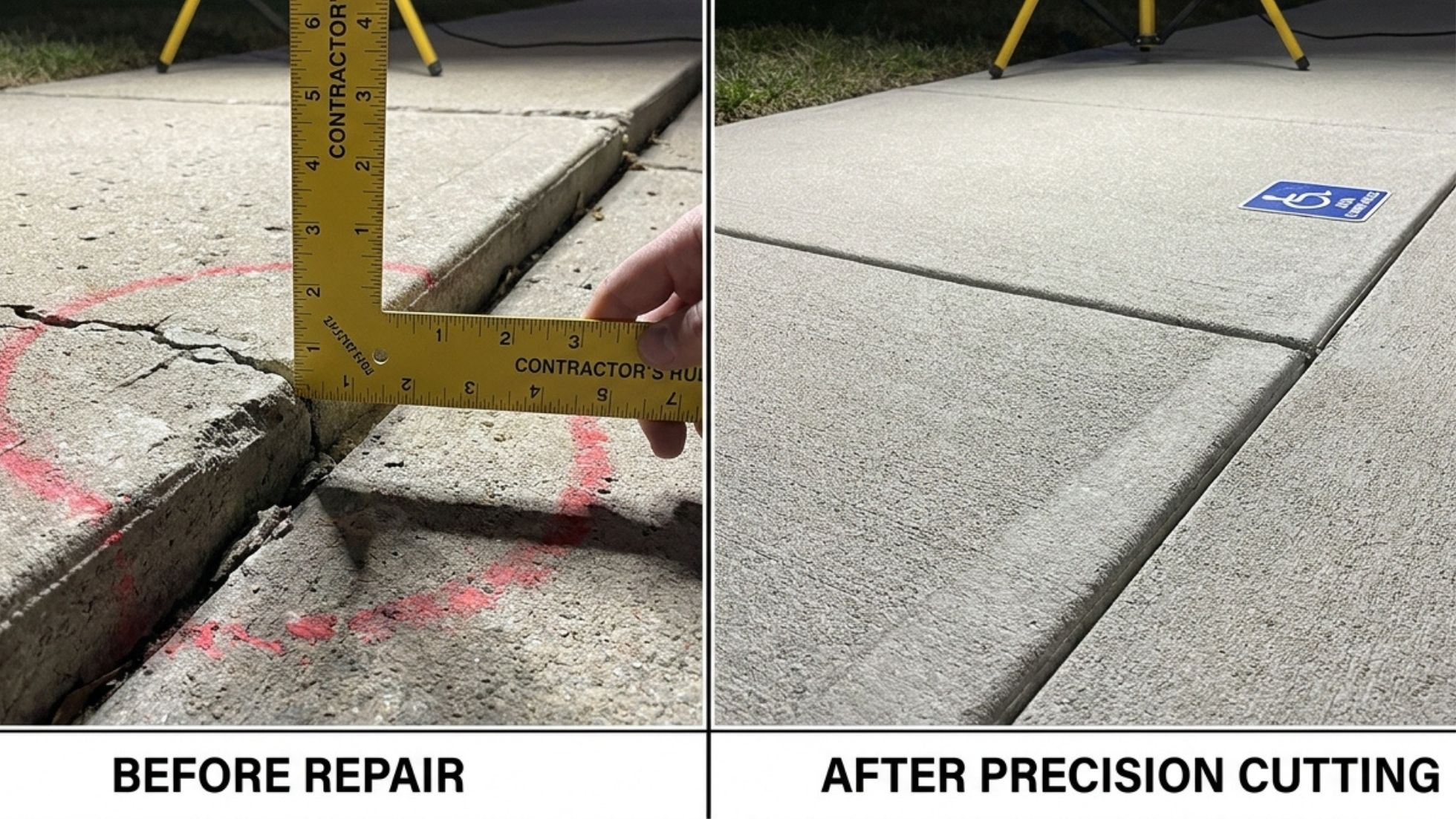
Traditional sidewalk repair methods — full panel replacement, mudjacking, or patching — are expensive, disruptive, and often unnecessary. A lifted panel caused by tree root growth or soil settlement rarely requires complete removal. Precision concrete cutting, specifically a patented horizontal slicing technique, removes the raised edge cleanly without damaging the surrounding slab. This method leaves a smooth, ADA-compliant surface with no vertical differential and a proper 1:12 slope, something traditional grinding cannot guarantee. Grinding often reduces the height of a trip hazard but fails to eliminate it entirely, leaving a measurable lip that still violates ADA standards. Cities that adopt precision cutting as their primary remediation method see faster resolution times, lower costs per repair, and fewer repeat hazards.
Building Your Sidewalk Safety Inventory
Before a city can manage trip hazards effectively, it must know what it owns. A complete sidewalk asset inventory is the foundation of any smart city maintenance program. This inventory should catalog every linear foot of sidewalk, cross slope measurements, material type, installation date, and condition rating. Modern approaches use GIS mapping, LiDAR scanning, and mobile assessment apps to capture this data efficiently.
Research from the American Public Works Association (APWA) indicates that municipalities with digital asset inventories complete repairs 60% faster than those relying on paper-based or complaint-driven systems. The inventory becomes a living document, updated after every inspection cycle and repair event. Key data points to capture include:
- Panel location (GPS coordinates tied to GIS parcel data)
- Vertical displacement measurements (in millimeters)
- Cross slope percentage
- Surface condition (cracking, spalling, scaling)
- Root zone proximity and tree species
- ADA ramp and detectable warning surface condition
- Pedestrian traffic volume classification
Prioritizing Repairs with a Risk-Based Matrix
Not all trip hazards carry equal risk. A half-inch uplift on a quiet residential street poses less immediate danger than the same defect outside a hospital emergency entrance. Smart cities use a risk-based prioritization matrix that weights several factors: vertical displacement severity, pedestrian volume, proximity to vulnerable populations (schools, senior centers, hospitals), and complaint history. The Institute of Transportation Engineers recommends a scoring system where hazards exceeding 0.25 inches in high-traffic zones receive immediate attention, while those in low-traffic areas are scheduled within 30 to 60 days.
As Maria Gonzalez, Public Works Director for a mid-sized California city, explains: “We shifted from a first-come-first-served repair model to a risk-prioritized system three years ago. Our trip-and-fall claims dropped 35% in the first year alone. The data doesn’t lie — fixing the right hazards first saves money and protects residents.”
The ADA Compliance Imperative in Trip Hazard Management
The Americans with Disabilities Act sets clear standards for pedestrian access routes. For sidewalks, the critical requirements are a maximum cross slope of 2%, a running slope of no more than 5% (or 8.3% where necessary with landings), and absolutely no vertical changes in level greater than 0.25 inches without a beveled transition. When a repair is made, the standard tightens further: the finished surface must have a zero vertical differential and a slope no steeper than 1:12. This is where many conventional repair methods fail.
Traditional concrete grinding cannot achieve a true zero differential. The rotating abrasive wheel removes material from the high side of the uplift, but it leaves a rough, often uneven surface that still presents a measurable lip. More critically, grinders cannot consistently produce the required 1:12 slope across the repair area. The result is a “repaired” sidewalk that remains non-compliant and exposes the city to continued liability. The U.S. Department of Justice has pursued enforcement actions against municipalities for failing to maintain ADA-compliant pedestrian routes, with settlement agreements often requiring millions of dollars in retroactive repairs.
Precision horizontal concrete slicing eliminates these compliance gaps. The patented cutting technique uses a diamond-tipped blade that moves horizontally through the raised concrete, shearing off the protruding edge at the exact plane of the adjacent slab. The cut is clean, flat, and leaves no vertical differential. The operator can then shape a precise 1:12 slope transition, ensuring full ADA compliance. This method also preserves the structural integrity of the panel, unlike grinding which can introduce micro-fractures from heat and vibration.
 Preventive Maintenance: The Smart City Checklist
A proactive sidewalk safety program follows a structured annual cycle. The checklist below integrates inspection, remediation, documentation, and community engagement into a repeatable workflow that public works teams can implement immediately.
1. Quarterly Visual Inspections
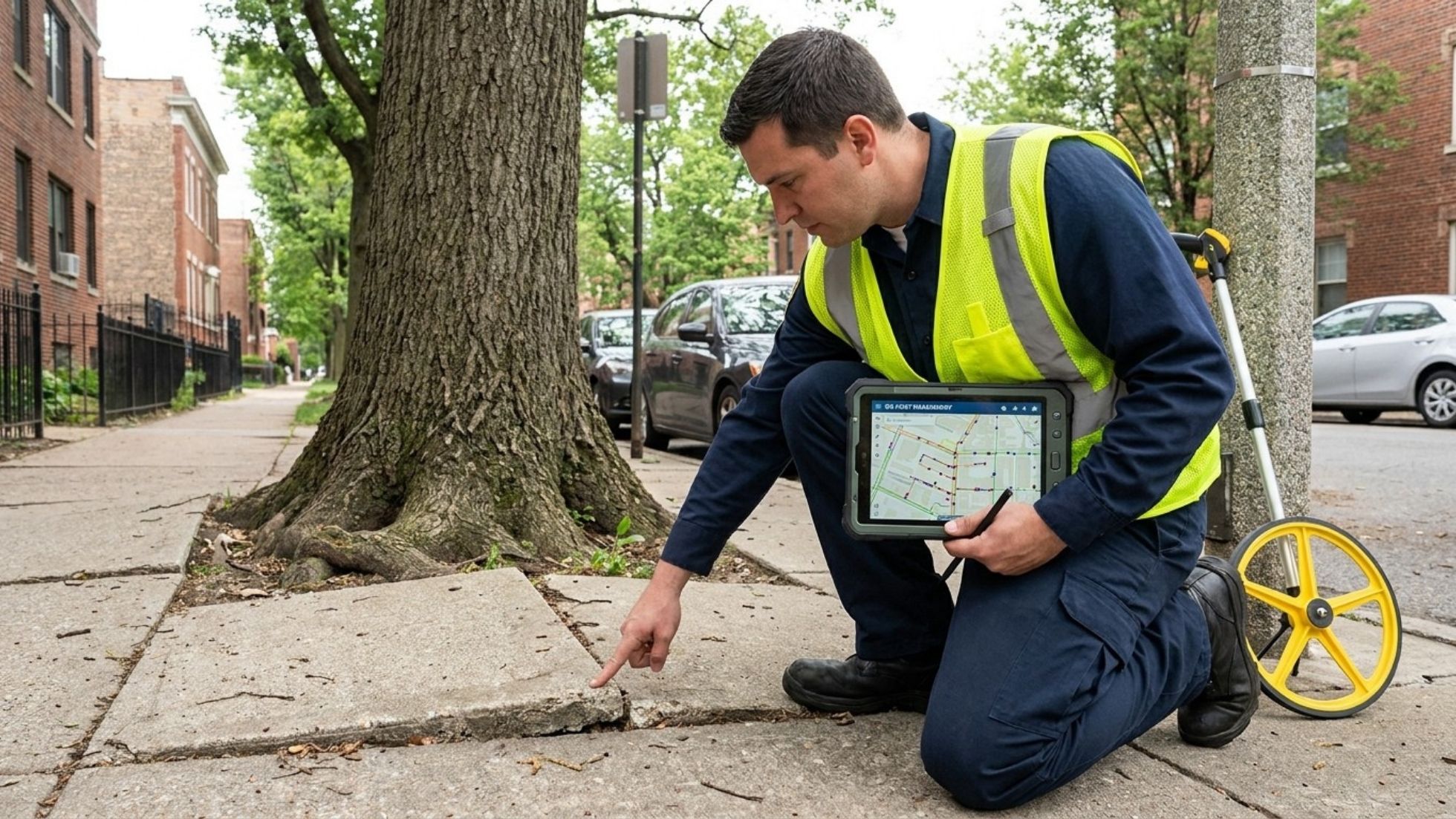
Train field crews to conduct walking inspections of high-priority zones every 90 days. Use a standardized digital form that captures photos, GPS location, and severity ratings. Focus on areas with mature trees, known soil movement, and high pedestrian traffic. The Urban Land Institute notes that tree root damage accounts for approximately 50% of all urban sidewalk uplift incidents, making tree-lined streets a perennial inspection priority.
2. Annual Comprehensive Assessment
Once per year, deploy a full assessment using laser measurement tools or LiDAR-equipped vehicles. This captures precise vertical displacement data across the entire sidewalk network. Feed this data into the GIS asset inventory and update risk scores. Compare year-over-year changes to identify accelerating deterioration patterns before they become hazards.
3. Seasonal Preparation
In regions with freeze-thaw cycles or heavy rainy seasons, schedule preventive treatments before weather extremes arrive. Seal expansion joints to prevent water intrusion, clear drainage paths, and address any panels showing early signs of movement. In Southern California, the rainy season preparation window runs from October through November. Cities that complete joint sealing and minor trip hazard removal before winter rains see significantly fewer emergency repairs during the wet months.
4. Precision Hazard Removal
When trip hazards are identified, deploy precision horizontal cutting crews to eliminate the vertical differential. This technique addresses the vast majority of uplift hazards without requiring panel replacement. For hazards caused by severe root damage or subgrade failure, coordinate with urban forestry teams to address the root cause before or concurrently with the concrete repair. In cases where patching is needed for spalled surfaces or expansion joint maintenance is required, ensure the same precision standards apply to the finished surface.
5. Documentation and Compliance Tracking
Every repair must be documented with before-and-after measurements, photos, and GPS coordinates. This documentation serves as legal evidence of due diligence if a claim arises and demonstrates ongoing ADA compliance. Store records in a searchable database accessible to risk management, legal, and public works departments. The International Municipal Lawyers Association recommends retaining sidewalk inspection and repair records for a minimum of seven years.
6. Community Reporting Integration
Empower residents to report sidewalk hazards through a mobile app or web portal. Geotagged submissions with photos streamline the identification process and demonstrate transparency. A 2026 study by the Smart Cities Council found that cities with integrated community reporting platforms resolve hazards 45% faster than those relying solely on scheduled inspections. Acknowledge every submission within 48 hours and provide status updates as repairs are scheduled and completed.
7. Annual Budget Allocation
Dedicate a specific line item in the annual budget for preventive sidewalk maintenance. The cost of precision trip hazard removal averages $30 to $75 per linear foot of hazard, compared to $150 to $300 per linear foot for full panel replacement. Cities that allocate consistent preventive funding avoid the budget spikes caused by emergency repairs and lawsuit settlements. As Thomas Keller, Risk Manager for a county government, states: “Every dollar we spend on preventive sidewalk maintenance saves us an estimated four dollars in claim payouts and legal defense costs. The ROI is undeniable.”
Common Mistakes in Municipal Sidewalk Programs
Even well-intentioned cities make errors that undermine sidewalk safety efforts. Recognizing these pitfalls is the first step to avoiding them.
| Mistake | Consequence | Solution |
|---|---|---|
| Relying solely on complaint-based repairs | Hazards in low-complaint areas go unaddressed for years | Implement scheduled proactive inspections |
| Using grinding for trip hazard removal | Rough finish, residual vertical differential, ADA non-compliance | Use precision horizontal cutting for zero-differential results |
| Ignoring tree root causes | Repeat uplift within 2-3 years at same location | Coordinate with urban forestry for root management |
| Inadequate repair documentation | Unable to defend against trip-and-fall claims | Maintain before/after records with measurements |
| Deferring maintenance to save budget | Exponential cost increase from emergency repairs and lawsuits | Allocate dedicated annual preventive funding |
Technology Tools for Smarter Sidewalk Management
Technology is transforming how cities approach urban sidewalk maintenance. Several tools have become essential for efficient trip hazard management programs.
GIS-Centric Asset Management Platforms
Platforms like Cartegraph and Cityworks integrate sidewalk inventories with work order management, allowing crews to receive digital assignments, update repair status in real time, and attach documentation directly to asset records. These systems generate automated reports on repair completion rates, budget utilization, and hazard reduction trends.
Mobile Inspection Applications
Field inspectors use tablets or smartphones equipped with apps that guide them through standardized assessment protocols. These apps enforce consistent data collection, automatically geotag photos, and sync data to the central asset database. Some applications now incorporate AI-powered image recognition that can identify and classify sidewalk defects from photos, reducing inspector subjectivity.
LiDAR and 3D Scanning
Vehicle-mounted or backpack LiDAR systems capture millions of data points per second, creating precise 3D models of sidewalk surfaces. These scans detect vertical displacements as small as 0.1 inches and calculate cross slopes automatically. While the initial investment is higher than manual methods, the speed and accuracy gains are substantial for cities with extensive sidewalk networks. The American Society of Civil Engineers has published case studies showing LiDAR-based assessments covering 20 miles of sidewalk per day, compared to 2-3 miles for manual inspection.
 Case Study: A Mid-Sized City Transforms Its Sidewalk Program
The City of Pasadena, California, faced a growing backlog of sidewalk repair requests and increasing trip-and-fall claims in the early 2020s. With over 300 miles of sidewalks and a mature urban forest, tree root uplift was the dominant hazard type. The city’s traditional approach — grinding high spots and replacing severely damaged panels — was slow, expensive, and resulted in repeat hazards at the same locations.
In 2023, Pasadena shifted to a preventive model built around precision horizontal cutting. The city completed a comprehensive LiDAR inventory of its entire sidewalk network, prioritized hazards using a risk matrix weighted toward school zones and transit corridors, and contracted with a specialized trip hazard removal provider using patented cutting technology. Within 18 months, the city eliminated its repair backlog, reduced per-repair costs by 60%, and saw trip-and-fall claims drop by 42%. The program’s success led to a dedicated annual funding allocation that ensures ongoing maintenance without budget battles.
Dr. Sarah Chen, a civil engineering professor at Cal Poly Pomona who studied the Pasadena program, notes: “What made Pasadena’s approach effective was the combination of accurate data, the right remediation technology, and political will to fund prevention. The precision cutting method was the linchpin — it solved the ADA compliance problem that grinding never could.”
Integrating Sidewalk Safety into Broader City Planning
Sidewalk maintenance should not operate in a silo. Smart cities integrate pedestrian infrastructure with urban forestry, stormwater management, and transit planning. For instance, when planting new street trees, selecting the right species and utilizing root barriers or permeable paving can mitigate future concrete conflicts before they arise.
Similarly, when a street undergoes resurfacing or utility work, a formal sidewalk inspection should be included in the project scope. Coordinating these evaluations across departments reduces mobilization costs and minimizes resident disruption. The National League of Cities advocates for “dig once” policies that bundle infrastructure improvements—including essential trip hazard removal—into single, highly efficient projhttps://socalpcc.com/sidewalk-repair/sidewalk-inspection/ects.
FAQ: Urban Sidewalk Maintenance and Trip Hazard Management
What is the most cost-effective method for removing sidewalk trip hazards?
Precision horizontal concrete cutting is the most cost-effective method for the majority of uplift hazards. It eliminates the vertical differential completely, achieves ADA-compliant slopes, and costs a fraction of full panel replacement. Unlike grinding, it leaves a smooth, clean finish with no residual lip.
How often should a city inspect its sidewalks for trip hazards?
High-priority zones — areas near schools, hospitals, transit stops, and senior centers — should receive quarterly visual inspections. A comprehensive, measurement-based assessment of the entire sidewalk network should occur annually. This schedule balances resource constraints with risk management needs.
What makes a sidewalk repair ADA compliant?
An ADA-compliant sidewalk repair must result in a surface with zero vertical change in level and a slope no steeper than 1:12 (one inch of rise for every 12 inches of run) where a beveled transition is used. The cross slope must not exceed 2%. Precision horizontal cutting achieves these standards reliably.
Can tree root damage be prevented without removing the tree?
Yes. Root pruning by a certified arborist, installation of root barriers, and use of structural soil or suspended pavement systems can redirect root growth downward, away from sidewalk panels. Coordination between public works and urban forestry departments is essential for long-term solutions.
How does precision concrete cutting differ from concrete grinding?
Precision concrete cutting uses a diamond-tipped blade that moves horizontally through the raised concrete, shearing off the protruding edge cleanly at the plane of the adjacent slab. Grinding uses a rotating abrasive wheel that wears down the surface, leaving a rough texture and often failing to eliminate the vertical differential entirely. Cutting achieves a true zero-differential finish that grinding cannot guarantee.
What should a city include in its sidewalk repair documentation?
Documentation should include GPS coordinates, before-and-after photographs, vertical displacement measurements before and after repair, cross slope measurements, repair date, method used, crew identification, and any notes on root cause or contributing factors. This documentation is critical for legal defense and compliance auditing.
How can residents report sidewalk hazards to their city?
Most cities offer mobile apps, web portals, or dedicated phone lines for reporting sidewalk hazards. Residents should provide a specific location, a photo if possible, and a brief description of the issue. Cities committed to transparency acknowledge reports within 48 hours and provide repair timeline updates.
Conclusion
Urban sidewalk maintenance and trip hazard management are not merely operational tasks — they are fundamental responsibilities that affect public safety, accessibility, and municipal fiscal health. A smart city approach replaces reactive, complaint-driven repairs with a systematic, data-informed program that prioritizes the highest-risk hazards, uses the most effective remediation technology, and documents every action for accountability. Precision horizontal concrete cutting stands as the superior method for trip hazard removal, delivering ADA-compliant results that grinding cannot match. By adopting the checklist outlined here — quarterly inspections, annual assessments, preventive treatments, precision repairs, thorough documentation, community engagement, and dedicated funding — cities can build sidewalk networks that are safe, sustainable, and welcoming for all pedestrians. For municipalities ready to transform their sidewalk safety programs, partnering with specialized trip hazard removal experts is the most direct path to compliance and cost savings. Contact our team today to discuss how precision concrete cutting can become the cornerstone of your city’s sidewalk maintenance strategy.
References
- National Safety Council. Injury Facts: Falls
- Federal Highway Administration. Pedestrian and Bicycle Safety
- American Public Works Association. Asset Management Best Practices
- Institute of Transportation Engineers. Pedestrian Facility Design Guidance
- U.S. Department of Justice, Civil Rights Division. ADA Standards for Accessible Design
- Urban Land Institute. Urban Forestry and Infrastructure
- Smart Cities Council. Community Engagement Platforms Report
- American Society of Civil Engineers. LiDAR Applications in Infrastructure Assessment
- International Municipal Lawyers Association. Risk Management Guidelines
- National League of Cities. Sustainable Infrastructure Planning

